Amylase, Phosphate, Zinc & Magnesium Serum Levels in Women with Toxoplasmosis
DOI:
https://doi.org/10.22401/ANJS.28.3.04Keywords:
Amylase enzyme, Trace elements, ToxoplasmosisAbstract
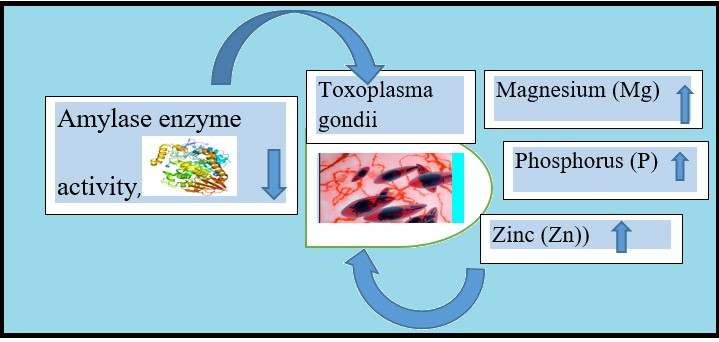
Toxoplasmosis has a significant infection rate in several Arab countries, such as Iraq. The role of the amylase enzyme and some trace elements, such as phosphorus (P), zinc, and magnesium, was evaluated with the incidence of toxoplasmosis in 80 Iraqi women (50% fertile and 50% infertile). Samples were collected from eighty blood infertile women (as patients, P group) and fertile women who were apparently healthy (as controls, C group), with an age range of 20-40 years. Each group was subdivided into two groups: with seropositive toxoplasma gondii IgG group (PP, and PC for patient and control group, respectively) and seronegative toxoplasma gondii IgG (NP, and NC for patient and control group, respectively). Amylase enzyme activity, phosphorus (P), zinc, and magnesium were estimated in the sera of women for each collected sample. There was a decrease in amylase level in positive and negative patients compared with healthy patients. The zinc level in fertile patients was significantly higher (P<0.05), while it was lower in positive patients compared to the C groups. The magnesium level increased significantly in positive patients (P<0.05) compared to the C groups. However, the magnesium level in patients with negative patients compared to healthy controls was non-significantly lower (P>0.05). Phosphorus level increased significantly (P<0.05) in positive patients compared to C groups. Changes in the level of the Amylase enzyme and the elements such as zinc, phosphorus, and magnesium can be considered indicators of the causes of toxoplasmosis.
References
[1] Cañedo‐Solares, I.; Gómez‐Chávez, F.; Luna‐Pastén, H.; Ortiz‐Alegría, L. B.; Flores‐García, Y.; Figueroa‐Damián, R.; Macedo‐Romero, C. A.; Correa, D.; “What do anti‐Toxoplasma gondii IgA and IgG subclasses in human saliva indicate?”. Parasite Immunol. 40(5): p.e12526, 2018.
[2] Cañedo-Solares, I.; de la Luz Galván-Ramírez, M.; Luna-Pastén, H.; Pérez, L. R. R.; Ortiz-Alegría, L. B.; Rico-Torres, C. P.; Vela-Amieva, M.; Pérez-Andrade, M.; Figueroa-Damián, R.; Correa, D.; “Congenital toxoplasmosis: specific IgG subclasses in mother/newborn pairs.” J. Pediatr. Infect. Dis. 27(5):469-474, 2008.
[3] Dubey, J. P.; “The history of Toxoplasma gondii—the first 100 years.” J. Eukaryot. Microbiol. 55(6): 467-475, 2008.
[4] Fischer, S.; Agmon-Levin, N.; Shapira, Y.; Porat Katz, B. S.; Graell, E.; Cervera, R.; Stojanovich, L.; Gómez Puerta, J. A.; Sanmartí, R.; Shoenfeld, Y.; “Toxoplasma gondii: bystander or cofactor in rheumatoid arthritis.” Immunol. Res. 56: 287-292, 2013.
[5] Mousa, M. A.; Soliman, H. E.; El-Shafie, M. S.; Abdel-Baky, M. S.; Aly, M. M.; “Toxoplasma seropositivity in patients with rheumatoid arthritis”. J Egypt Soc Parasitol. 18(1): 345-351, 1988.
[6] Ketcheson, M. R.; Barron, G. P.; Cox, D. H.; “Relationship of maternal dietary zinc during gestation and lactation to development and zinc, iron and copper content of the postnatal rat.” J Nutr. 98(3): 303-311, 1969.
[7] Kinnamon, K. E.; “Some independent and combined effects of copper, molybdenum, and zinc on the placental transfer of zinc-65 in the rat”. J. Nutr. 81(4): 312-320, 1963.
[8] Kumar, S.; “Effect of zinc supplementation on rats during pregnancy”. Clin. Chem. 23: 1834–1837, 1976.
[9] Campbell, J. K.; Mills, C. F.; “The toxicity of zinc to pregnant sheep”. Environ. Res. 20(1): 1-13, 1979.
[10] Rajput, R.; Denniston, A. K.; Murray, P. I.; “False negative Toxoplasma serology in an immunocompromised patient with PCR positive ocular toxoplasmosis”. Ocul. Immunol. Inflamm. 26(8): 1200-1202, 2018.
[11] Murdaca, G.; Tonacci, A.; Negrini, S.; Greco, M.; Borro, M.; Puppo, F.; Gangemi, S.; “Emerging role of vitamin D in autoimmune diseases: An update on evidence and therapeutic implications”. Autoimmun. Rev. 18(9): 102350, 2019.
[12] Chistiakov, D. A.; Melnichenko, A. A.; Orekhov, A. N.; Bobryshev, Y. V.; “Paraoxonase and atherosclerosis-related cardiovascular diseases.” Biochimie. 132: 19-27, 2017.
[13] Abbas, I. E.; Villena, I.; Dubey, J. P.; “A review on toxoplasmosis in humans and animals from Egypt”. Parasitol. 147(2): 135-159, 2020.
[14] Yang, J.; Yang, C.; Qian, J.; Li, F.; Zhao, J.; Fang, R.; “Toxoplasma gondii α‐amylase deletion mutant is a promising vaccine against acute and chronic toxoplasmosis”. Microb. Biotechnol. 13(6): 2057-2069, 2020.
[15] Sindhu, R.; Binod, P.; Madhavan, A.; Beevi, U. S.; Mathew, A. K.; Abraham, A.; Pandey, A.; Kumar, V.; “Molecular improvements in microbial α-amylases for enhanced stability and catalytic efficiency.” Bioresour. Technol. 245: 1740-1748, 2017.
[16] Yazar, S.; Kilic, E.; Saraymen, R.; “Changes of total content of magnesium and zinc status in patients with chronic toxoplasmosis”. Biol. Trace Elem. Res. 92: 11-15, 2003.
[17] Jones, T. C.; Hunt, R. D.; King, N. W.; “Veterinary Pathology”, 6th ed.; Williams & Wilkins, A Waverly Company: Baltimore, MD, USA, 1996.
[18] Wellinghausen, N.; Jochle, W.; Reuter, S.; Flegel, W. A.; Grunert, A.; Kern, P.; “Zinc status in patients with alveolar echinococcosis is related to disease progression”. Parasite Immunol. 21(5): 237-241, 1999.
[19] Asady, B.; Dick, C. F.; Ehrenman, K.; Sahu, T.; Romano, J. D.; Coppens, I.; “A single Na+-Pi cotransporter in Toxoplasma plays key roles in phosphate import and control of parasite osmoregulation”. PLoS Pathog. 16(12): e1009067, 2020.
[20] Rodrigues, C. O.; Ruiz, F. A.; Rohloff, P.; Scott, D. A.; Moreno, S. N.; “Characterization of isolated acidocalcisomes from Toxoplasma gondii tachyzoites reveals a novel pool of hydrolyzable polyphosphate”. J. Biol. Chem. 277(50): 48650-48656, 2002.
[21] Chaudhry, S. A.; Gad, N.; Koren, G.; “Toxoplasmosis and pregnancy.” Can Fam Physician. 60(4): 334-336, 2014.
[22] Afifi, M. A.; Jiman-Fatani, A. A.; Al-Rabia, M. W.; Al-Hussainy, N. H.; El Saadany, S.; Mayah, W.; “More than an association: latent toxoplasmosis might provoke a local oxidative stress that triggers the development of bipolar disorder”. J. Microsc. Ultrastruct. 6(3): 139-144, 2018.
[23] Hussain, T.; Tan, B.; Yin, Y.; Blachier, F.; Tossou, M. C.; Rahu, N.; “Oxidative stress and inflammation: what polyphenols can do for us?”. Oxid. Med. Cell. Longev. 2016: 1-9, 2016.
[24] Agarwal, A.; Aponte-Mellado, A.; Premkumar, B. J.; Shaman, A.; Gupta, S.; “The effects of oxidative stress on female reproduction: a review”. Reprod. Biol. Endocrinol. 10: 49, 2012.
[25] Shi, L.; Zhang, J.; Lai, Z.; Tian, Y.; Fang, L.; Wu, M.; Xiong, J.; Qin, X.; Luo, A.; Wang, S. “Long-term moderate oxidative stress decreased ovarian reproductive function by reducing follicle quality and progesterone production”. PLoS One. 11(9): e0162194, 2016.
[26] Khadhim, N. A.; Al-Khafaji, Q. A. M.; Hussein, M. S.; “Iron Status, Malondialdehyde, and Nitric-oxide Levels in Iraqi Infertile Women with IgG Seropositive Toxoplasma Gondii”. J. Glob. Pharma. Technol. 11(9):414-421, 2019.
[27] Kashan, Z. F.; Shojaee, S.; Keshavarz, H.; Arbabi, M.; Delavari, M.; Salimi, M.; “Vitamin D deficiency and Toxoplasma infection”. Iran J. Public Health. 48(6): 1184-1186, 2019.
[28] Khadhim, N. A.; Al-Khafaji, Q. A. M.; Hussein, M. S.; “Serum vitamin D and TNF-alpha in Iraqi infertile women with positive IgG toxoplasma gondii: Is there a correlation between infertility and vitamin D deficiency”. Res. J. Pharm. Biol. Chem. Sci. 9(1): 628-639, 2018.
[29] Waldron, J. L.; Ashby, H. L.; Cornes, M. P.; Bechervaise, J.; Razavi, C.; Thomas, O. L.; Chugh, S.; Deshpande, S.; Ford, C.; Gama, R.; “Vitamin D: a negative acute phase reactant”. J. Clin. Pathol. 66(7): 620-622, 2013.
[30] Ruder, E. H.; Hartman, T. J.; Goldman, M. B.; “Impact of oxidative stress on female fertility”. Curr. Opin. Obstet. Gynecol. 21(3): 219-22, 2009.
Downloads
Published
Issue
Section
License
Copyright (c) 2025 Sarra A. Abrahem, Suhad A. Ibrahim, Maryam Y. Hashim

This work is licensed under a Creative Commons Attribution 4.0 International License.

.jpg)