Kinetics Study of Heavy Metal Removal from Synthetic Aqueous Solutions Using Modified Poly(Methylmethacrylates)
DOI:
https://doi.org/10.22401/ANJS.29.2.02Keywords:
Modified poly(methylmethacrylates), Adsorption, Metal ions, KineticsAbstract
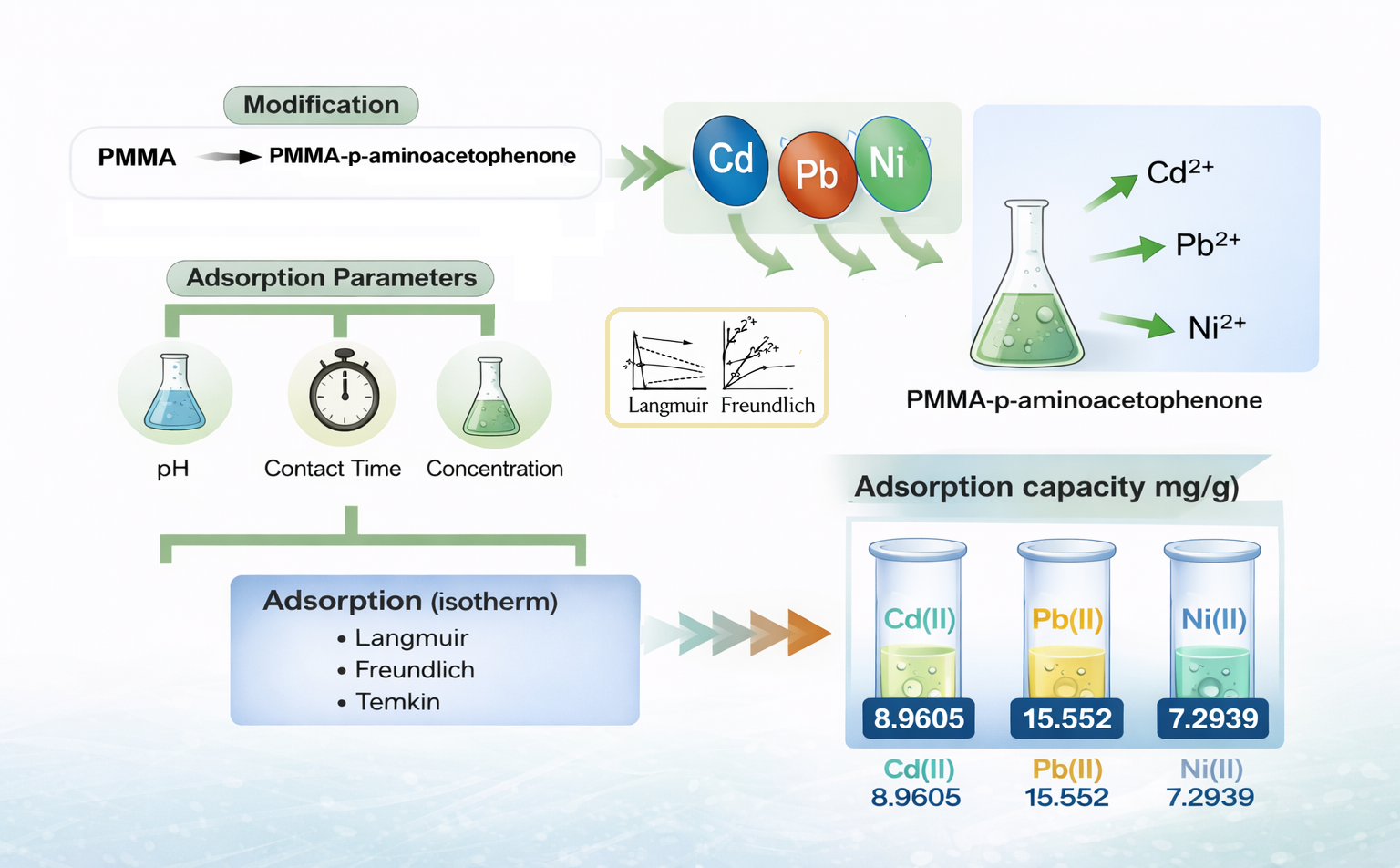
The investigative results from the elimination of the cadmium (II), nickel (II), and lead (II) ions into solution form utilizing p-aminoacetophenone modified poly (methylmethacrylates) are presented in the current paper. Fourier transform infrared spectroscopy (FTIR) was employed to characterize the modified polymer. The pH level in the solution, the time of the interaction, the starting concentration of a heavy metal and the dosage of adsorbent were all examined to better comprehend the adsorption procedure. Three models were utilized to examine the adsorption isotherm. Results showed that improved polymer could adsorb higher concentrations of heavy metal (II) ions. The PMMA-p-aminoacetophenone was found to have a maximum adsorption capacity of 8.9605, 15.552 and 7.2939 mg/g for cadmium (II), lead (II), nickel (II) ions respectively.
References
[1] Islam, A.K.; “Domestic and industrial wastewater generation and its energy recovery potential in Bangladesh”. Cleaner. Energy Syst., 6: 100092, 2023.
[2] Pérez-Marín, A.B.; Zapata, V.M.; Ortuno, J.F.; Aguilar, M.; Sáez, J.; and Lloréns, M.; “Removal of cadmium from aqueous solutions by adsorption onto orange waste”. J. Hazard. Mater., 139 (1): 122-131, 2007.
[3] Bahadir, T.; Bakan, G.; Altas, L.; and Buyukgungor, H.; “The investigation of lead removal by biosorption: an application at storage battery industry wastewaters”. Enzyme Microb. Technol., 41 (1): 98-102, 2007.
[4] Ben, P.; Mikhail, G.; and Salman, M. S.; “Impact of Surface Functional Groups and Their Introduction Methods on the Mechanisms of CO2 Adsorption on Porous Carbonaceous Adsorbents”. Carbon Capture Sci. Technol., 3: 100045, 2022.
[5] Satyam, S.; and Sanjukta, P.; “Innovations and challenges in adsorption-based wastewater remediation: A comprehensive review”. Heliyon, 10(9): e29573, 2024.
[6] Barakat, M.A.; “New trends in removing heavy metals from industrial wastewater”. Arabian J. Chem., 4(4): 361-377, 2011.
[7] Zarifeh, R.; Ahasanul, K.; Antoine K.; and Seddik K.; “Adsorption of Heavy Metals: Mechanisms, Kinetics, and Applications of Various Adsorbents in Wastewater Remediation—A Review”. Waste, 1(3): 775-805, 2023.
[8] Ravikumar, L.; Kalaivani, S.S.; Murugesan, A.; Vidhyadevi, T.; Karthik, G.; Kirupha, S.D.; and Sivanesan, S.; “Synthesis, characterization, and heavy metal ion adsorption studies of polyamides, polythioamides having pendent chlorobenzylidine rings”. J. Appl. Polym. Sci., 122(3): 1634-1642, 2011.
[9] Huang, M.R.; Lu, H.J.; and Li, X.G.; “Synthesis and strong heavy-metal ion sorption of copolymer microparticles from phenylenediamine and its sulfonate”. J. Mater. Chem., 22(34): 17685-17699. 2012.
[10] Zhang, Y.; Chen, Y.; Wang, C.; and Wei, Y.; “Immobilization of 5-aminopyridine-2-tetrazole on cross-linked polystyrene for the preparation of a new adsorbent to remove heavy metal ions from aqueous solution”. J. Hazard. Mater., 276: 129-137, 2014.
[11] Muhammad, S.A.; Sajid, A.; and Wajid, Z.; “Innovative Adsorbents for Pollutant Removal: Exploring the Latest Research and Applications”. Molecules, 29(18): 4317, 2024.
[12] Noha, A.M.; Ehssan, N.; and Mohamed, H.; “Use of spent oil shale to remove methyl red dye from aqueous solutions”. AIMS Mater. Sci., 7(3): 338–353, 2020.
[13] Ma, J.; Zhou, G.; Chu, L.; Liu, Y.; Liu, C.; Luo, S.; and Wei, Y.; “Efficient removal of heavy metal ions with an EDTA functionalized chitosan/polyacrylamide double network hydrogel”. ACS Sustainable Chem. Eng., 5(1): 843-851, 2017.
[14] Shi, J.; Li, H.; Lu, H.; and Zhao, X.; “Use of carboxyl functional magnetite nanoparticles as potential sorbents for the removal of heavy metal ions from aqueous solution”. J. Chem. Eng. Data, 60(7): 2035-2041, 2015.
[15] Zhang, H.; Dang, Q.; Liu, C.; Cha, D.; Yu, Z.; Zhu, W.; and Fan, B.; “Uptake of Pb (II) and Cd (II) on chitosan microsphere surface successively grafted by methyl acrylate and diethylenetriamine”. ACS Appl. Mater. Interfaces, 9(12): 11144-11155, 2017.
[16] Ge, Y.; and Li, Z.; “Application of lignin and its derivatives in adsorption of heavy metal ions in water: a review”. ACS Sustainable Chem. Eng., 6(5): 7181-7192, 2018.
[17] Pourjavadi, A.; Abedin-Moghanaki, A.; and Hosseini, S.H.; “Synthesis of poly (amidoamine)-graft-poly (methyl acrylate) magnetic nanocomposite for removal of lead contaminant from aqueous media”. Int. J. Environ. Sci. Technol., 13: 2437-2448, 2016.
[18] Mahmoud, A.; Nassef, E.; Salah, H.; and El-taweel, Y.; “Use of hydrazide derivative of poly methylacrylate for the removal of cupric ions from solutions”. AIMS Mater. Sci., 7(4): 420-430, 2020.
[19] Hadeel, A.; Hanan, A.I.; Huda, G.N.; Ala’a, R.S.; Husam, S.; Mohammed, H.A.; Maya, A.; Mamoun, F.; Amani, A.H.; and Emad, Y.; “Enhancing Photoirradiation Stability: A Review on Modification of Poly(methylmethacrylate)”. Al-Nahrain J. Sci., 27(3): 32-42, 2024.
[20] Salisu, A.; Sanagi, M.M.; Abu Naim, A.; Wan I.W.A., and Abd Karim, K.J.; “Removal of lead ions from aqueous solutions using sodium alginate-graft-poly (methyl methacrylate) beads”. Desalin. Water Treat., 57(33): 15353-15361, 2016.
[21] Shanthini, G.M.; Martin, C.A.; Sakthivel, N.; Veerla, S.C.; Elayaraja, K.; Lakshmi, B.S.; and Kalkura, S.N.; “Physical and biological properties of the ion beam irradiated PMMA-based composite films”. Appl. Surf. Sci., 329: 116-126, 2015.
[22] Ramdani, A.; Kadeche, A.; Adjdir, M.; Taleb, Z.; Ikhou, D.; Taleb, S.; and Deratani, A.; “Lead and cadmium removal by adsorption process using hydroxyapatite porous materials”. Water Pract. Technol., 15(1): 130-141, 2020.
[23] Babel, S.; and Kurniawan, T.A.; “Cr (VI) removal from synthetic wastewater using coconut shell charcoal and commercial activated carbon modified with oxidizing agents and/or chitosan”. Chemosphere, 54(7): 951-967, 2004.
[24] Mohammed, M.; Manal, A.T.; Adil H.D.; Ebtihal Q.A.; and Hanaa K.; “Synthesis and Characterization of New Azo Dyes Based on Thiazole and Assess the Biological and Laser Efficacy for Them and Study their Dyeing Application”. Egypt. J. Chem., 64(6): 2903-2911, 2021.
[25] Ola, A.; “Kinetic and isotherm studies of copper (II) removal from wastewater using various adsorbents”. Egypt. J. Aquat. Res., 33(1): 125-143, 2007.
[26] Clint, S.; Beverly, S.C.; and Amar S.; “The status of scientific development on the application of biosorption of heavy metals at laboratory and pilot-scale: a review”. Desalin. Water Treat., 299: 13–49, 2023.
[27] Hasan, I.; and Ahamd, R.; “A facile synthesis of poly (methyl methacrylate) grafted alginate@ Cys-bentonite copolymer hybrid nanocomposite for sequestration of heavy metals”. Groundwater Sustainable. Dev., 8: 82-92, 2019.
[28] Cifci, C.; and Durmaz, O.; “Removal of heavy metal ions from aqueous solutions by poly (methyl m ethacrylate-co-ethyl acrylate) and poly (methyl methacrylate-co-buthyl methacrylate) membranes”. Desalin. Water Treat., 28(1-3): 255-259, 2011.
[29] Hilal, R.H.; and Nassif, R.A.; “Study on adsorption of some metals from waste solution by (unsaturated polyester-kaolin) composite”. Kuwait J. Sci., 50(3): 257-261, 2023.
[30] Dehghani, M.H.; Sanaei, D.; Ali, I.; and Bhatnagar, A.; “Removal of chromium (VI) from aqueous solution using treated waste newspaper as a low-cost adsorbent: kinetic modeling and isotherm studies”. J. Mol. Liq., 215: 671-679, 2016.
[31] Taiwo, O.C.; Afolabi, T.J.; Osuolale, F.N.; Ajani, A.O.; Aworanti, O.A.; Ogunleye, O.R.; and Alade, A.O.; “Recycling of Waste Expanded Polystyrene as an Effective Adsorbent of Naphthalene from Aqueous Solution”. Chem. Ind., 70(9-10): 519-534, 2021.
[32] Ho, Y.S.; “Review of second-order models for adsorption systems”. J. Hazard. Mater., 136(3): 681-689, 2006.
[33] Gupta, V.K.; Pathania, D.; Sharma, S.; Agarwal, S.; and Singh, P.; “Remediation of noxious chromium (VI) utilizing acrylic acid grafted lignocellulosic adsorbent”. J. Mol. Liq., 177: 343-352, 2013.
[34] El-Araby, H.A.; Ibrahim, A.M., Mangood, A.H.; and Adel, A.H.; “Sesame husk as adsorbent for copper (II) ions removal from aqueous solution”. J. Geosci. Environ. Prot., 5(07): 109-152, 2017.
[35] Al-Abachi, M.Q.; Al-Awady, N.S.; and Al-Anbakey, A.M.; “Evaluation of poly acrylic acid (PAA) hydrogel beads as adsorbent for the removal of lead (II) ion from water”. Al-Nahrain J. Sci., 16(3): 30-39, 2013.
[36] Filipowiak, K.; Dudzińska, P.; Wieszczycka, K.; Buchwald, T.; Nowicki, M.; Lewandowska, A.; and Marcinkowska, A.; “Novel Polymer Sorbents with Imprinted Task-Specific Ionic Liquids for Metal Removal”. Materials, 14(17): 5008, 2021.
[37] Li, W.; Liao, X.; Wang, L.; and Huang, Z.; “Adsorption of cadmium and lead in wastewater by four kinds of biomass xanthates”. Water Sci. Technol., 79(6): 1222-1230, 2019.
[38] Akram, M.; Salman, M.; Farooq, U.; Saleem, U.; Tahir, S.; Nazir, H.; and Arsalan, H.; “Phthalate-functionalized Sorghum bicolor L.; an effective biosorbent for the removal of Alizarin Red S and Bromophenol blue dyes from simulated wastewater”. Desalin. Water Treat., 190: 383-392, 2020.
[39] Li, M.; Zhang, Z.; Li, R.; Wang, J.J.; and Ali, A.; “Removal of Pb (II) and Cd (II) ions from aqueous solution by thiosemicarbazide modified chitosan”. Int. J. Biol. Macromol., 86: 876-884, 2016.
Downloads
Published
Issue
Section
License
Copyright (c) 2026 Siham Alwan Shukur, Ahmed Ahmed, Dheaa Zageer, Yasmine Mashabi, Nany Hairunisa

This work is licensed under a Creative Commons Attribution 4.0 International License.

.jpg)