Retention and Selectivity of the Nalidixic Acid and Enoxacin by Hydrophilic Interaction Liquid Chromatography on Various Polar Columns with Different Chain Lengths
DOI:
https://doi.org/10.22401/ANJS.28.4.21Keywords:
Enoxacin, Nalidixic acid, Pharmaceutical formulations, Quinolones, ZIC-HILICAbstract
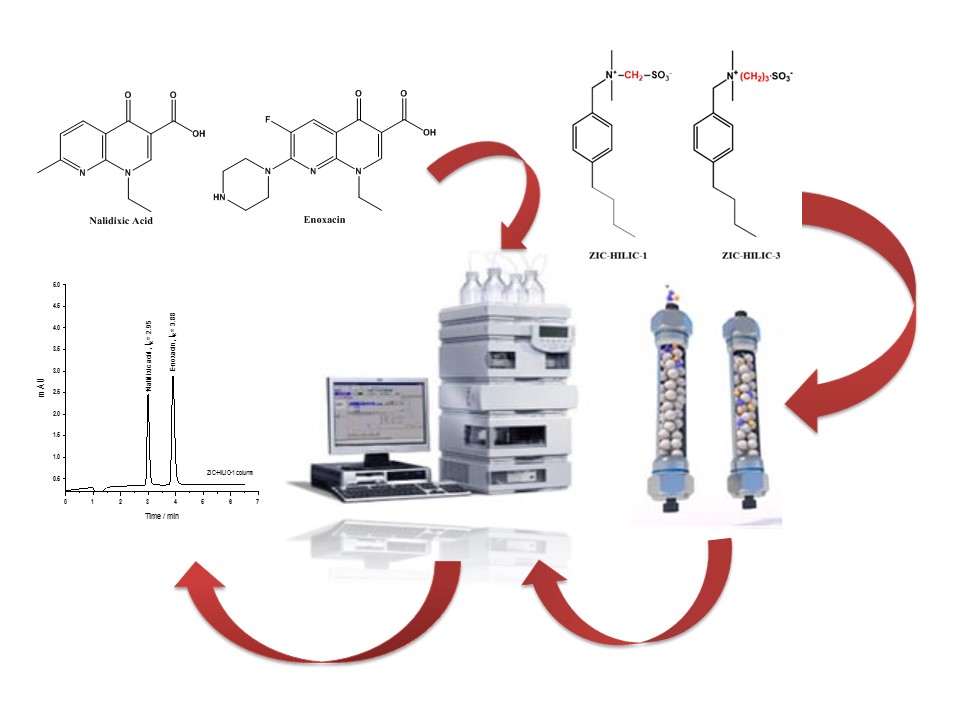
This research aims to provide a comprehensive view of the separation mechanisms of HILIC stationary phases in various applications. This study was conducted to understand the retention behavior of nalidixic acid and enoxacin, to show the effect of alkyl chain length on their selectivity, and to develop a simple and sensitive HILIC method for their determination in pharmaceutical formulations. Two lab-made columns (ZIC-HILIC-1 and ZIC-HILIC-3) were used to examine the retention behavior of nalidixic acid and Enoxacin. The retention mechanism in this research was studied by investigating the effect of parameters that affect the selectivity of the separation, which include (acetonitrile content, pH, and buffer concentration). The zwitterionic columns are characterized by their different alkyl spacer chain length, which have been employed to examine the retention behavior of select drugs. The eluent consists of acetonitrile: 10mM acetate buffer (90:10 v/v, pH 4.75) equipped with a UV detector set at 220nm, at a flow rate of 0.75 mL/min. This research developed a ZIC-HILIC method to determine nalidixic acid and enoxacin in pharmaceutical formulations. The technique exhibited linearity in the concentration range (0.1– 6 μg/mL) and 0.1-12 μg/mL for nalidixic acid and Enoxacin, respectively. LOD is 0.070 and 0.04 μg/mL for nalidixic acid, and LOD is 0.080 and 0.060 μg/mL for enoxacin in ZIC-HILIC-1 and ZIC-HILIC-3 columns, respectively.
References
[1] Armstrong, G.L.; Conn, L.A.; Pinner, R.W.; “Trends in infectious disease mortality in the United States during the 20th century” .JAMA, 281(1): 61–66, 1999.
[2] Naeem, A.; Badshah, S.L.; Muska, M.; Ahmad, N.; Khan, K.; “The current case of quinolones: synthetic approaches and antibacterial activity” .Molecules, 21(4): 268, 2016.
[3] Emami, S.; Shafiee, A.; Foroumadi, A.; “Structural features of new quinolones and relationship to antibacterial activity against Gram-positive bacteria”. Mini Rev. Med. Chem., 6(4): 375–386, 2006.
[4] Bennett, J.E.; Dolin, R.; Blaser, M.J. Mandell, Douglas, and Bennett's Principles and Practice of Infectious Diseases. 9th ed.; Elsevier Health Sciences: Philadelphia, USA, 2019.
[5] Gatto, B.; Capranico, G.; Palumbo, M.; “Drugs acting on DNA topoisomerases: recent advances and future perspectives.” Curr. Pharm. Des. , 5(3): 195–215, 1999.
[6] Hooper, D.C.; “Mode of action of fluoroquinolones”. Drugs, 58: 6–10, 1999.
[7] Spencer, A.C.; Panda, S.S.; “DNA Gyrase as a Target for Quinolones”. Biomedicines, 11(2): 371, 2023.
[8] Drlica, K.; Zhao, X.; “DNA gyrase, topoisomerase IV, and the 4-quinolones” .Microbiol. Mol. Biol. Rev., 61(3): 377–392, 1997.
[9] Wood, M.; “Tissue penetration and clinical efficacy of enoxacin in respiratory tract infections” .Clin. Pharmacokinet., 16(Suppl 1): 38–45, 1989.
[10] Jałbrzykowska, K.; Chrzanowska, A.; Roszkowski, P.; Struga, M.; “The New Face of a Well-Known Antibiotic: A Review of the Anticancer Activity of Enoxacin and Its Derivatives” .Cancers, 14(13): 3056, 2022.
[11] Eskandarian, H.; Sheikhian, L.; “Multi-walled carbon nanotube sorbent for extraction, preconcentration, and HPLC/UV determination of Nalidixic acid in human blood serum and tablet samples” . J. Iran. Chem. Soc., 18: 1657–1665, 2021.
[12] Toujani, E.; Belgaied, W.; Toujani, S.; “Simultaneous Quantitative Determination of Eight Fluoroquinolones by High-Performance Liquid Chromatography with UV Detection using a C18 Monolithic Column”. Methods & Objects Chem. Anal., 18(2),101-108, 2023.
[13] Kokoszka, K.; Kobus, A.; Bajkacz, S.; “Optimization of a method for extraction and determination of residues of selected antimicrobials in soil and plant samples using HPLC-UV-MS/MS” .Int. J. Environ. Res. Public Health, 18(3): 1159, 2021.
[14] Samanidou, V.; Demetriou, C.; Papadoyannis, I.; “Direct determination of four fluoroquinolones, enoxacin, norfloxacin, ofloxacin, and ciprofloxacin, in pharmaceuticals and blood serum by HPLC” . Anal. Bioanal. Chem., 375(5): 623–629, 2003.
[15] Espinosa-Mansilla, A.; De La Peña, A.M.; Gómez, D.G.; Salinas, F.; “HPLC determination of enoxacin, ciprofloxacin, norfloxacin and ofloxacin with photoinduced fluorimetric detection and multiemission scanning: application to urine and serum” .J. Chromatogr. B, 822(1-2): 185–193, 2005.
[16] Daneshfar, A.; Lotfi, H.; Khezeli, T.; “Determination of nalidixic acid using dispersive liquid-liquid microextraction followed by HPLC-UV”. Acta Chromatogr., 23(4): 567–577, 2011.
[17] Al-Phalahy, B.A.; Mohammed, M.J.; “Exploration of the separation mechanism of flurbiprofen and nimesulide utilizing RP-HPLC”. Baghdad Sci. J.,22(4):10-21, 2024.
[18] Guo, Y.; Shah, R.; “Detailed insights into the retention mechanism of caffeine metabolites on the amide stationary phase in hydrophilic interaction chromatography”. J. Chromatogr. A, 1463: 121–127, 2016.
[19] Fan, F.; Wang, L.; Li, Y.; Wang, X.; Lu, X.; Guo, Y.; “A novel process for the preparation of Cys-Si-NIPAM as a stationary phase of hydrophilic interaction liquid chromatography”. Talanta, 218: 121154, 2020.
[20] Guo, Y.; “A survey of polar stationary phases for hydrophilic interaction chromatography and recent progress in understanding retention and selectivity.” Biomed. Chromatogr., 36(4): e5332, 2022.
[21] Wang, Y.; Li, X.; Xu, X.; Wang, S.; Zhang, X.; Jiang, S.; “High efficiency and simple preparation of polyacrylamide coated silica stationary phase for hydrophilic interaction liquid chromatography”. J. Chromatogr. A, 1605: 360357, 2019.
[22] Hou, Y.; Zhang, F.; Liu, X.; Ren, Y.; Yang, B. “A positively charged porous graphitic carbon stationary phase for hydrophilic interaction liquid chromatography” ,Talanta, 164: 159–163, 2017.
[23] Guo, Y.; Baran, D.; “Hydrophilic Partitioning or Surface Adsorption? A Quantitative Assessment of Retention Mechanisms for Hydrophilic Interaction Chromatography (HILIC)”. Molecules, 28(18): 6459, 2023.
[24] Taylor, M.R.; Kawakami, J.; McCalley, D.V.; “Managing sample introduction problems in hydrophilic interaction liquid chromatography” .J. Chromatogr. A, 1700: 464006, 2023.
[25] Guo, Y.; Gaiki, S.; “Retention behavior of small polar compounds on polar stationary phases in hydrophilic interaction chromatography”. J. Chromatogr. A, 1074(1-2): 71–80, 2005.
[26] Alpert, A.J.; “Electrostatic repulsion hydrophilic interaction chromatography for isocratic separation of charged solutes and selective isolation of phosphopeptides”. Anal. Chem., 80(1): 62–76, 2008.
[27] Greco, G.; Grosse, S.; Letzel, T.; “Study of the retention behavior in zwitterionic hydrophilic interaction chromatography of isomeric hydroxy- and aminobenzoic acids”. J. Chromatogr. A, 1235: 60–67, 2012.
[28] Bicker, W.; Wu, J.; Lämmerhofer, M.; Lindner, W.; “Hydrophilic interaction chromatography in nonaqueous elution mode for separation of hydrophilic analytes on silica-based packings with noncharged polar bondings”. J. Sep. Sci., 31(16-17): 2971–2987, 2008.
[29] Rasheed, A.S.; Mohammed, M.J.; “Evaluating the Selectivity of Novel ZIC-HILIC Columns and an Application for Determining Antihistaminic Drugs in Pharmaceutical Preparations”. Baghdad Sci. J., 22(8):2517-2526, 2025.
[30] Mohammed, M.J.; Rasheed, A.S.; Qasim, B.; “Retention Behavior of Pantoprazole and Rabeprazole on Zwitterionic Stationary Phases in Hydrophilic Interaction Chromatography.” In: AIP Conference Proceedings, Proceedings of the Conference, Cincinnati, Ohio, USA, 2025; Link, J.; Raad, H.; McGrath, S.; Al-Jadir, T.; Al-Sharif, Z. T.; TA, M. M.; Jassim, M., Eds.; Publisher: AIP Publishing, Melville, NY, USA; 2025.
[31] Qiu, H.; Loukotková, L.; Sun, P.; Tesařová, E.; Bosáková, Z.; Armstrong, D.W. “Cyclofructan 6 based stationary phases for hydrophilic interaction liquid chromatography”. J. Chromatogr. A, 1218(2): 270–279, 2011.
[32] Guo, Y.; Gaiki, S. “Retention and selectivity of stationary phases for hydrophilic interaction chromatography” .J. Chromatogr. A, 1218(35): 5920–5938, 2011.
[33] Kawachi, Y.; Ikegami, T.; Takubo, H.; Ikegami, Y.; Miyamoto, M.; Tanaka, N. “Chromatographic characterization of hydrophilic interaction liquid chromatography stationary phases: Hydrophilicity, charge effects, structural selectivity, and separation efficiency” .J. Chromatogr. A, 1218(35): 5903–5919, 2011.
[34] Gilar, M.; Jaworski, A. “Retention behavior of peptides in hydrophilic-interaction chromatography”. J. Chromatogr. A, 1218(49): 8890–8896, 2011.
[35] Rasheed, A.S.; Al-Phalahy, B.A.; Seubert, A. “Studies on behaviors of interactions between new polymer-based ZIC-HILIC stationary phases and carboxylic acids”. J. Chromatogr. Sci., 55(1): 52–59, 2017.
[36] Walfish, S. “Analytical methods: a statistical perspective on the ICH Q2A and Q2B guidelines for validation of analytical methods”. BioPharm Int., 19(12): 1–6, 2006.
[37] Heyward, J.; Padula, W.; Tierce, J. C.; Alexander, G. C. “The value of US pharmacopeial standards: a review of the literature”. J. Pharm. Sci., 107(10): 2611–2617, 2018.
Downloads
Published
Issue
Section
License
Copyright (c) 2025 Bashaer A. Al-phalahy, Raad Radi Karabat, Ali Amer Waheb, Mustafa J. Mohammed, Ashraf Saad Rasheed

This work is licensed under a Creative Commons Attribution 4.0 International License.

.jpg)