Air Quality Based on the Spatial-Temporal Variations of Particulate Matter (PM2.5 and PM10) Concentrations Using R
DOI:
https://doi.org/10.22401/ANJS.29.2.06Keywords:
Air pollution, PM2 and PM10, WHO-AQGs, CAMS data, Statistical software RAbstract
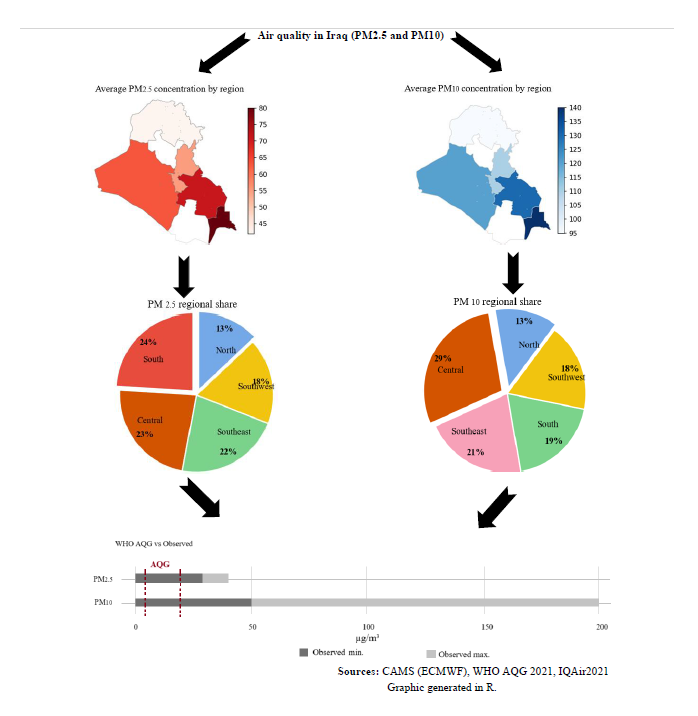
Air pollution is an escalating health problem in Iraq, particularly since dry and semi-dry conditions often exacerbate the loads of airborne dust and particles. We assess the impact of fine particulate matter PM2. with freely available Copernicus Atmosphere Monitoring Service (CAMS) products from the European Centre for Medium-Range Weather forecast (ECMWF) over Iraq. The analyses were performed on the year 2021, with a focus from January to March due to higher pollution levels within this period, it can be expected that particle concentrations are elevated. We also calculated the annual mean PM2. PM2. 5 and PM10 for 2021 are provided for a more global perspective with relevant international air-quality reference level. We used spatial methods in R to apply particulate matter fields to 20 of Iraq’s major cities, which allowed us to map geographic inconsistencies and areas with chronically high pollution. Results show that regional contrasts are considered very strong: PM2. 5 and PH10 than cities situated north or southwest. The observed patterns are in line with the synergistic influences of weather variability, recurrent dust storms, and local emissions associated with oil industry activity and urban stressors. PM2. In the most polluted areas, it was trained to 2023 data. Large portion of fine particles as implied by 5 relative to PM10. In total, mean PM concentrations were above WHO guidelines for all the cities surveyed with high levels of exposure likely resulting in health consequences. These results support the case for air pollution control and place specific interventions in Iraq.
References
[1] Calatayud V.; Diéguez J.J.; Agathokleous E.; Sicard P.; “Machine learning model to predict vehicle electrification impacts on urban air quality and related human health effects.” Environ. Res., 228(1): 115835, 2023.
[2] Kanet, R. E.; “The statesman’s Yearbook 2024”; 1st edition , Palgrave Macmillan: London, UK, 2024. https://link.springer.com/rwe/10.1057/978-1-349-96076-7_90
[3] Hadi, S.J.; Shafri, H.Z.M.; Mahir, M.D.; “Factors affecting to Eco-environment identification through change detection analysis by using remote sensing and GIS: A case study of Tikrit, Iraq.” Arab. J. Sci. Eng., 39:395-405, 2014. https://link.springer.com/article/10.1007/s13369-013-0859-8
[4] Gavin Shaddick; Matthew L. Thomas; Heresh Amini ;David Broday; Aaron Cohen; Joseph Frostad; Amelia Green; et al. "Data integration for global air quality and health assessment: Combining ground-monitoring and satellite-based estimates", Environ. Sci. Technol, 52 (16), 9069-9078, 2018.
[5] Kadhum, S.A.; Hussain, L.I.; Azeez, O.S.; Abed, O.S.; Jaafar, B.l.;” The burden of air quality in neighbourhoods near oil fields: an alarm for public health in Basra city, Iraq.” Bull. Atmos. Sci. Technol., 6:1, 2025. https://link.springer.com/article/10.1007/s42865-024-00084-9
[6] Hashim, B; Al-Naseri, S; Al-Maliki, A; Al-Ansari, N.; "Impact of COVID-19 lockdown on NO2, O3 PM2.5 and PM10 concentrations and assessing air quality changes in Baghdad, Iraq". Sci. Total Environ., 754, 141978.2021.
[7] De Marco, A.; Proietti, C.; Anav, A.; Ciancarella, L.; D'Elia, I.; Fares, S.; Fornasier, M. F.; et.al. "Impacts of air pollution on human and ecosystem health, and implications for the National Emission Ceilings Directive: Insights from Italy". Environ. Int., 125: 320–333, 2019.
[8] Awe, Y. A.; Larsen, B. K.; Sanchez-Triana, E.;” The Global Health Cost of PM 2.5 Air Pollution: A Case for Action Beyond 2021”,1st edition, International Bank for Reconstruction and Development: Washington, USA , 2022.
[9] Manisalidis, I.; Stavropoulou, E.; Stavropoulos, A.; Bezirtzoglou, E.; "Environmental and Health Impacts of Air Pollution: A Review"; Front. Public Health, 8: 14, 2020.
[10] Murray C, Aravkin A, Zheng P ;“Global burden of 87 risk factors in 204 countries and territories, 1990-2019: a systematic analysis for the Global Burden of Disease Study 2019”. The Lancet, 396: 1223-1249, 2020. https://pubmed.ncbi.nlm.nih.gov/33069327/
[11] Environmental Protection Agency; "Handbook for Criteria Pollutant Inventory Development: A Guide for Point, Area, and Mobile Sources"; 1st edition, Office of Air Quality Planning and Standards: North Carolina, USA, 1999.
[12] Chen, Z.; Chen, D.; Kwan, M.P.; Cai J.; Zhuang, Y.; Zhao B.; Wang X.; “Influence of meteorological conditions on PM2.5 concentrations across China: A review of methodology and mechanisms.” Environ. Int., 139:105558, 2020.
[13] Omran Omer Ali, Nazar Ameen Mohammed, Aurélie Broeckerhoff. ;"Demographic Change and Social Cohesion in Post-Islamic State Iraq". Middle East Policy, 32(1) :133-1, 2025.
[14] Awadh, S. M.; Al-Dabbas, M., Eds.; "The Geography of Iraq"; 1st edition, Springer Nature Switzerland AG: Cham, Switzerland, 2024.
[15] Rasul, A.; Ibrahim, G.; Hameed, H.; Tansey, K.; "A trend of increasing burned areas in Iraq from 2001 to 2019"; Environ. Dev. Sustain., 23: 5739–5755, 2021.
[16] Inness, A., Ades, M., Agustí-Panareda, A., Barré, J; Benedictow, A; Blechschmidt, A; Dominguez, J; et al. "The CAMS reanalysis of atmospheric composition". Atmos. Chem. Phys., 19(5) 3515–3556, 2019.
[17] Vincent-Henri Peuch; Richard Engelen; Michel Rixen; Dick Dee; Johannes Flemming; Martin Suttie; Melanie Ades; et al. "The Copernicus Atmosphere Monitoring Service: From Research to Operations" Bull. Am. Meteorol. Soc. 103(12): E2650–E2668, 2022
[18] Colette, A.; Couvidat, F.; Bessagnet, B.; Menut, L.; Meleux, F.; Rouïl, L.; Ung, A.; et al.; "Copernicus Atmosphere Monitoring Service – Regional Air Quality Production System v1.0"; Geosci. Model Dev., 18: 6835–6880, 2025.
[19] Marécal V; Peuch VH; Andersson C.; Andersson, S.; Arteta, J.; Beekmann, M.; Benedictow, A.; et.al.; “A regional air-quality forecasting system over Europe: The MACC-II daily ensemble production.” Geosci. Model Dev, 8:2777–2796, 2015.
[20] Bivand RS; Pebesma E; Gómez-Rubio V; “Applied Spatial Data Analysis with R”, 2nd ed. Springer: New York, USA, 2013.
[21] Pebesma, E. J.; Bivand, R. S.; "Classes and Methods for Spatial Data in R"; R News, 5(2): 9–13, 2005.
[22] Fuller R; Landrigan P.J.; Balakrishnan, K.; Bathan, G.; Bose-O'Reilly, S.; Brauer M.; Caravanos, J.; et.al.; “Pollution and health: A progress update.” Lancet Planet. Health., 6(6): 535–547, 2022.
[23] World Health Organization."WHO global air quality guidelines: particulate matter PM2.5 and PM10, ozone, nitrogen dioxide, sulfur dioxide and carbon monoxide",1st edition, World Health Organization: Geneva, Switzerland, 2021.
Downloads
Published
Issue
Section
License
Copyright (c) 2026 Layali Y. Salih Al-Mashhadani, Salam Dulaimi, Asmaa Hadi Mohammed

This work is licensed under a Creative Commons Attribution 4.0 International License.

.jpg)