Hybrid Texture and Deep Learning Framework for Automated Bone Fracture Classification
DOI:
https://doi.org/10.22401/ANJS.29.2.09Keywords:
Bone fracture, X-ray image, Deep learning, CNN models, GLCM, DNN classifierAbstract
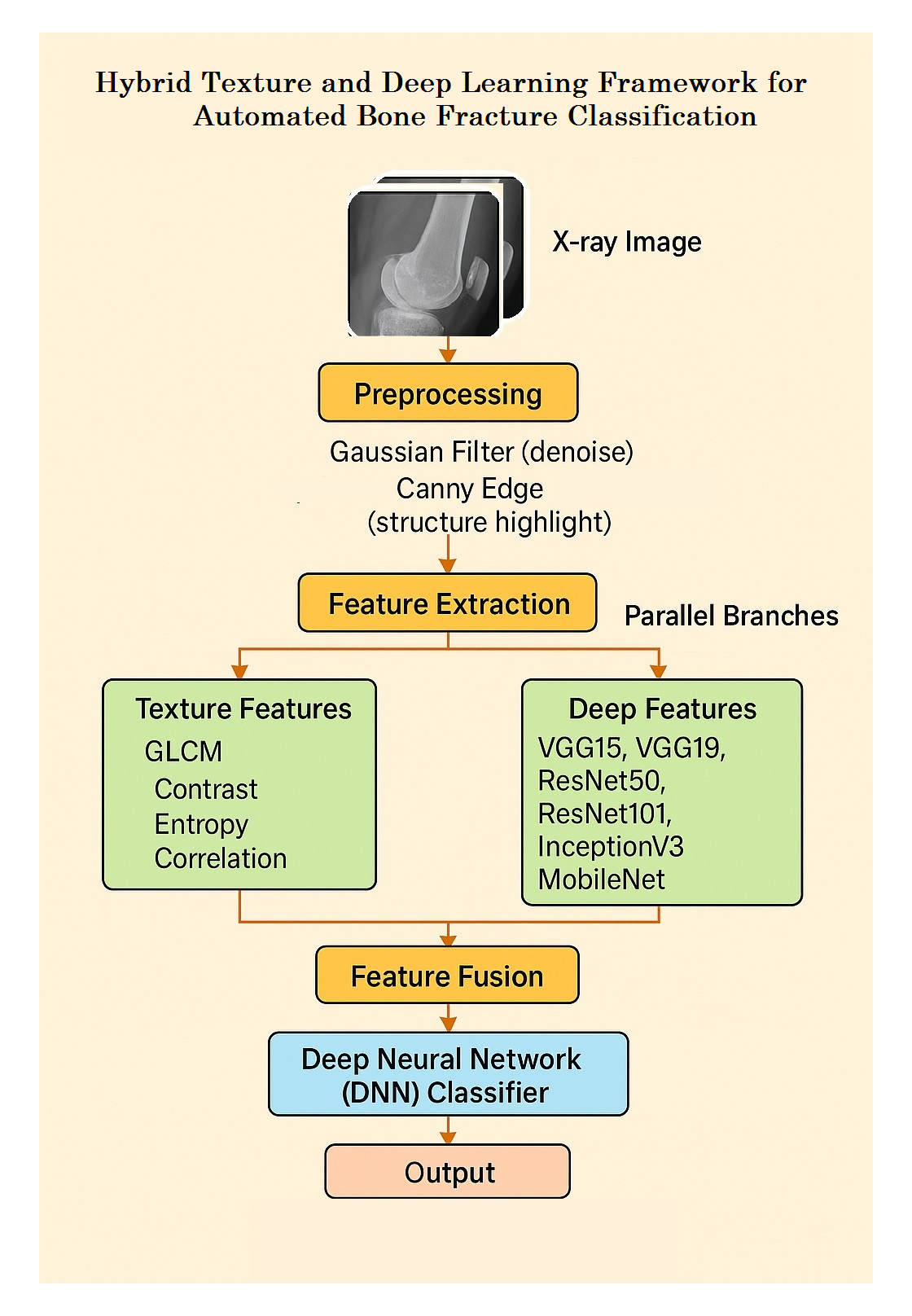
Bone fractures are frequent injuries that compromise the structural integrity and function of bones. Detecting these fractures in X-ray images can be particularly challenging, especially when dealing with small or complex cases. Manual diagnosis is often time-consuming and error-prone due to image quality limitations and clinician fatigue. Although deep learning techniques have shown promise, their performance is often constrained by limited annotated datasets and poor generalisation across diverse imaging conditions. This paper presents a hybrid deep learning framework that integrates handcrafted texture features—extracted using the Grey-Level Co-occurrence Matrix (GLCM)—with deep features derived from six pre-trained Convolutional Neural Networks (CNNs): ResNet101, ResNet50, InceptionV3, MobileNet, VGG16, and VGG19. Preprocessing techniques such as Gaussian filtering and Canny edge detection were employed to enhance image clarity and feature extraction. The combined feature vectors were classified using a Deep Neural Network (DNN). Experiments were conducted on a merged dataset from MURA and FracAtlas, comprising 6,466 X-ray images. The highest classification accuracy of 95.54% was achieved using VGG19 features combined with GLCM, without Canny preprocessing. Comparative analysis and cross-validation confirmed the robustness of the proposed approach. These findings highlight the effectiveness of combining handcrafted and deep features for reliable and clinically relevant bone fracture classification.
References
[1] Ismael, H.A.; Al-A’araji, N.H.; Shukur, B.K.; "An enhanced diabetic foot ulcer classification approach using GLCM and a deep convolution neural network". Karbala Int. J. Mod. Sci., 8(4): 682-691, 2022. https://doi.org/10.33640/2405-609X.3268
[2] Ahmed, K.D.; Hawezi, R.; "Detection of bone fracture based on machine learning techniques". Sensors, 27(10): 100723, 2023. https://doi.org/10.3390/s271000723
[3] Chai, H.Y.; Wee, L.K.; Swee, T.T.; Salleh, S.-H.; Ariff, A.K.; Kamarulafizam; "Gray-level co-occurrence matrix bone fracture detection". Am. J. Appl. Sci., 8(1): 26–32, 2011. https://doi.org/10.3844/ajassp.2011.26.32
[4] Alshahrani, A.; Alsairafi, A.; "Bone fracture classification using convolutional neural networks from X-ray images". Eng. Technol. Appl. Sci. Res., 14(5): 16640–16645, 2024. https://doi.org/10.48084/etasr.8050
[5] Bhakare, D.B.; Jawalekar, P.A.; Korde, S.D.; "A novel approach for bone fracture detection using image processing". Int. Res. J. Eng. Technol., 5(2): 193, 2018.
[6] Bagaria, R.; Wadhwani, S.; Wadhwani, A.K.; "Bone fracture detection in X-ray images using convolutional neural network". Conf. Proc. Intell. Syst., pp. 459–466, 2022. https://doi.org/10.52458/978-93-91842-08-6-43
[7] Noureen, A.; Zia, M.A.; Adnan, A.; Hashim, M.; "Analysis and Classification of Bone Fractures Using Machine Learning Techniques". E3S Web Conf., 409: 02015, 2023. https://doi.org/10.1051/e3sconf/202340902015
[8] Patel, S.; Talati, B.; Shah, S.; Panchal, B.Y.; "Bone fracture classification using modified AlexNet". Stoch. Model. Appl., 26(3): 501, 2022.
[9] Tahir, A.; Saadia, A.; Khan, K.; Gul, A.; Qahmash, A.; Akram, R.N.; "Enhancing diagnosis: Ensemble deep-learning model for fracture detection using X-ray images". Clin. Radiol., 79(11): e1394–e1402, 2024. https://doi.org/10.1016/j.crad.2024.08.006
[10] Riska; "Analysing musculoskeletal bone fractures using decision trees: A deep learning approach with Canny segmentation and Hu moments feature extraction". Int. J. Artif. Intell. Med. Issues, 2(1): 30, 2024. https://doi.org/10.56705/ijaimi.v2i1.140
[11] Jones, R.M.; Sharma, A.; Hotchkiss, R.; Sperling, J.W.; Hamburger, J.; et al.; "Assessment of a deep-learning system for fracture detection in musculoskeletal radiographs". NPJ Digit. Med., 3: 144, 2020.
[12] Alomar, K.; Aysel, H.I.; Cai, X.; "Data augmentation in classification and segmentation: A survey and new strategies". J. Imaging, 9(2): 46, 2023. https://doi.org/10.3390/jimaging9020046
[13] Young, I.T.; Van Vliet, L.J.; "Recursive implementation of the Gaussian filter". Signal Process., 44(2): 139-151, 1995.
[14] Abedeen, I.; Rahman, M.A.; Prottyasha, F.Z.; Ahmed, T.; Chowdhury, T.M.; Shatabda, S.; "FracAtlas: A dataset for fracture classification, localization, and segmentation of musculoskeletal radiographs". Sci. Data, 10: 521, 2023. https://doi.org/10.1038/s41597-023-02432-4
[15] Jifara, W.; Jiang, F.; Rho, S.; Cheng, M.; Liu, S.; "Medical image denoising using convolutional neural network: a residual learning approach". J. Supercomput., 75(2): 704-718, 2019.
[16] Cadena, L.; Zotin, A.; Cadena, F.; Korneeva, A.; Legalov, A.; Morales, B.; "Noise reduction techniques for the processing of medical images". Lect. Notes Eng. Comput. Sci., 2229: 5–7, 2017.
[17] Makki, T.M.; Al-Dulaimi, K.; "Blood Cell Microscopic Image Classification in Computer-Aided Diagnosis Using Machine Learning: A Review". Iraqi J. Comput. Sci. Math., 4(2): 4, 2023. https://doi.org/10.52866/ijcsm.2023.02.01.004
[18] Cheribet, M.; Mazouzi, S.; "A new adapted Canny filter for edge detection in range images". Jordanian J. Comput. Inf. Technol., 7(3): 229–241, 2021. https://doi.org/10.5455/jjcit.71-1620428305
[19] Al-Ayyoub, M.; Hmeidi, I.; Rababah, H.; "Detecting hand bone fractures in X-ray images". J. Multimedia Process. Technol., 4(3): 155, 2013.
[20] Srinivasan, K.; Garg, L.; Datta, D.; Alaboudi, A.A.; Jhanjhi, N.Z.; Agarwal, R.; Thomas, A.G.; "Performance comparison of deep CNN models for detecting driver’s distraction". Comput. Mater. Continua, 69(3): 4567–4583, 2021. https://doi.org/10.32604/cmc.2021.016736
[21] Dodamani, P.S.; Danti, A.; "Transfer learning-based osteoporosis classification using simple radiographs". Int. J. Online Biomed. Eng., 19(8): 45–60, 2023. https://doi.org/10.3991/ijoe.v19i08.39864
[22] Perez, H.; Tah, J.H.M.; "Improving the accuracy of convolutional neural networks by identifying and removing outlier images in datasets using t-SNE". Mathematics, 8(5): 662, 2020. https://doi.org/10.3390/math8050662
[23] Chakravarthy, S.R.S.; Bharanidharan, N.; Vinothini, C.; Vinoth Kumar, V.; Mahesh, T.R.; Guluwadi, S.; "Adaptive Mish activation and Ranger optimizer-based SEA-ResNet50 model with explainable AI for multiclass classification of COVID-19 chest X-ray images". BMC Med. Imaging, 24: 206, 2024. https://doi.org/10.1186/s12880-024-01052-x
[24] Iparraguirre-Villanueva, O.; Guevara-Ponce, V.; Roque Paredes, O.; Sierra-Liñan, F.; Zapata-Paulini, J.; Cabanillas-Carbonell, M.; "Convolutional neural networks with transfer learning for pneumonia detection". Int. J. Adv. Comput. Sci. Appl., 13(9): 544, 2022. https://doi.org/10.14569/IJACSA.2022.0130958
[25] Ahmed, N.; Joy, M.I.K.; Rahman, M.M.; Sabuj; "Classification of Plants Leaf Diseases using Convolutional Neural Network". Al-Nahrain J. Sci., 24(2): 64–71, 2021. https://doi.org/10.22401/ANJS.24.2.09
[26] Al-Akkam, R.M.J.; Altaei, M.S.M.; Zhao, X.; Wang, L.; Zhang, Y.; Han, X.; Deveci, M.; Parmar, M.; "A review of convolutional neural networks in computer vision". Artif. Intell. Rev., 57(4): 99, 2024. https://doi.org/10.1007/s10462-024-10721-6
Downloads
Published
Issue
Section
License
Copyright (c) 2026 Al-Zahraa Adil, Khamael Al-Dulaimi

This work is licensed under a Creative Commons Attribution 4.0 International License.

.jpg)