Image Augmentation for Passionfruit Disease Classification Using Conditional Generative Adversarial Networks (cGANs)
DOI:
https://doi.org/10.22401/ANJS.29.1.12Keywords:
Passionfruit disease classification, Conditional GAN (cGAN), Image augmentation, Deep learning, Agricultural AIAbstract
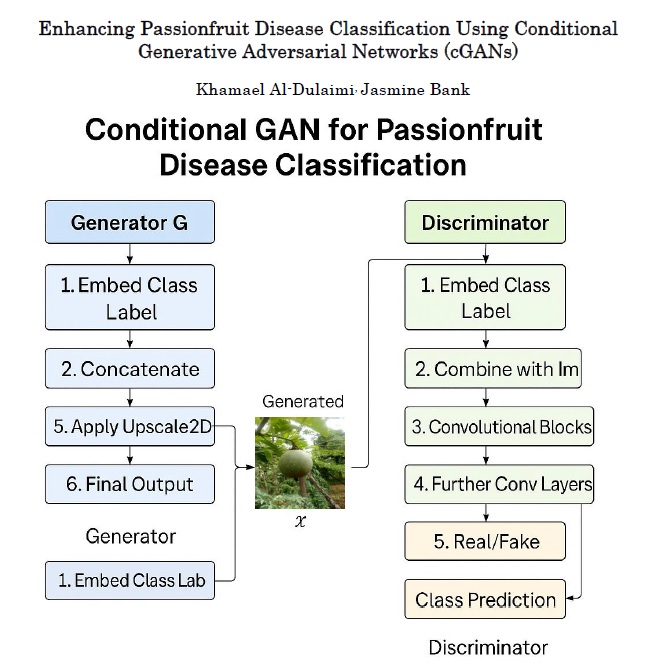
Early and accurate detection of crop diseases is vital for safeguarding food security and improving agricultural productivity, particularly in regions where access to the prognosis and diagnostic tools as well as expert knowledge is remote. This paper presents the first targeted application of class-conditional Generative Adversarial Networks (cGANs) to passionfruit disease detection using the publicly available Makerere Passionfruit dataset, which contains 3,001 labelled images across three classes: Healthy, Brownspot, and Woodiness. We propose a domain-specific augmentation pipeline that integrates progressive growing, spectral normalization, hinge loss, and gradient penalty to generate high-quality, class-specific synthetic images for under-represented disease categories. Experimental results demonstrate that cGAN augmentation significantly enhances minority class recognition. The F1-score for Brownspot improved from 0.72 to 0.78 and for Woodiness from 0.60 to 0.71, raising the macro-average F1-score from 0.76 to 0.80. To validate robustness, the framework is evaluated across multiple architectures, including LeNet, ResNet-18, and MobileNetV2. In each case, cGAN-based augmentation consistently improved macro-F1 scores by 3–5% without reducing overall accuracy, confirming the model-agnostic nature of the approach. These findings establish a novel and practical foundation for AI-powered plant/crop disease detection in realistic field conditions. The framework is computationally efficient and suitable for deployment on mobile or edge devices, making it particularly relevant for low-resource and inaccessible agricultural environments.
References
[1] Ochwo-Ssemakula, D.; Rubaihayo, P.R.; Adipala, E.; Ekwamu, A.E.; Winter, S. “Characterization and distribution of a potyvirus associated with passion fruit woodiness disease in Uganda.” Plant Dis., 96(5), 659–665, 2012. https://doi.org/10.1094/PDIS-03-11-0263
[2] Kamal, K.C.; Yin, Z.; Wu, M.; Wu, Z. “Depthwise separable convolution architectures for plant disease classification.” Comput. Electron. Agricult., 165, 104948, 2019. https://doi.org/10.1016/j.compag.2019.104948
[3] Lu, Y.; Chen, D.; Olaniyi, E.; Huang, Y. “Generative adversarial networks (GANs) for image augmentation in agriculture: A systematic review.” Comput. Electron. Agricult., 200, 107208, 2022. https://doi.org/10.1016/j.compag.2022.107208
[4] Al-Badri, A.H.; Ismail, N.A.; Al-Dulaimi, K.; Salman, G.A.; Salam, M.S.H. “Adaptive Non-Maximum Suppression for improving performance of Rumex detection.” Expert Syst. Appl., 219, 119634, 2023. https://doi.org/10.1016/j.eswa.2023.119634
[5] Mohanty, S.P.; Hughes, D.P.; Salathé, M. “Using deep learning for image-based plant disease detection.” Front. Plant Sci., 7, 1419, 2016. https://doi.org/10.3389/fpls.2016.01419
[6] Tran, N.-T.; Tran, V.-H.; Nguyen, N.-B.; Nguyen, T.-K.; Cheung, N.-M. “On data augmentation for GAN training.” IEEE Trans. Image Process., 30, 1882–1897, 2021. https://doi.org/10.1109/TIP.2021.3049349
[7] Lee, M.; Seok, J.; “Estimation with Uncertainty via Conditional Generative Adversarial Networks”. Sensors, 21, 6194,2021. https://doi.org/10.3390/s21186194Too, E.C.; Yujian, L.; Njuki, S.; Yingchun, L. “A comparative study of fine-tuning deep learning models for plant disease identification.” Comput. Electron. Agricult., 161, 272–279, 2019. https://doi.org/10.1016/j.compag.2018.03.032
[8] Ferentinos, K.P. “Deep learning models for plant disease detection and diagnosis.” Comput. Electron. Agricult., 145, 311–318, 2018. https://doi.org/10.1016/j.compag.2018.01.009
[9] Ahmed, A.A.; Reddy, G.H. “A mobile-based system for detecting plant leaf diseases using deep learning.” AgriEngineering, 3(3), 478–493, 2021. https://doi.org/10.3390/agriengineering3030031
[10] Al-Badri, A.H.; Ismail, N.A.; Al-Dulaimi, K.; Rehman, A.; Abunadi, I.; Bahaj, S.A. “Hybrid CNN model for classification of Rumex obtusifolius in grassland.” IEEE Access, 10, 90940–90957, 2022. https://doi.org/10.1109/ACCESS.2022.3200603
[11] Yu, L.; Tang, L.; Mu, L.; “A Review of DEtection TRansformer: From Basic Architecture to Advanced Developments and Visual Perception Applications”. Sensors, 25, 3952,2025. https://doi.org/10.3390/s25133952
[12] Lu, Y.; Chen, D.; Olaniyi, E.; Huang, Y. “Generative adversarial networks (GANs) for image augmentation in agriculture: A systematic review.” Comput. Electron. Agricult., 200, 107208, 2022. https://doi.org/10.1016/j.compag.2022.107208
[13] Frid-Adar, M.; Diamant, I.; Klang, E.; Amitai, M.; Goldberger, J.; Greenspan, H.; “GAN-based synthetic medical image augmentation for increased CNN performance in liver lesion classification”. Neurocomput., 321, 321-331, 2018. https://doi.org/10.1016/j.neucom.2018.09.013
[14] Nazal, S.; Al-Dulaimi, K.; “Rumex weed classification using region-convolution neural networks based-colour space information”. Intelig. Artif., 26(72), 244–255,2023.
[15] Lu, Y.; Chen, D.; Olaniyi, E.; Huang, Y. “Generative adversarial networks (GANs) for image augmentation in agriculture: A systematic review.” Comput. Electron. Agricult, 200, 107208, 2022. https://doi.org/10.1016/j.compag.2022.107208
[16] Kotwal, J.; Kashyap, D.; Pathan, D. “Agricultural plant diseases identification: From traditional approach to deep learning.” Mater. Today Proc., 80, 344–356, 2023. https://doi.org/10.1016/j.matpr.2023.02.370
[17] Hinz, T.; Heinrich, S.; Wermter, S.; “Generating Multiple Objects at Spatially Distinct Locations”. Proceedings of the International Conference on Learning Representations (ICLR), New Orleans, LA, USA, 6–9 May 2019;
[18] Lu, Y.; Chen, D.; Olaniyi, E.; Huang, Y. “Generative adversarial networks (GANs) for image augmentation in agriculture: A systematic review.” Comput. Electron. Agricult., 200, 107208, 2022. https://doi.org/10.1016/j.compag.2022.107208
[19] Fedoruk, O.; Klimaszewski, K.; Ogonowski, A.; Możdżonek, R. “Performance of GAN-based augmentation for deep learning COVID-19 image classification.” In AIP Conference Proceedings, International Workshop on Machine Learning and Quantum Computing Applications in Medicine and Physics (WMLQ 2022), Warsaw, Poland, 13–16 Sept 2022 (published 15 Mar 2024), K. Klimaszewski, W. Krzemień, L. Raczyński (Eds.), vol. 3061, p. 030001. AIP, New York, USA, 2023.
[20] Al-Akkam, R.M.J.; Altaei, M.S.M. “Classification of Plants Leaf Diseases using Convolutional Neural Network.” Al-Nahrain J. Sci., 24(2), 64–71, 2021. https://doi.org/10.22401/ANJS.24.2.09.
[21] Pacal, I.; Uçar, E.; Karaboga, D.; Atila, U.; Ergen, B.; Yildirim, O.; Tuncer, T.; et al. “A systematic review of deep learning techniques for plant diseases.” Artif. Intell. Rev., 57(11), 304, 2024. https://doi.org/10.1007/s10462-024-10944-7
[22] LeCun, Y.; Bottou, L.; Bengio, Y.; Haffner, P. “Gradient-based learning applied to document recognition.” Proc. IEEE, 86(11), 2278–2324, 1998. https://doi.org/10.1109/5.726791
Downloads
Published
Issue
Section
License
Copyright (c) 2026 Khamael Al-Dulaimi, Jasmine Bank

This work is licensed under a Creative Commons Attribution 4.0 International License.

.jpg)