In Silico and In Vitro Studies Unveil the Protective Potential of Diosmin-Hesperidin Conjugate in Doxorubicin Toxicity
Keywords:
Diosmin-Hesperidine Conjugate, Doxorubicin Toxicity, Oxidative Stress, Antioxidant Activity, In Silico and In Vitro StudiesAbstract
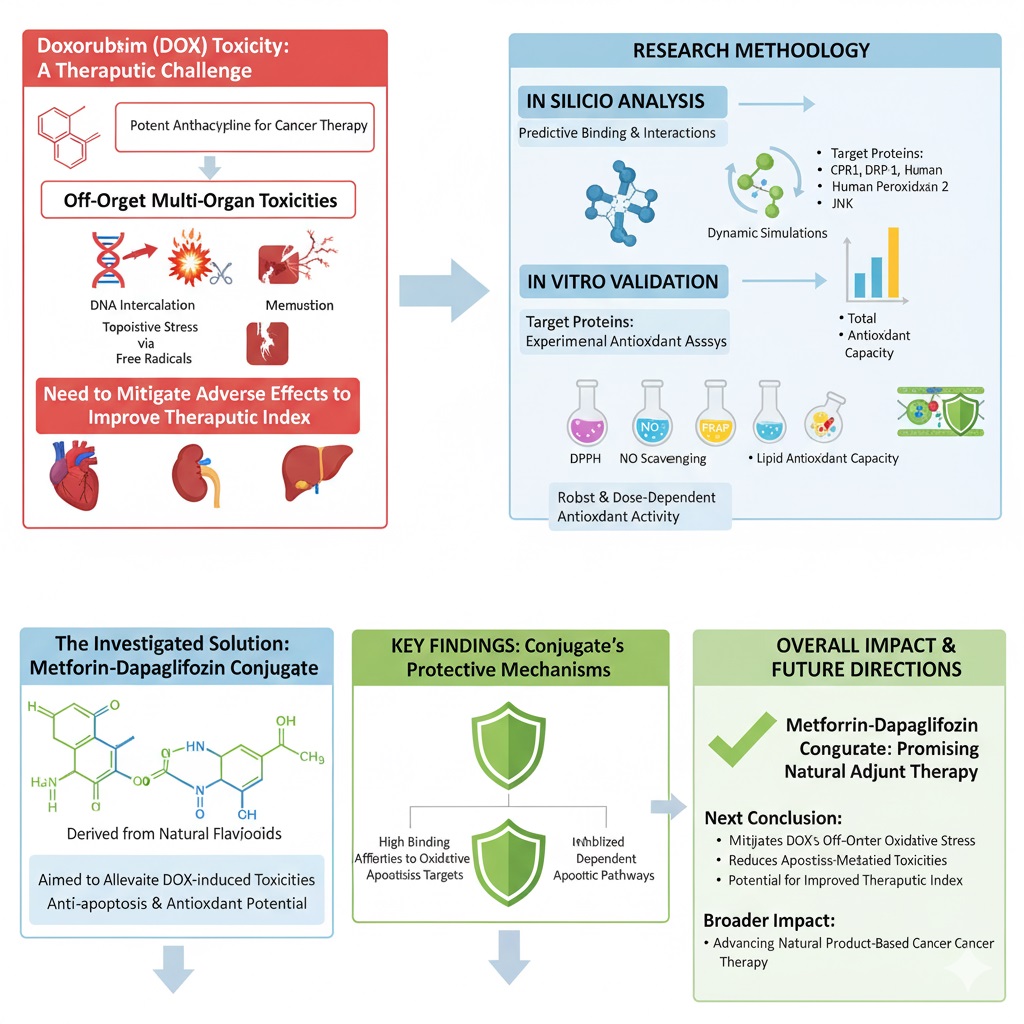
Doxorubicin (DOX), a potent anthracycline antibiotic widely used in cancer therapy, is notorious for inducing off-target multi-organ toxicities. These toxicities arise through mechanisms such as DNA intercalation, topoisomerase II poisoning, oxidative stress via free radical generation, and membrane disruption caused by altered sphingolipid metabolism. Mitigating these adverse effects is essential to improving the therapeutic index of DOX. This study investigates the protective potential of a diosmin-hesperidin conjugate using in silico and in vitro methods. The diosmin-hesperidin conjugate, derived from natural flavonoids, was assessed for its anti-apoptosis and antioxidant potential to alleviate DOX-induced toxicities. In silico analyses, including molecular docking and dynamic simulations, revealed high binding affinities of the conjugate to key oxidative stress-related targets, such as catalase, glutathione reductase, and apoptosis-related proteins (e.g., caspase-3, Hsp70, and Hsp90β). In vitro assays, including DPPH, NO scavenging, FRAP, H₂O₂ scavenging, lipid peroxidation inhibition, and total antioxidant capacity, validated the conjugate’s robust antioxidant activity. The computational and in vitro studies showed that the conjugate stabilized antioxidant enzymes and inhibited apoptotic pathways. Overall, by leveraging the synergistic effects of this flavonoid conjugate, this study highlighted the diosmin-hesperidin conjugate as a promising natural adjunct therapy to mitigate DOX’s off-target oxidative stress- and apoptosis-mediated toxicities. Thus, providing a foundation for further preclinical and clinical evaluations, and contributing to the advancement of natural product-based cancer therapy.
References
[1] Carvalho, C.; Santos, R. X.; Cardoso, S.; Correia, S.; Oliveira, P. J.; Santos, M.S.; Moreira, P.I. “Doxorubicin: The good, the bad and the ugly effect”. Curr. Med. Chem., 16(25): 3267-3285, 2009. https://doi.org/10.2174/092986709788803312.
[2] Kciuk, M.; Gielecińska, A.; Mujwar, S.; Kołat, D.; Kałuzińska-Kołat, Ż.; Celik, I.; Kontek, R. “Doxorubicin - An agent with multiple mechanisms of anticancer activity”. Cells, 12(4): 659, 2023. https://doi.org/10.3390/cells12040659.
[3] Adeneye, A.A.; Babatope, F.E.; Adesiji-Adelekan, A.E.; Olorundare, O.E.; Okoye, I.I. “Tadalafil pretreatment attenuates doxorubicin-induced hepatorenal toxicity by modulating oxidative stress and inflammation in Wistar rats”. Toxicol. Rep., 13: 101737, 2024. https://doi.org/10.1016/j.toxrep.2024.101737.
[4] Boeno, F.P.; Patel, J.; Montalvo, R.N.; Lapierre-Nguyen, S.S.; Schreiber, C.M.; Smuder, A.J. “Effects of exercise preconditioning on doxorubicin-induced liver and kidney toxicity in male and female rats”. Intl. J. Mol. Sci., 24(12): 10222, 2023. https://doi.org/10.3390/ijms241210222.
[5] Renu, K.; Pureti, L.P.; Vellingiri, B.; Valsala Gopalakrishnan, A. “Toxic effects and molecular mechanism of doxorubicin on different organs – an update”. Toxin Reviews, 41(2): 650-674, 2021. https://doi.org/10.1080/15569543.2021.1912099
[6] Kumar, S.; Pandey, A.K. “Chemistry and biological activities of flavonoids: An overview”. Sci. World J., 2013: 162750, 2013. https://doi.org/10.1155/2013/162750
[7] Osama, H.; Hamed, E.O.; Mahmoud, M.A.; Abdelrahim, M.E.A. “The effect of hesperidin and diosmin individually or in combination on metabolic profile and neuropathy among diabetic patients with metabolic syndrome: A randomized controlled trial”. J. Diet Suppl., 20(5): 749-762, 2023. https://doi.org/10.1080/19390211.2022.2107138.
[8] Wójciak, M.; Feldo, M.; Borowski, G.; Kubrak, T.; Płachno, B.J.; Sowa, I. “Antioxidant potential of diosmin and diosmetin against oxidative stress in endothelial cells.” Molecules, 27(23): 8232, 2022. https://doi.org/10.3390/molecules27238232
[9] Yasım, A.; Özbağ, D.; Kılınç, M.; Çıralık, H.; Toru, İ. “The effect of diosmin-hesperidin combination treatment on the lipid profile and oxidative-antioxidative system in high-cholesterol diet-fed rats.” Turkish J. Thorac. Cardiovasc. Surg., 19(1): 55-61, 2011.
https://tgkdc.dergisi.org/uploads/pdf/pdf_TGKDC_1353.pdf
[10] Ahmed, O.M.; Elkomy, M.H.; Ashour, M.B.; Mahmoud, H.U.R.; Naguib, I.A.; Fahim, H.I.; Alghamdi, B.S.; Ahmed, N.A. “Rutin and quercetin counter doxorubicin-induced liver toxicity in Wistar rats via their modulatory effects on inflammation, oxidative stress, apoptosis, and Nrf2.” Oxid. Med. Cell. Longev., 2022: 2710607, 2022. https://doi.org/10.1155/2022/2710607
[11] Chandimali, N.; Bak, S.G.; Park, E.H.; Lim, H-J.; Won, Y-S.; Kim, E-K., Park, S-I.; Lee, S.J. “Free radicals and their impact on health and antioxidant defenses: a review.” Cell Death Discov., 11: 19, 2025. https://doi.org/10.1038/s41420-024-02278-8
[12] Morgan, E.M.; Boltia, S.A.; Fayez, Y.M.; Abdelkawy M; Lotfy HM. “Coupling of physical extraction and mathematical filtration in spectrophotometric analysis of natural therapy essential for prophylaxis and treatment of COVID-19 infection - Comparative study along with greenness evaluation”. Heliyon, 9(6): e16284, 2023. https://doi.org/10.1016/j.heliyon.2023.e16284
[13] Fatoki, T.H.; Balogun, T.C.; Ojewuyi, A.E.; Omole, A.C.; Olukayode, O.V.; Adewumi, A.P.; Umesi, A.J.; Ijeoma, N.P.; Apooyin, A.E.; Chinedu, C.P.; Idowu, I.E.; Isah, M.J. “In silico molecular targets, docking, dynamics simulation and physiologically based pharmacokinetics modeling of oritavancin”. BMC Pharmacol. Toxicol., 25: 79, 2024. https://doi.org/10.1186/s40360-024-00804-z
[14] Dhuli, K.; Bonetti, G.; Anpilogov, K.; Herbst, K.L.; Connelly, S.T.; Bellinato, F.; Gisondi, P.; Bertelli, M. (2022). “Validating methods for testing natural molecules on molecular pathways of interest in silico and in vitro. J. Prev. Med. Hyg., 63(2 Suppl. 3): E279-E288, 2022. https://doi.org/10.15167/2421-4248/jpmh2022.63.2S3.2770
[15] Patil, N.; Mirveis, Z.; Byrne, H.J. (2024), “Kinetic modelling of the cellular metabolic responses underpinning in vitro glycolysis assays”. FEBS Open Bio, 14: 466-486, 2024. https://doi.org/10.1002/2211-5463.13765
[16] Trott, O.; Olson, A.J. “AutoDock Vina: Improving the speed and accuracy of docking with a new scoring function, efficient optimization and multi-threading. J. Comput. Chem., 31: 455-461, 2010. https://doi.org/10.1002/jcc.21334
[17] López-López, E.; Naveja, J.J.; Medina-Franco, J.L. (2019). “DataWarrior: An evaluation of the open-source drug discovery tool” Expert Opin. Drug Discov., 15: 13-17, 2019. https://doi.org/10.1080/17460441.2019.1581170
[18] Du, X.; Li, Y.; Xia, Y.L.; Ai, S.M.; Liang, J.; Sang, P. “Insights into protein-ligand interactions: mechanisms, models, and methods”. Int. J. Mol. Sci., 17: 144-147, 2016. https://doi.org/10.3390/ijms17020144
[19] Baroroh, U.; Si. S.; Biotek, M.; Muscifa, Z.S.; Destiarani, W.; Rohmatullah, F.G.; Yusuf. M. “Molecular interaction analysis and visualization of protein-ligand docking using Biovia Discovery Studio Visualizer”. Indonesian J. Comput. Biol., 2(1): 22-30, 2023.
[20] Hussen, E.M.; Endalew, S.A. “In vitro antioxidant and free-radical scavenging activities of polar leaf extracts of Vernonia amygdalina”. BMC Complement. Med. Ther., 23, 146 (2023). https://doi.org/10.1186/s12906-023-03923-y
[21] Etim, O.E.; Ekanem S.E.1.; Sam, S.M. “In vitro antioxidant activity and nitric oxide scavenging activity of Citrullus lanatus seeds”. J. Nat. Sci. Res., 3(12): 126-132, 2013. https://core.ac.uk/download/pdf/234654281.pdf
[22] Gülçin, İ.; Huyut, Z.; Elmastaş, M.; Aboul-Enein, H.Y. “Radical scavenging and antioxidant activity of tannic acid”. Arab. J. Chem. 3(1): 43-53, 2010. https://doi.org/10.1016/j.arabjc.2009.12.008
[23] Vishwakarma, A.; Wany, A.; Pandey, S.; Bulle, M.; Kumari, A.; Kishorekumar, R.; Igamberdiev, A.U.; Mur, L.A.J.; Gupta, K.J. “Current approaches to measure nitric oxide in plants”. J. Exp. Bot., 70(17) (2019), 4333-4343. https://doi.org/10.1093/jxb/erz242
[24] Peach, M.L.; Beedie, S.L.; Chau, C.H.; Collins, M.K.; Markolovic, S.; Luo, W.; Tweedie, D.; Steinebach, C.; Greig, N.H.; Gütschow, M.; Vargesson, N.; Nicklaus, M.C.; Gigg, W.D. (2020). “Antiangiogenic activity and in silico cereblon binding analysis of novel thalidomite analogs”. Molecules, 25(23): 5683. https://doi.org/10.3390/molecules25235683
[25] Hoeh, B.; Würnschimmel, C.; Flammia, R.S.; Horlemann, B.; Sorce, G.; Chierigo, F.; Tian, Z.; Saad, F.; Graefen, M.; Gallucci, M.; Briganti, A.; Terrone, C.; Shariat, S.F.; Tilki, D.; Kluth, L.A.; Mandel, P.; Chun, F.K.H.; Karakiewicz, P.I. “Effect of chemotherapy on overall survival in contemporary metastatic prostate cancer patients”. Front. Oncol. 11:778858. https://doi.org/10.3389/fonc.2021.778858
[26] Copeland-Halperin, R.S.; Al-Sadawi, M.; Patil, S.; Liu, J.E.; Steingart, R.M.; Dang, C.T.; Yu, A.F. “Early trastuzumab interruption and recurrence-free survival in ERBB2-positive breast cancer”. JAMA Oncol., 6(12):1971-1972, 2020. https://doi.org/10.1001/jamaoncol.2020.4749.
[27] Mudd, T.W. Jr.; Khalid, M.; Guddati, A.K. “Cardiotoxicity of chemotherapy and targeted agents”. Am. J. Cancer Res., 11(4):1132-1147, 2021. https://pmc.ncbi.nlm.nih.gov/articles/PMC8085845/
[28] Mattioli, R.; Ilari, A.; Colotti, B.; Mosca, L.; Fazi, F.; Colotti, G. “Doxorubicin and other anthracyclines in cancers: Activity, chemoresistance and its overcoming”. Mol. Asp. Med., 93: 101205, 2023. https://doi.org/10.1016/j.mam.2023.101205
[29] Patil, P.P.; Kumar, P., Khanal, P.; Patil, V.S.; Darasaguppe, H.R.; Bhandare, V.V.; Bhatkande, A.; Shukla, S.; Joshi, R.K.; Patil, B.M.; Roy, S. “Computational and experimental pharmacology to decode the efficacy of Theobroma cacao L. against doxorubicin-induced organ toxicity in EAC-mediated solid tumor induced mice”. Front. Pharmacol. 2023; 14:1174867, 2023. https://doi.org/10.3389/fphar.2023.1174867
[30] Thorn, C.F.; Oshiro, C.; Marsh, S.; Hernandez-Boussard, T.; McLeod, H.; Klein, T.E.; Altman, R.B. “Doxorubicin pathways: pharmacodynamics and adverse effects”. Pharmacogenet Genom, 21(7): 440-446, 2011. https://doi.org/10.1097/FPC.0b013e32833ffb56
[31] Adeneye, A.A.; Olorundare, O.E.; Akinsola, A.O.; Sanni, D.A.; Okoye, I.I.; Ntambi, J.M.; Mukhtar, H. “Ameliorative potential of Clerodendrum volubile ethanol leaf extract on doxorubicin-induced hepatorenal toxicities in rats”. Pharmacol. Toxicol. Nat. Med., 1(1): 1-13, 2021. https://doi.org/10.52406/ptnm.v1i1.8
[32] Nitiss, J.L. “Targeting DNA topoisomerase II in cancer chemotherapy’. Nat Rev Cancer, 9(5): 338-50, 2009. https://doi.org/10.1038/nrc2607
[33] Baikar, S.; Malpathak, N. “Secondary metabolites as DNA topoisomerase inhibitors: A new era towards designing of anticancer drugs”. Phcog. Rev., 4(7): 12-26, 2010. https://doi.org/10.4103/0973-7847.65320
[34] Yan, T.; Yu, H.; Li, T.; Dong, Y. “Mechanisms of cardiovascular toxicities induced by cancer therapies and promising biomarkers for their prediction: A scoping review”. Heart Lung Circ., 33: 605-638, 2024. https://doi.org/10.1016/j.hlc.2023.12.006
[35] Birbo, B.; Madu, E.E.; Madu, C.O.; Jain, A.; Lu, Y. “Role of HSP90 in Cancer.” Int. J. Mol. Sci., 22: 10317, 2021. https://doi.org/10.3390/ijms221910317
[36] Wei, H.; Zhang, Y.; Jia, Y.; Chen, X.; Niu, T.; Chatterjee, A.; He, P.; Hou, G. “Heat shock protein 90: biological functions, diseases, and therapeutic targets”. MedComm., 5: e470, 2024. https://doi.org/10.1002/mco2.47
[37] Singh, M.K., Shin, Y., Ju, S., Han, S., Choe, W., Yoon, K.S., Kim, S.S., Kang, I. “Heat shock response and heat shock proteins: current understanding and future opportunities in human diseases”. Int. J. Mol. Sci., 25(8): 4209, 2024. https://doi.org/10.3390/ijms25084209
[38] Liu, P., Bao, H-Y., Jin, C-C., Zhou, J-C., Hua, F., Li, K., Lv, X-X., Cui, B., Zhuo-Wei Hu, Z-W., Zhang, X-W. “Targeting extracellular heat shock protein 70 ameliorates doxorubicin-induced heart failure through resolution of toll-like receptor 2-mediated myocardial inflammation”. JAHA, 8: e012338, 2019. https://doi.org/10.1161/JAHA.119.012338.
[39] Demidenko, Z.; Vivo, C.; Halicka, H.D.; Li, C.J.; Bhalla, K.; Broude, E.V.; Blagosklonny, M.V. “Pharmacological induction of Hsp70 protects apoptosis-prone cells from doxorubicin: comparison with caspase-inhibitor- and cycle-arrest-mediated cytoprotection”. Cell Death Differ., 13: 1434-1441, 2006. https://doi.org/10.1038/sj.cdd.4401812
[40] Whitesell, L.; Lindquist, S.L. “Hsp 90 and the chaperoning of cancer”. Nat. Rev. Cancer, 5(10): 761-772, 2005. https://doi.org/10.1038/nrc1716
[41] Hajimahmoodi, M.; Moghaddam, G.; Mousavi, S.M.; Sadeghi, N.; Oveisi. M.R.; Jannat, B. “Total antioxidant activity, and hesperidin, diosmin, eriocitrin and quercetin contents of various lemon juices”. TJPR, 13(6): 951-956, 2014. https://doi.org/10.4314/tjpr.v13i6.18
[42] Lee, H.J.; Lee, S.H.; Hong, S.K.; Gil, B.I.; Lee KA. “In vitro biological activities of hesperidin-related compounds with different solubility. Antioxidants (Basel), 13(6): 727. https://doi.org/10.3390/antiox13060727.
[43] Choi, S.S.; Lee, S.H.; Lee, K.A. “A comparative study of hesperetin, hesperidin, and hesperidin glucoside: antioxidant, anti-Inflammatory, and antibacterial activities in vitro. Antioxidants (Basel), 11(8): 1618, 2022. https://doi.org/10.3390/antiox11081618.
[44] Rajasekar, M; Baskaran, P.; Mary, J.; Sivakumar, M.; Selvam, M. “Revisiting diosmin for their potential biological properties and applications”. Carbohydr. Polym. Technol. Appl., 7: 100419, 2024. https://doi.org/10.1016/j.carpta.2023.100419.
[45] Yasım, A.; Özbağ, D.; Kılınç, M.; Çıralık, H.; Toru, I. “The effect of diosmin-hesperidin combination treatment on the lipid profile and oxidative-antioxidative system in high-cholesterol diet-fed rats”. Turk. J. Thorac. Cardiovasc. Surg., 19(1): 55-561, 2011.
[46] Huwait, E.; Mobashir, M. “Potential and therapeutic roles of diosmin in human diseases”. Biomedicines, 10(5): 1076, 2022. https://doi.org/10.3390/biomedicines10051076
[47] Shaaban, H.H.; Hozayen, W.G.; Khaliefa, A.K.; El-Kenawy, A.E.; Ali, T.M.; Ahmed, O.M. (2022). “Diosmin and trolox have anti-arthritic, anti-inflammatory and antioxidant potencies in complete Freund’s adjuvant-induced arthritic male Wistar rats: roles of NF-κB, iNOS, Nrf2 and MMPs”. Antioxidants, 11(9): 1721, 2022. https://doi.org/10.3390/antiox11091721
[48] Lebrecht, D.; Geist, A.; Ketelsen, U.P.; Haberstroh, J.; Setzer, B.; Walker, U.A. “Dexrazoxane prevents doxorubicin-induced long-term cardiotoxicity and protects myocardial mitochondria from genetic and functional lesions in rats.” Br. J. Pharmacol., 151(6): 771-778, 2007. https://doi.org/10.1038/sj.bjp.0707294
[49] Che, F.; Liu, Y.; Xu, C. “Prevention and treatment of doxorubicin-induced cardiotoxicity by dexrazoxane and Schisandrin B in rabbits.” Int. J. Toxicol., 30(6): 681-689, 2011. https://doi.org/10.1177/1091581811415873
[50] Jirkovsky, E.; Jirkovská, A.; Bavlovič-Piskáčková, H.; Skalická, V.; Pokorná, Z.; Karabanovich, G.; Kollárová-Brázdová, P.; Kubeš, J.; Lenčová-Popelová, O.; Mazurová, Y.; Adamcová, M.; Lyon, A.R.; Roh, J.; Šimůnek, T.; Štěrbová-Kovaříková, P.; Štěrba, M. “Clinically translatable prevention of anthracycline cardiotoxicity by dexrazoxane is mediated by topoisomerase II beta and not metal chelation.” Circ Heart Fail, 14(11): e008209, 2021. https://doi.org/10.1161/CIRCHEARTFAILURE.120.008209
[51] Bosman, M.; Krüger, D.N.; Favere, K.; De Meyer, G.R.Y.; Franssen, C.; Van Craenenbroeck, E.M.; Guns, P-J. “Dexrazoxane does not mitigate early vascular toxicity induced by doxorubicin in mice.” PLoS ONE, 18(11): e0294848, 2023. https://doi.org/10.1371/journal.pone.0294848
[52] Arica, V.; Demir, İ.H.; Tutanc, M.; Basarslan, F.; Arica, S.; Karcoıglu, M.; Öztürk, H.; Nacar, A. “N-acetylcysteine prevents doxorubucin-induced cardiotoxicity in rats.” Hum Exp Toxicol., 32(6): 655–61, 2013. https://doi.org/10.1177/0960327112467043
[53] Khazdooz, H.; Nourian, M.; Jalaeikhoo, H.; Rajaeinejad, M.; Moghadam, A.J.; Iranpour, M.; Naghoosi, H.; Tofangchiha, S. “The effect of N-acetylcysteine administration to prevent anthracycline-induced cardiotoxicity in breast cancer patients. Multidiscip. Cancer Investig., 3(3): 16-19, 2019. https://doi.org/10.30699/acadpub.mci.3.3.16
[54] Mahmoud, E.; Hussien, R.; George, S.;Refaiy, A.; Radwan, R.A. “The role of N-acetyl cysteine in ameliorating doxorubicin induced cardiotoxicity in rats.” Zagazig J. Forensic Med. Toxicol., 20(2): 319-338, 2022. https://doi.org/10.21608/zjfm.2021.71789.1075.
Downloads
Published
Issue
Section
License
Copyright (c) 2025 Adejuwon A. Adeneye, Taiwo M. Abdulrafiu

This work is licensed under a Creative Commons Attribution 4.0 International License.

.jpg)