Histopathological Effects of Repeated Low-Dose Aspirin Administration on the Stomach and Duodenum of Male Albino Rats
DOI:
https://doi.org/10.22401/anjs.29.3.3823Keywords:
Aspirin, Stomach, Duodenum, Histopathology, Albino ratsAbstract
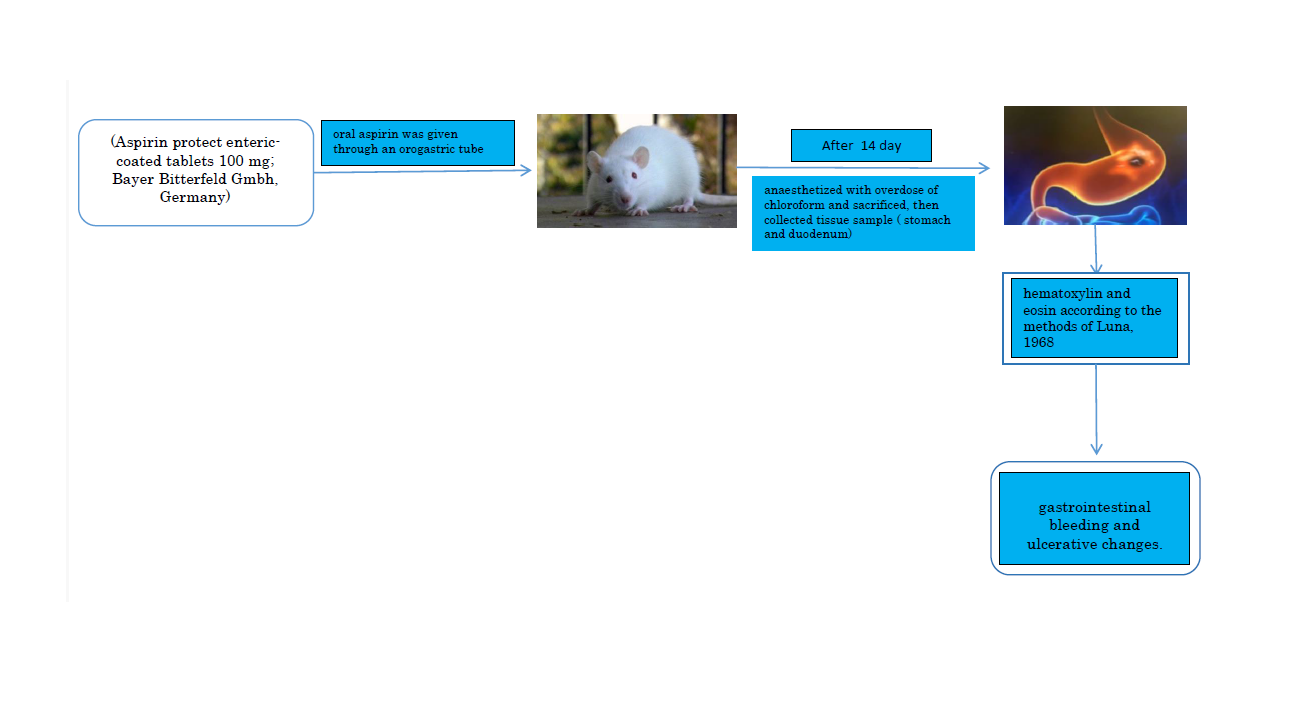
Aspirin is a widely used non-steroidal anti-inflammatory drug with analgesic, antipyretic, and antiplatelet properties. Despite its mounted healing blessings, repeated exposure may additionally impair gastrointestinal mucosal integrity and increase the threat of gastric and intestinal damage. The present study aims to investigate the histopathological results of repeated oral administration of aspirin on the stomach and duodenum of twelve adult male of albino rats. The control group acquired no aspirin, while the treatment group acquired aspirin at a dose of 13.2 mg/kg/day by way of orogastric gavage for 14 consecutive days. After experiments, animals were euthanized underneath anesthesia, and stomach and duodenal tissues were amassed, fixed in 10% neutral buffered formalin,and stained with hematoxylin and eosin. Histopathological changes had been evaluated in both organs using lesion scoring. At baseline, there was no significant difference in body weight between control and aspirin-treated groups (221.6 ± 13.29, 225.0 ± 12.24 g, respectively; P= 0.66). After 14 days, the control group showed an increase in body weight to 233.3 ± 15.05 g, whereas Aspirin-treated group showed a decrease to 215.8 ± 9.70 g, with a significant differences (P = 0.03) between the groups. The histopathological examination of these animals revealed gastric epithelial degeneration, mucosal abrasion and ulcerative/wound repair changes, inflammatory cell infiltration, vasoconstriction, and hemorrhagic changes. In the duodenum, epithelial degeneration, villous damage, inflammatory cell infiltration, edema, and congestive and hemorrhagic changes were observed. Overall, lesion severity was greater in the aspirin-treated animals than in the control animals across the histopathological parameters evaluated. Repeated oral administration of aspirin up to 13.2 mg/kg/day for 14 days induced marked histopathological changes within the gastric and duodenal mucosa of adult male albino rats, accompanied by a reduction in body weight. The findings provide experimental evidence of gastrointestinal mucosal injury after repeated aspirin administration. Further studies using larger model sizes, two dose scores, quantitative morphometry, and molecular biomarkers to elucidate dose-response timelines and underlying mechanisms.
References
[1] Shahzad, N.; Ibrahim, I. A.; Alzahrani, A. R.; Al-Ghamdi, S. S.; Alanazi, I. M. M.; Ahmad, M. P.; Singh, A. K.; et al., ″A comprehensive review on phytochemicals as potential therapeutic agents for stress induced gastric ulcer″. J. Umm Al-Qura Univ. Appl. Sci., 10: 793–808, 2024.
[2] Sayed, A.; Mahmoud, N.; Mohawed, O.; Ahmed, H., ″Combined effect of pantoprazole and mesenchymal stem cells on experimentally induced gastric ulcer: implication of oxidative stress, inflammation and apoptosis pathway″. Inflammopharmacology, 32(3): 1961–1982, 2024.
[3] Zatorski, H., ″Introduction to Gastrointestinal Diseases″. In Gastrointestinal Diseases; Fichna, J., Ed.; Springer Nature: Switzerland, Switzerland, 7–20, 2017.
[4] Jankowski, J. A.; de Caestecker, J.; Love, S. B.; Reilly, G.; Watson, P.; Sanders, S.; Ang, Y.; et al., ″Esomeprazole and aspirin in Barrett's oesophagus (AspECT): A randomised factorial trial″. Lancet, 392(10145): 400–408, 2018.
[5] Caroline, S.; Julie, C.; Jean-Pierre, G., ″Acetylsalicylic acid for primary prevention of cardiovascular diseases in older patients with diabetes: do the benefits overcome the risks?″. Ther. Adv. Drug Saf., 3(5): 213–226, 2012.
[6] Guirguis-Blake, J. M.; Evans, C. V.; Senger, C. A.; O'Connor, E. A.; Whitlock, E. P., ″Aspirin for the primary prevention of cardiovascular events: a systematic evidence review for the U.S. Preventive Services Task Force″. Ann. Intern. Med., 164(12): 804–813, 2016.
[7] Vane, J. R.; Botting, R. M., ″The mechanism of action of aspirin″. Thromb. Res., 110(5–6): 255–258, 2003.
[8] Suvarna, S. K.; Layton, C.; Bancroft, J. D., ″Bancroft's Theory and Practice of Histological Techniques″. 7th ed.; Elsevier: London, United Kingdom, 2013.
[9] Olayemi, K. O.; Omamuyovwi, M. I.; Adeshina, J. A., ″Histomorphometric study of stomach and duodenum of aspirin treated Wistar rats″. J. Exp. Clin. Anat., 13(1): 12–16, 2014.
[10] Mukaddes, E.; Elif, T.; Aslı, C., ″Development of the Esophagus and Stomach″. Bezmialem Sci., 5: 175–182, 2017.
[11] Călămar, C. D.; Pătruică, S.; Dumitrescu, G.; Bura, M.; Dunea, I. B.; Nicula, M., ″Morphohistological study of the digestive tract and the annex glands of chinchilla laniger″. Sci. Pap. Anim. Sci. Biotechnol., 47(1): 269–274, 2014.
[12] Junqueira, L. C.; Carneiro, J.; Kelley, R., ″Basic Histology″. 9th ed.; Appleton & Lange: Stamford, Connecticut, USA, 1995.
[13] Gartner, L. P.; Hiatt, J. L., ″Color Atlas of Histology″. 3rd ed.; Lippincott Williams & Wilkins: Philadelphia, PA, USA, 2000.
[14] Mohammed, S. S.; Naim, M. M.; Abdel Gawad, S. K.; Mahmoud, S. H., ″Possible Protective Effect of Nigella Sativa Oil Against Piroxicam-Induced Gastric Mucosal Damage in Adult Male Albino Rats Light and Scanning Electron Microscopic Study″. Egypt. J. Histol., 33(1): 127–139, 2010.
[15] Saeed, M. G.; Al-Hamdany, E. K.; Ismail, H. Kh., ″Pathological and histomorphometric study of comparative gastric ulcer induced by indomethacin, aspirin, and ethanol in rats″. Iraqi J. Vet. Sci., 37(2): 339–346, 2023.
[16] Ittiyavirah, S. P.; Paul, A. S., ″Gastroprotective effect of plumbagin and ethanolic extract of plumbaginales in experimentally-induced ulcer″. J. Herb. Med. Pharmacol., 5(3): 92–98, 2016.
[17] Akpamu, U.; Owoyele, V. B.; Ozor, M.; Osifo, U. C., ″Indomethacin-induced gastric ulcer Model in female wistar rats″. Int. J. Basic Appl. Innov. Res., 2(4): 78–84, 2013.
[18] Ng, C. J.; Chen, J. C.; Chiu, D. F.; Chen, M. F.; Chen, H. M., ″Role of prostacyclin on microcirculation in endotoxin-induced gastroprotection in rats: A Microdialysis study″. Shock, 17(4): 334–338, 2002.
[19] Seleem, H. S.; Ghobashy, H. A.; Zolfakar, A. S., ″Effect of Aspirin versus Aspirin and Vitamin C on Gastric Mucosa (Fundus) of Adult Male Albino Rats: Histological and Morphometric Study″. Egypt. J. Histol., 33(2): 313–326, 2010.
[20] Wallace, J. L., ″Pathogenesis of NSAID-induced gastro duodenal mucosal injury″. Best Pract. Res. Clin. Gastroenterol., 15(5): 691–703, 2001.
[21] AlRashdi, A. S.; Salama, S. M.; Alkiyumi, S. S.; Abdulla, M. A.; Hadi, A. H. A.; Abdelwahab, S. I.; Taha, M. M.; et al., ″Mechanisms of gastroprotective effects of ethanolic leaf extract of Jasminum sambac against HCl/ethanol-induced gastric mucosal injury in rats″. Evid.-Based Complement. Alternat. Med., 2012: 786426, 2012.
[22] Almasaudi, S. B.; Abbas, A. T.; Al-Hindi, R. R.; El-Shitany, N. A.; Abdel-Dayem, U. A.; Ali, S. S.; Saleh, R. M.; et al., ″Manuka honey exerts antioxidant and anti-inflammatory activities that promote healing of acetic acid-induced gastric ulcer in rats″. Evid.-Based Complement. Alternat. Med., 2017: 5413917, 2017.
[23] Kokura, S.; Wolf, R. E.; Yoshikawa, T.; Granger, D. N.; Aw, T. Y., ″T-Lymphocyte–Derived Tumor Necrosis Factor Exacerbates Anoxia-Reoxygenation–Induced Neutrophil–Endothelial Cell Adhesion″. Circ. Res., 86(2): 205–213, 2000.
[24] Levison, D. A.; Reid, R.; Burt, A. D.; Harrison, D. J.; Fleming, S., Eds.; ″Muir's Textbook of Pathology″. 14th ed.; Hodder Arnold: London, United Kingdom, 2008.
[25] Mohan, H., ″Textbook of Pathology″. 7th ed.; Jaypee Brothers Medical Publishers: New Delhi, India, 2015.
[26] Yehia, N. M.; Abdel Salam, N. F.; Saleh, H. A.; Bayomi, N. S., ″Effect of α-lipoic acid on fundic gastric mucosal damage induced by acetyl salicylic acid: a histological study″. Egypt. J. Histol., 37(2): 280–291, 2014.
[27] Leung, A. M.; Redlak, M. J.; Miller, T. A., ″Aspirin-induced mucosal cell death in human gastric cells: role of a caspase-independent mechanism″. Dig. Dis. Sci., 54: 28–35, 2009.
[28] Mescher, A. L., ″Junqueira's Basic Histology: Text and Atlas″. 17th ed.; McGraw-Hill: New York, USA, 2023.
[29] Garcia Rodriguez, L. A.; Lanas, A.; Soriano-Gabarro, M.; Cea Soriano, L., ″Low-Dose Aspirin and Risk of Upper/Lower Gastrointestinal Bleeding by Bleed Severity: A Cohort Study with Nested Case-Control Analysis Using Primary Care Electronic Health Records from the United Kingdom″. Ann. Med., 51(2): 182–192, 2019.
[30] Goldstein, J.; Silberstein, S. D.; Saper, J. R., ″Acetaminophen, aspirin, and caffeine in combination versus ibuprofen for acute migraine: Results from a multicenter, double blind, randomized, parallel group, single dose, placebo controlled study″. Headache, 46(3): 444–453, 2006.
[31] Macdonald, S., ″Aspirin use to be banned in under 16 year olds″. BMJ, 325(7371): 988, 2002.
[32] Tanideh, N.; Masoumi, S.; Hosseinzadeh, M.; Safarpour, A. R.; Erjaee, H.; Koohi-Hosseinabadi, O.; Rahimikazerooni, S., ″Healing effect of Pistacia atlantica fruit oil extract in acetic acid-induced colitis in rats″. Iran. J. Med. Sci., 39(6): 522–528, 2014.
[33] Brzozowski, T.; Konturek, P. C.; Konturek, S. J.; Sliwowski, Z.; Pajdo, R.; Drozdowicz, D.; Ptak, A.; et al., ″Classic NSAID and selective cyclooxygenase (COX)-1 and COX-2 inhibitors in healing of chronic gastric ulcers″. Microsc. Res. Tech., 53(5): 343–353, 2001.
[34] Mahmoud, Y. I.; Abd El-Ghffar, E. A., ″Spirulina ameliorates aspirin-induced gastric ulcer in albino mice by alleviating oxidative stress and inflammation″. Biomed. Pharmacother, 109: 314–321, 2019.
Downloads
Published
Issue
Section
License
Copyright (c) 2026 Mohammed K. Hassani

This work is licensed under a Creative Commons Attribution 4.0 International License.

.jpg)