Association between Serum Procollagen Type I N-Terminal Propeptide and Bone Metabolism Markers in Iraqi Patients with Acromegaly: A Cross-Sectional Study
DOI:
https://doi.org/10.22401/anjs.29.3.3656Keywords:
Procollagen type 1, 1N terminal propeptide, Vitamin D3, Bone turnover rate, Calcium, Phosphorus, AcromegalyAbstract
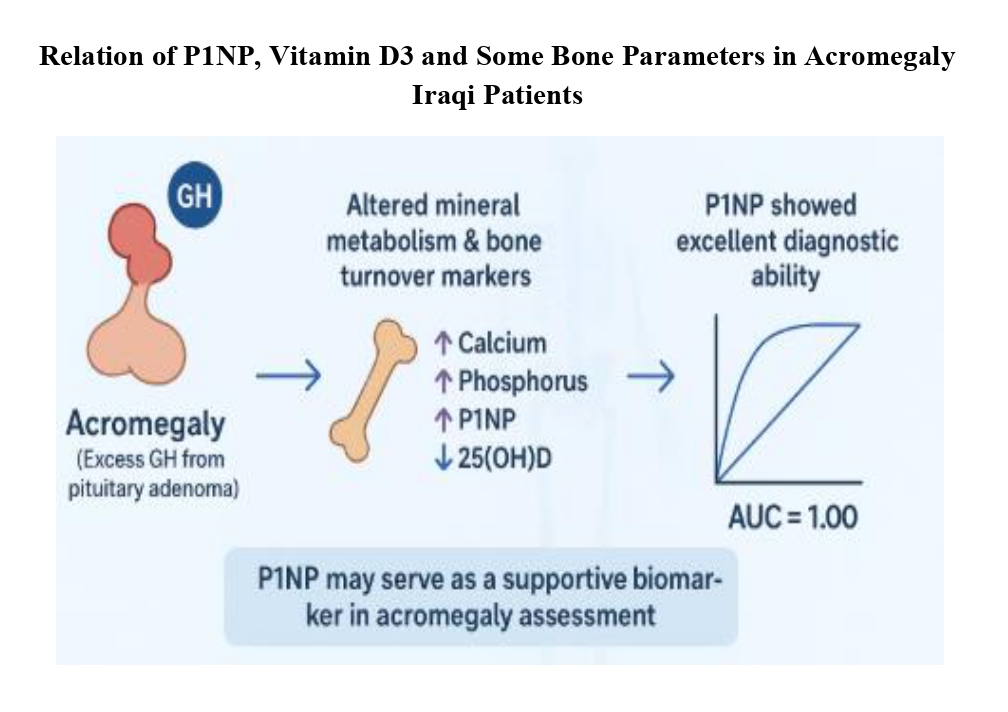
Background: Acromegaly is caused by excess secretion of growth hormone (GH) due to a benign pituitary adenoma, which significantly disrupts mineral metabolism and bone turnover. Aims of the study : To compare the serum levels of calcium, phosphorus, 25(OH)D3, and P1NP in patients with acromegaly to those of healthy controls; investigate relationships between P1NP and important metabolic indicators; and use ROC curve analysis to assess P1NP's diagnostic value. Methods: This study is a cross-sectional study, where 60 patients with acromegaly (mean age 46.66 ± 6.75) and 30 age-sex matched healthy controls (mean age 45.10 ± 5.98) were enrolled. The levels of glucose, insulin like growth factor 1 (IGF-1), GH, calcium, phosphorus, 25(OH) D₃, and P1NP were evaluated in the serum. Results: The patients with acromegaly demonstrated significantly higher levels of calcium, phosphorus and P1NP and significantly lower levels of 25(OH)D3 compared with controls. The bone formation (as measured by P1NP) correlated negatively with age (r = –0.26, p < 0.05), indicating that bone formation decreases with age even in the presence of excess GH/IGF-1. The independent variables, phosphate levels, and disease duration were inversely correlated, with a correlation coefficient of –0.29 (p < 0.05), and calcium was positively correlated with the independent variable of phosphate levels, with a correlation coefficient of 0.38 (p = 0.01).ROC analysis of P1NP yielded an AUC of 1.00, indicating strong discriminative ability in this cohort. Conclusion: Changes in bone turnover markers, particularly P1NP, may offer valuable insights into skeletal alterations in acromegaly. While the findings support the potential diagnostic value of P1NP, the cross-sectional design limits causal interpretation. Larger prospective studies are needed to validate these preliminary results and clarify the longitudinal utility of P1NP in clinical practice.
References
[1] Turki, T.G.; Hashim, N.M. "Association between a High Level of Growth Hormone–Releasing Hormone (GHRH) and GHRH Genetic Polymorphism (rs566092278) with Acromegaly Cases". Med J Babylon, 22(2): 400–405, 2025.
[2] Iglesias, P. "Acromegaly and Cardiovascular Disease: Associated Cardiovascular Risk Factors, Cardiovascular Prognosis, and Therapeutic Impact". J Clin Med, 14(6): 1906, 2025.
[3] Fleseriu, M.; Biller, B.M.K.; Freda, P.U.; Gadelha, M.R.; Giustina, A.; Katznelson, L.; Molitch, M.E.; Samson, S.L.; Strasburger, C.J.; van der Lely, A.J.; Melmed, S. "A Pituitary Society update to acromegaly management guidelines". Pituitary, 24(1): 1–13, 2021.
[4] Sorohan, M.C.; Baciu, I.F.; Galoiu, S.A.; Niculescu, D.A.; Caragheorgheopol, A.; Iordachescu, C.N.; Poiana, C. "Acromegaly Versus Hypogonadism: Bone Fragility and Evaluation". Ann Endocrinol (Paris), 84(6): 719–726, 2023.
[5] Malek, F.K.; Abbas, S.A.; Abed, B.A. "Measurement of Arginase Activity in Sera of Iraqi Acromegaly Patients with Diabetes". Al-Mustansiriyah J Sci, 35(1): 44–49, 2024.
[6] Chiloiro, S.; Giampietro, A.; Gagliardi, I.; Bondanelli, M.; Veleno, M.; Ambrosio, M.R.; Zatelli, M.C.; et al. "Impact of the Diagnostic Delay of Acromegaly on Bone Health: Data from a Real Life and Long Term Follow-up Experience". Pituitary, 25(6): 831–841, 2022.
[7] Melmed, S. "Acromegaly pathogenesis and treatment". J Clin Invest, 119(11): 3189–3202, 2009.
[8] Chen, H.; Huang, H.; Wang, Y.; Zhang, Y.; Liu, M.; Lou, Y.; Zhang, Z.; et al. "Decreased Serum Wnt Antagonist Levels in Patients with Active Acromegaly". Endocr Pract, 28(5): 515–520, 2022.
[9] Mazziotti, G.; Frara, S.; Giustina, A. "Pituitary Diseases and Bone". Endocr Rev, 39(4): 440–488, 2018.
[10] Kim, T.Y.; Shoback, D.M.; Black, D.M.; Rogers, S.J.; Stewart, L.; Carter, J.T.; Posselt, A.M.; et al. "Increases in PYY and Uncoupling of Bone Turnover are Associated with Loss of Bone Mass After Gastric Bypass Surgery". Bone, 131: 115115, 2020.
[11] Piskinpasa, M.E.; Piskinpasa, H. "Bone Biochemical Markers in Acromegaly: An Association with Disease Activity and Gonadal Status". North Clin Istanbul, 9(1): 74–81, 2022.
[12] Sawicka-Gutaj, N.; Derwich-Rudowicz, A.; Biczysko, A.; Turchyn, S.; Ziółkowska, P.; Ziemnicka, K.; Gut, P.; et al. "Serum Phosphorus and Calcium as Biomarkers of Disease Status in Acromegaly". Biomedicines, 11(12): 3278, 2023.
[13] Nuti, R.; Brandi, M.L.; Checchia, G.; Di Munno, O.; Dominguez, L.; Falaschi, P.; Fiore, C.E.; et al. "Guidelines for the Management of Osteoporosis and Fragility Fractures". Intern Emerg Med, 14(1): 85–102, 2019.
[14] Cherian, K.E.; Kapoor, N.; Meeta, M.; Paul, T.V. "Dual-energy X-ray Absorptiometry Scanning in Practice, Technical Aspects, and Precision Testing". J Midlife Health, 12(4): 252–256, 2021.
[15] Di Medio, L.; Brandi, M.L.; "Advances in Bone Turnover Markers". In Advances in Clinical Chemistry, 1st ed.; Makowski, G.S., Ed.; Elsevier: Cambridge, MA, USA, pp. 101–140, 2021.
[16] Voulgaridou, G.; Papadopoulou, S.K.; Detopoulou, P.; Tsoumana, D.; Giagini, C.; Kondyli, F.S.; Lymperaki, E.; et al. "Vitamin D and Calcium in Osteoporosis, and the Role of Bone Turnover Markers: A Narrative Review of Recent Data from RCTs". Diseases, 11(1): 29, 2023.
[17] Szulc, P.; Bauer, D.C.; Eastell, R. "Biochemical Markers of Bone Turnover in Osteoporosis". In: Marcus and Feldman's Osteoporosis, 5th ed.; Dempster, D.W.; Cauley, J.A.; Bouxsein, M.L.; Cosman, F., Eds.; Elsevier: 1545–1588, 2021.
[18] Lorentzon, M.; Branco, J.; Brandi, M.L.; Bruyere, O.; Chapurlat, R.; Cooper, C.; Cortet, B.; et al. "Algorithm for the Use of Biochemical Markers of Bone Turnover in the Diagnosis, Assessment and Follow-up of Treatment for Osteoporosis". Adv Ther, 36(10): 2811–2824, 2019.
[19] Bellissimo, M.P.; Roberts, J.L.; Jones, D.P.; Liu, K.H.; Taibl, K.R.; Uppal, K.; Weitzmann, M.N.; et al. "Metabolomic Associations with Serum Bone Turnover Markers". Nutrients, 12(10): 3161, 2020.
[20] Kwak, S. "Are Only p-Values Less Than 0.05 Significant? A p-Value Greater Than 0.05 Is Also Significant!". J Lipid Atheroscler, 12(2): 89–95, 2023.
[21] Giustina, A. "Acromegaly and Bone: An Update". Endocrinol Metab (Seoul), 38(6): 655–666, 2023.
[22] Ozer, F.F.; Dagdelen, S.; Erbas, T. "Relation of RANKL and OPG Levels with Bone Resorption in Patients with Acromegaly and Prolactinoma". Horm Metab Res, 50(7): 562–567, 2018.
[23] Constantin, T.; Tangpricha, V.; Shah, R.; Oyesiku, N.M.; Ioachimescu, O.C.; Ritchie, J.; Ioachimescu, A.G. "Calcium and Bone Turnover Markers in Acromegaly: A Prospective, Controlled Study". J Clin Endocrinol Metab, 102(7): 2416–2424, 2017.
[24] Takada, J.; Dinavahi, R.; Miyauchi, A.; Hamaya, E.; Hirama, T.; Libanati, C.; Nakamura, Y.; et al. "Relationship Between P1NP, a Biochemical Marker of Bone Turnover, and Bone Mineral Density in Patients Transitioned From Alendronate to Romosozumab or Teriparatide: A Post Hoc Analysis of the STRUCTURE Trial". J Bone Miner Metab, 38(3): 310–315, 2020.
[25] Shi, S.; Zhang, L.; Yu, Y.; Wang, C.; Li, J. "Acromegaly and Non-parathyroid Hormone-dependent Hypercalcemia: A Case Report and Literature Review". BMC Endocr Disord, 21(1): 90, 2021.
[26] Abdullah, A.H.; Mohaisn, I.K.; Nsaif, A.S.; Safaryan, A. "Studying the Impact of Vitamin D Deficiency in Iraqi Acromegalic Patients and its Relation with Some Biochemical Parameters". Ann Trop Med Public Health, 23(11): 231131, 2020.
[27] Halupczok-Żyła, J.; Jawiarczyk-Przybyłowska, A.; Bolanowski, M. "Patients with Active Acromegaly are at High Risk of 25(OH)D Deficiency". Frontiers in Endocrinology (Lausanne), 6: 89, 2015.
[28] Kamenický, P.; Mazziotti, G.; Lombès, M.; Giustina, A.; Chanson, P. "Growth hormone, insulin-like growth factor-1, and the kidney: pathophysiological and clinical implications". Endocr Rev, 35(2): 234-81, 2014.
[29] Bikle, D.D.; Schwartz, J. "Vitamin D Binding Protein, Total and Free Vitamin D Levels in Different Physiological and Pathophysiological Conditions". Front Endocrinol (Lausanne), 10: 317, 2019.
[30] Voulgaridou, G.; Papadopoulou, S.K.; Detopoulou, P.; Tsoumana, D.; Giaginis, C.; Kondyli, F.S.; Lymperaki, E.; et al. "Vitamin D and Calcium in Osteoporosis, and the Role of Bone Turnover Markers: A Narrative Review of Recent Data from RCTs". Diseases, 11(1): 29, 2023.
[31] Chubb, S.P.; Byrnes, E.; Manning, L.; Beilby, J.P.; Ebeling, P.R.; Vasikaran, S.D.; Golledge, J.; et al. "Reference Intervals for Bone Turnover Markers and their Association with Incident Hip Fractures in Older Men: The Health in Men Study". J Clin Endocrinol Metab, 100(1): 90–99, 2015.
[32] Shao, J.; Zhou, S.S.; Qu, Y.; Liang, B.B.; Yu, Q.H.; Wu, J. "Correlation Between Bone Turnover and Metabolic Markers with Age and Gender: A Cross-sectional Study of Hospital Information System Data".BMC Musculoskelet Disord,21: 603, 2020.
[33] Shaker, J.; Deftos, L. "Calcium and Phosphate Homeostasis". Endotext [Internet], 2023.
[34] Vasikaran, S.; Thambiah, S.C.; Tan, R.Z.; Loh, T.P. "The Use of Bone-Turnover Markers in Asia-Pacific Populations". Ann Lab Med, 44(2): 126–134, 2024.
Downloads
Published
Issue
Section
License
Copyright (c) 2026 Najlaa Q. Muftin

This work is licensed under a Creative Commons Attribution 4.0 International License.

.jpg)