Advancing Prediction of Antimicrobial Resistance Using Decision Tree-Based Machine Learning Approaches: A Systematic Review
DOI:
https://doi.org/10.22401/anjs.29.3.3476Keywords:
Antimicrobial resistance, Decision trees, Explainable AI, Gradient Boosted Decision, Trees, Machine learning, Random Forest, XGBoostAbstract
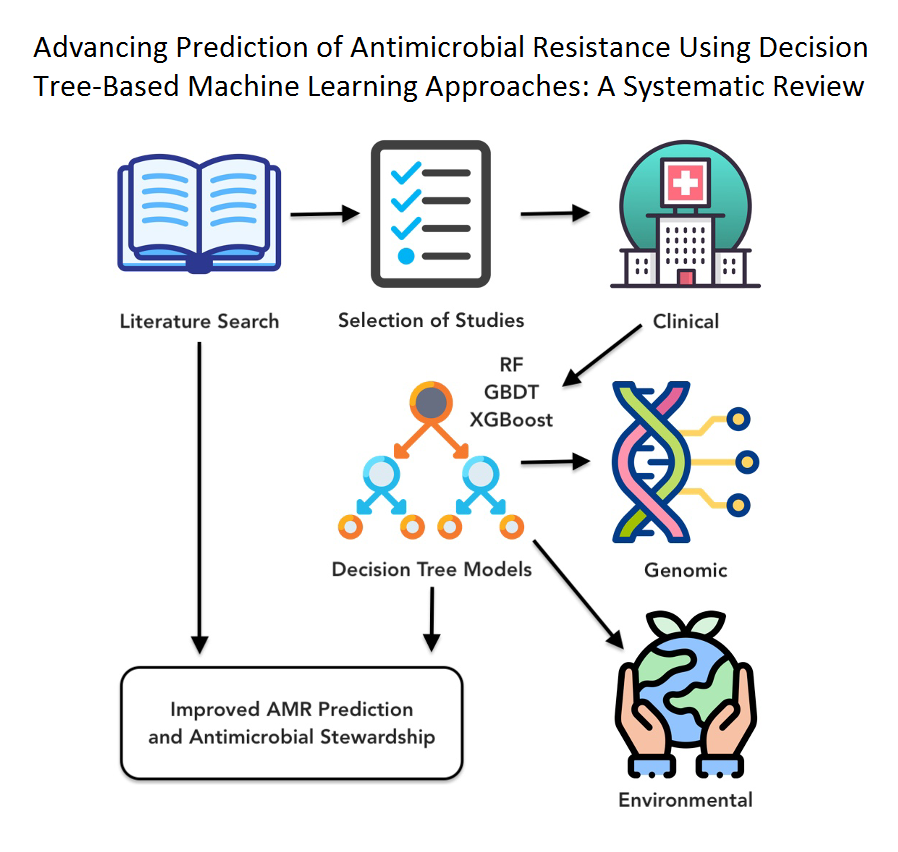
Antimicrobial resistance is a growing global health threat, since it limits the effectiveness of traditional medicines and adds to the burden on health care systems and economies across the globe. Several techniques have been developed for modelling the patterns of data in a range of data sources (e.g. Random Forest, Gradient Boosted Decision Trees and eXtreme Gradient Boosting). The research is reported in accordance with the PRISMA guidelines and systematically reviews the data extracted from seventeen peer-reviewed articles published between 2019 and 2023 and identified using comprehensive searches of the PubMed, Scopus, IEEE Xplore, ProQuest, ASME, and Cochrane Library databases. The studies included in this overview described clinical, genomic and environmental contexts and reported consistent outperformance of classical statistical models by ensembles of decision trees with predictive accuracies and AUROC values often exceeding 0.90, especially in high-dimensional genomic data sets and intensive care unit settings. Further supporting the chances for clinical adoption, SHapley Additive Explanations, a framework for model interpretability, provided more transparency into predictions outputs beyond correctness. The results of the study provide evidence of the effectiveness of decision tree methods to inform targeted antimicrobial stewardship efforts, to optimize empiric treatment, and to support early intervention programs. These models connect computational accuracy with clinical utility, providing a scalable and flexible approach to relieve the burden of antibiotic resistance in high or low resource settings.
References
[1] Ferraz, M.P.; "Antimicrobial Resistance: The Impact from and on Society According to One Health Approach". Societies, 14 (9): 187, 2024.
[2] Giri, P.; Aikat, A.; "The Impending Global Challenge of Antimicrobial Resistance: A Call for Urgent Action". Indian J. Comm. Health, 36 (5): 624–628, 2024.
[3] Uddin, T.M.; Chakraborty, A.J.; Khusro, A.; Zidan, B.R.M.; Mitra, S.; Emran, T. B.; Dhama, K.; et al.; "Antibiotic resistance in microbes: History, mechanisms, therapeutic strategies and future prospects". J. Infect. Public Health, 14 (12): 1750–1766, 2021.
[4] Naghavi, M.; Vollset, S.E.; Ikuta, K.S.; Swetschinski, L.R.; Gray, A.P.; Wool, E.E.; Aguilar, G.R.; et al.; "Global burden of bacterial antimicrobial resistance 1990–2021: a systematic analysis with forecasts to 2050". Lancet, 404 (10459): 1199–1226, 2024.
[5] Morel, C.M.; de Kraker, M.E.A.; Harbarth, S.; "Surveillance of Resistance to New Antibiotics in an Era of Limited Treatment Options". Front. Med. (Lausanne)., 8: 652638, 2021.
[6] Zai, M.J.; Cheesman, M.J.; Cock, I.E.; "Targeted Antimicrobial Therapies: A Solution to Overcoming Antimicrobial Resistance in Humans". BioMed, 4 (3): 318–337, 2024.
[7] Ahmed, S.K.; Hussein, S.; Qurbani, K.; Ibrahim, R.H.; Fareeq, A.; Mahmood, K.A.; Mohamed, M.G.; "Antimicrobial resistance: Impacts, challenges, and future prospects". J. Med. Surg. Public Health, 2: 100081, 2024.
[8] Khadse, S.N.; Ugemuge, S.; Singh, C.; "Impact of Antimicrobial Stewardship on Reducing Antimicrobial Resistance". Cureus, 15 (12): e49935, 2023.
[9] Tang, K.W.K.; Millar, B.C.; Moore, J.E.; "Antimicrobial Resistance (AMR)". Br. J. Biomed. Sci., 80: 11387, 2023.
[10] Bobate, S.; Mahalle, S.; Dafale, N.A.; Bajaj, A.; "Emergence of environmental antibiotic resistance: Mechanism, monitoring and management". Environ. Adv., 13: 100409, 2023.
[11] Fletcher, S.; "Understanding the contribution of environmental factors in the spread of antimicrobial resistance". Environ. Health Prev. Med., 20 (4): 243, 2015.
[12] Ankolekar, A.; Eppings, L.; Bottari, F.; Pinho, I.F.; Howard, K.; Baker, R.; Nan, Y.; et al.; "Using artificial intelligence and predictive modelling to enable learning healthcare systems (LHS) for pandemic preparedness". Comput. Struct. Biotechnol. J., 24: 412–419, 2024.
[13] Dixon, D.; Sattar, H.; Moros, N.; Kesireddy, S. R.; Ahsan, H.; Lakkimsetti, M.; Fatima, M.; et al.; "Unveiling the Influence of AI Predictive Analytics on Patient Outcomes: A Comprehensive Narrative Review". Cureus, 16 (5): e59954, 2024.
[14] Olawade, D.B.; Wada, O.J.; David-Olawade, A.C.; Kunonga, E.; Abaire, O.; Ling, J.; "Using artificial intelligence to improve public health: a narrative review". Front. Public Health, 11: 1196397, 2023.
[15] Ghozali, M.T.; "Assessing ChatGPT’s accuracy and reliability in asthma general knowledge: implications for artificial intelligence use in public health education". J. Asthma, 62 (6): 975–983, 2025.
[16] Tian, Y.; Zhang, H.; Qiao, Y.; Yang, H.; Liu, Y.; Ji, X.; "Intelligent Prediction of Ionic Liquids and Deep Eutectic Solvents by Machine Learning". Chin. J. Chem. Eng., 84: 227–243, 2025.
[17] Kim, J.I.; Maguire, F.; Tsang, K.K.; Gouliouris, T.; Peacock, S.J.; McAllister, T.A.; McArthur, A.G.; et al.; "Machine Learning for Antimicrobial Resistance Prediction: Current Practice, Limitations, and Clinical Perspective". Clin. Microbiol. Rev., 35 (3): e00179-21, 2022.
[18] Sakagianni, A.; Koufopoulou, C.; Koufopoulos, P.; Kalantzi, S.; Theodorakis, N.; Nikolaou, M.; Paxinou, E.; et al.; "Data-Driven Approaches in Antimicrobial Resistance: Machine Learning Solutions". Antibiotics, 13 (11): 1052, 2024.
[19] Ho, C.S.; Wong, C.T.H.; Aung, T.T.; Lakshminarayanan, R.; Mehta, J.S.; Rauz, S.; McNally, A.; et al.; "Antimicrobial resistance: a concise update". Lancet Microbe, 6 (1): 100947, 2025.
[20] Farhat, F.; Athar, M.T.; Ahmad, S.; Madsen, D.Ø.; Sohail, S.S.; "Antimicrobial resistance and machine learning: past, present, and future". Front. Microbiol., 14: 1179312, 2023.
[21] Rusic, D.; Kumric, M.; Perisin, A.S.; Leskur, D.; Bukic, J.; Modun, D.; Vilovic, M.; et al.; "Tackling the Antimicrobial Resistance “Pandemic” with Machine Learning Tools: A Summary of Available Evidence". Microorganisms, 12 (5): 842, 2024.
[22] Prosperi, M.; Azarian, T.; Johnson, J.A.; Salemi, M.; Milicchio, F.; Oliva, M.; "Unexpected Predictors of Antibiotic Resistance in Housekeeping Genes of Staphylococcus Aureus". In: Proceedings of the 10th ACM International Conference on Bioinformatics, Computational Biology and Health Informatics (BCB '19), Niagara Falls, NY, United States, September 7–10, 2019; Shi, X.M.; Buck, M.; Ma, J.; Veltri, P.; Eds.; ACM: New York, NY, United States, 2019.
[23] Lee, H.G.; Seo, Y.; Kim, J.H.; Han, S.B.; Im, J.H.; Jung, C.Y.; Durey, A.; "Machine learning model for predicting ciprofloxacin resistance and presence of ESBL in patients with UTI in the ED". Sci. Rep., 13 (1): 3282, 2023.
[24] Ning, Q.; Wang, D.; Cheng, F.; Zhong, Y.; Ding, Q.; You, J.; "Predicting rifampicin resistance mutations in bacterial RNA polymerase subunit beta based on majority consensus". BMC Bioinform., 22 (1): 210, 2021.
[25] Quoc, V.T.; Ngoc, D.N.T.; Hoang, T.N.; Thi, H.V.; Duc, M.T.; Nguyet, T.D.P.; Van, T.N.; et al.; "Predicting Antibiotic Resistance in ICUs Patients by Applying Machine Learning in Vietnam". Infect. Drug Resist., 16: 5535–5546, 2023.
[26] Matsuzaki, T.; Kato, Y.; Mizoguchi, H.; Yamada, K.; "A machine learning model that emulates experts’ decision making in vancomycin initial dose planning". J. Pharmacol. Sci., 148 (4): 358–363, 2022.
[27] Zahra, Q.; Gul, J.; Shah, A.R.; Yasir, M.; Karim, A.M.; "Antibiotic resistance genes prevalence prediction and interpretation in beaches affected by urban wastewater discharge". One Health, 17: 100642, 2023.
[28] Liang, Q.; Zhao, Q.; Xu, X.; Zhou, Y.; Huang, M.; "Early prediction of carbapenem-resistant Gram-negative bacterial carriage in intensive care units using machine learning". J. Glob. Antimicrob. Resist., 29: 225–231, 2022.
[29] Jalali, F.M.; Chahkandi, B.; Gheibi, M.; Eftekhari, M.; Behzadian, K.; Campos, L.C.; "Developing a smart and clean technology for bioremediation of antibiotic contamination in arable lands". Sustain. Chem. Pharm., 33: 101127, 2023.
[30] Yasir, M.; Karim, A.M.; Malik, S.K.; Bajaffer, A.A.; Azhar, E.I.; "Application of Decision-Tree-Based Machine Learning Algorithms for Prediction of Antimicrobial Resistance". Antibiotics, 11 (11): 1593, 2022.
[31] Deelder, W.; Napier, G.; Campino, S.; Palla, L.; Phelan, J.; Clark, T.G.; "A modified decision tree approach to improve the prediction and mutation discovery for drug resistance in Mycobacterium tuberculosis". BMC Genomics, 23 (1): 46, 2022.
[32] Müller, S.J.; Meraba, R.L.; Dlamini, G.S.; Mapiye, D.S.; "First-line drug resistance profiling of Mycobacterium tuberculosis: a machine learning approach". In: AMIA Annual Symposium Proceedings, AMIA 2021 Annual Symposium, San Diego, CA, United States, October 30 – November 3, 2021; Petersen, C.; Dixon, B.E.; Lehmann, C.U.; Eds.; American Medical Informatics Association: Bethesda, MD, United States, 2022.
[33] Rich, S.N.; Jun, I.; Bian, J.; Boucher, C.; Cherabuddi, K.; Morris, J.G.; Prosperi, M.; "Development of a Prediction Model for Antibiotic-Resistant Urinary Tract Infections Using Integrated Electronic Health Records from Multiple Clinics in North-Central Florida". Infect. Dis. Ther., 11 (5): 1869–1882, 2022.
[34] Akhter, S.; Miller, J.H.; "BPAGS: a web application for bacteriocin prediction via feature evaluation using alternating decision tree, genetic algorithm, and linear support vector classifier". Front. Bioinform., 3: 1284705, 2023.
[35] Goodman, K.E.; Simner, P.J.; Klein, E.Y.; Kazmi, A.Q.; Gadala, A.; Toerper, M.F.; Levin, S.; et al.; "Predicting probability of perirectal colonization with carbapenem-resistant Enterobacteriaceae (CRE) and other carbapenem-resistant organisms (CROs) at hospital unit admission". Infect. Control Hosp. Epidemiol., 40 (5): 541–550, 2019.
[36] Salgueiro, H.S.; Ferreira, A.C.; Duarte, A.S.R.; Botelho, A.; "Source Attribution of Antibiotic Resistance Genes in Estuarine Aquaculture: A Machine Learning Approach". Antibiotics, 13 (1): 107, 2024.
[37] Noman, S.M.; Zeeshan, M.; Arshad, J.; Amentie, M.D.; Shafiq, M.; Yuan, Y.; Zeng, M.; et al.; "Machine Learning Techniques for Antimicrobial Resistance Prediction of Pseudomonas Aeruginosa from Whole Genome Sequence Data". Comput. Intell. Neurosci., 2023 (1): 5236168, 2023.
[38] Wu, Y.; Jiang, P.; Goh, S.G.; Yu, K.; Chen, Y.; He, Y.; Gin, K.Y.H.; "Predicting Relative Risk of Antimicrobial Resistance using Machine Learning Methods". IFAC-PapersOnLine, 55 (10): 1266–1271, 2022.
[39] Salih, A.M.; Raisi-Estabragh, Z.; Galazzo, I.B.; Radeva, P.; Petersen, S.E.; Lekadir, K.; Menegaz, G.; "A Perspective on Explainable Artificial Intelligence Methods: SHAP and LIME". Adv. Intell. Syst., 7 (1): 2400304, 2025.
[40] Pang, K.; "A comparative study of explainable machine learning models with Shapley values for diabetes prediction". Healthc. Anal., 7: 100390, 2025.
Downloads
Published
Issue
Section
License
Copyright (c) 2026 Anita Agustina Styawan, Muhammad Thesa Ghozali

This work is licensed under a Creative Commons Attribution 4.0 International License.

.jpg)