Proposing a Hybrid Model to Enhance the Prediction of Arabic Fake News: A Comparative Analysis
DOI:
https://doi.org/10.22401/ANJS.29.2.10Keywords:
Fake news detection , Arabic language , Deep learning , CNN , BiLSTM , GRU , AraBERTAbstract
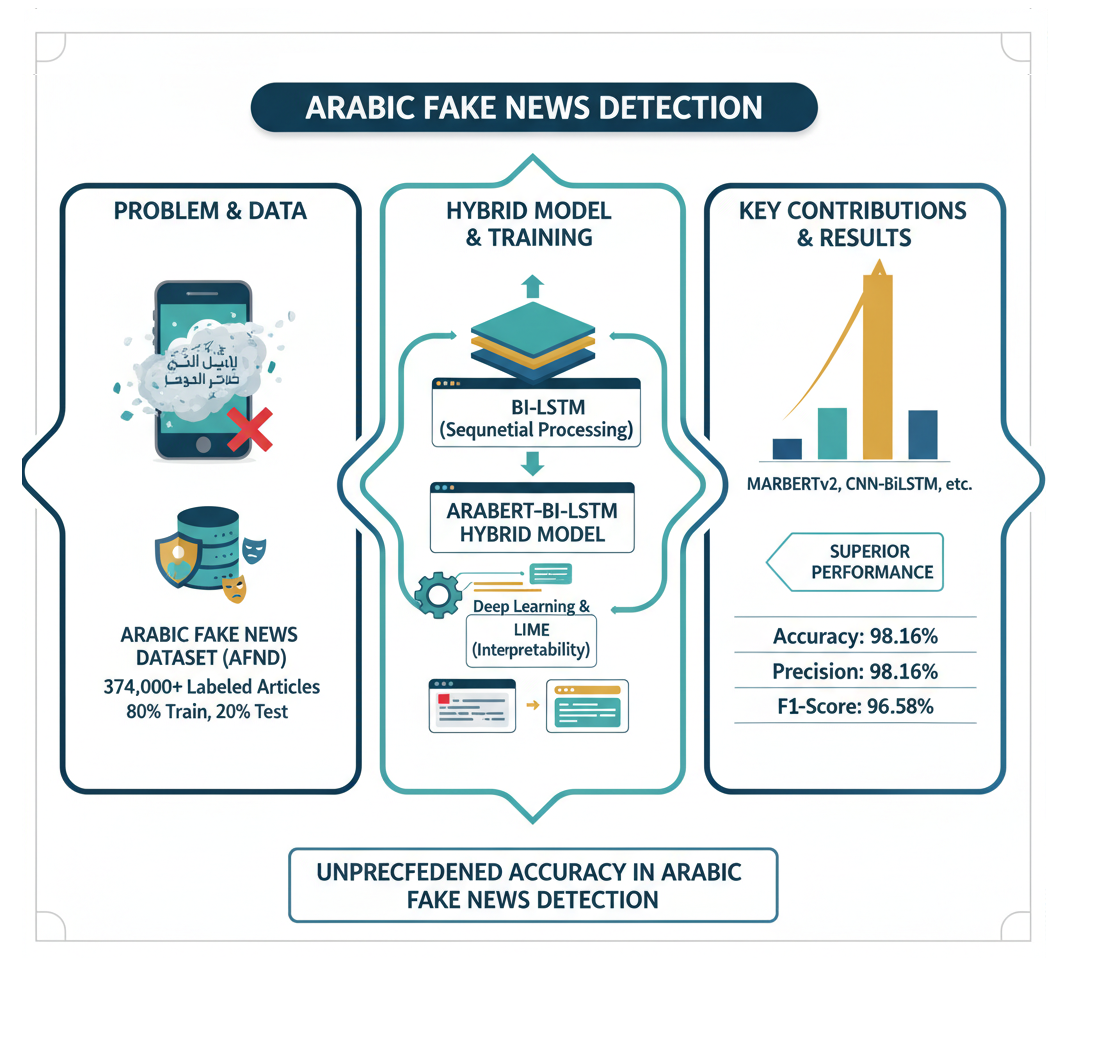
The spread of fake news within social media networks in recent years is seen as a troublesome element in the flow of public information. Malicious actors, such as some media professionals, use fabricated stories to influence vulnerable social groups. In this paper, a hybrid model is proposed to identify disinformation in Arabic language material. A pre-training algorithmic framework for detection and categorization of fake news is developed using deep learning approaches based on the Arabic Fake News Dataset (AFND) with approximately 374,000 labeled articles (80% training and 20% testing). The proposed model was compared with baseline architectures, such as CNN-BiLSTM, CNN-BiGRU, standalone recurrent networks, and pretrained language models, such as AraBERT, MARBERTv2, and AraELECTRA. The results show that the hybrid AraBERT-BiLSTM model outperforms all baseline architectures with 98.16%, 98.16%, 98.16%, and 96.58% accuracy, precision, recall, and F1-score, respectively. This is because AraBERT offers rich contextual embeddings that extract the deep semantic and syntactic nuances of Arabic text. Additionally, the model interpretability was improved by using Local Interpretable Model-agnostic Explanations (LIME) to identify the important linguistic features driving predictions.
References
[1] Kumar, S.; Singh, T.D.; "Fake News Detection on Hindi News Dataset". Glob. Transit. Proc., 3(1): 289–297, 2022. https://doi.org/10.1016/j.gltp.2022.03.014.
[2] Obayes, H.K.; Alhussayni, K.H.; Hussain, S.M.; "Predicting COVID-19 Vaccinators Based on Machine Learning and Sentiment Analysis". Bull. Electr. Eng. Inform., 12(3): 1648–1656, 2023.
https://doi.org/10.11591/eei.v12i3.4278.
[3] Pierri, F.; Ceri, S.; "False News on Social Media: A Data-Driven Survey". SIGMOD Rec., 48(2): 18–27, 2019. https://doi.org/10.1145/3377330.3377334.
[4] Nassif, A.B.; Elnagar, A.; Elgendy, O.; Afadar, Y.; "Arabic Fake News Detection Based on Deep Contextualized Embedding Models". Neural Comput. Appl., 34(18): 16019–16032, 2022. https://doi.org/10.1007/s00521-022-07206-4.
[5] Alruily, M.; "Classification of Arabic Tweets: A Review". Electronics, 10(10): 1143, 2021.
https://doi.org/10.3390/electronics10101143.
[6] Albtoush, E.S.; Gan, K.H.; Alrababa, S.A.; "Fake News Detection: State-of-the-Art Review and Advances with Attention to Arabic Language Aspects". PeerJ Comput. Sci., 11: e2693, 2025. https://doi.org/10.7717/peerj-cs.2693.
[7] Abbas, M.A.; Abd, D.H.; Frikha, M.; Alimi, A.M.; "Arabic Fake News Detection Techniques: A Review". J. Intell. Syst. Internet Things, 18(1): 150–168, 2026.
[8] Hamadouche, K.; Bousmaha, K.Z.; Amar, M.Y.B.; Hadrich, B.L.; "Detection of Arabic and Algerian Fake News". Appl. Comput. Syst., 29(2): 14–21, 2024. https://doi.org/10.2478/ACSS-2024-0017.
[9] Alnabrisi, I.; Saad, M.; "Detect Arabic Fake News Through Deep Learning Models and Transformers". Expert Syst. Appl., 251: 123997, 2024. https://doi.org/10.1016/J.ESWA.2024.123997.
[10] Al-Yahya, M.; Al-Khalifa, H.; Al-Baity, H.; AlSaeed, D.; Essam, A.; "Arabic Fake News Detection: Comparative Study of Neural Networks and Transformer-Based Approaches". Complexity, 2021(1): 5516945, 2021. https://doi.org/10.1155/2021/5516945.
[11] Shehata, A.; Al-Suqri, M.N.; Elshaiekh, N.E.; Hamad, F.; Alhusaini, Y.N.; Mahfouz, A.; "ArabFake: A Multitask Deep Learning Framework for Arabic Fake News Detection, Categorization, and Risk Prediction". IEEE Access, 12: 191345–191360, 2024. https://doi.org/10.1109/ACCESS.2024.3518204.
[12] Wotaifi, T.A.; Dhannoon, B.N.; "Improving Prediction of Arabic Fake News Using Fuzzy Logic and Modified Random Forest Model". Karbala Int. J. Mod. Sci., 8(3): 477–485, 2022. https://doi.org/10.33640/2405-609X.3241.
[13] Almandouh, M.E.; Alrahmawy, M.F.; Eisa, M.; Elhoseny, M.; Tolba, A.S.; "Ensemble Based High Performance Deep Learning Models for Fake News Detection". Sci. Rep., 14(1): 26591, 2024.
https://doi.org/10.1038/S41598-024-76286-0.
[14] Othman, N.A.; Elzanfaly, D.S.; Elhawary, M.M.M.; "Arabic Fake News Detection Using Deep Learning". IEEE Access, 12: 122363–122376, 2024. https://doi.org/10.1109/ACCESS.2024.3451128.
[15] Matti R. S.; Yousif S. A.; "Leveraging Arabic BERT for High-Accuracy Fake News Detection". Iraqi J. Sci., 66(2): 751–764, 2025. https://doi.org/10.24996/ijs.2025.66.2.18
[16] Azzeh M.; Qusef, A.; Alabboushi, O.; "Arabic Fake News Detection in Social Media Context Using Word Embeddings and Pre-trained Transformers ". Arab. J. Sci. Eng. 50(2), 923–936, 2025.
https://doi.org/10.1007/s13369-024-08959-x.
[17] El-Mageed, S.M.; Aboutabl, A.E.; Mohamed, E.H.; "ArFakeDetect: A Deep Learning Approach for Detecting Fabricated Arabic Tweets on COVID-19 Vaccines". In: 2024 Intelligent Methods, Systems, and Applications (IMSA), Giza, Egypt, 13-14 July; Gomaa, W.; Ghoneimy, M.; El-Sersey, W.; IEEE: Piscataway, NJ, USA, 2024. https://doi.org/10.1109/IMSA61967.2024.10652806.
[18] Aboulola, O.I.; Umer, M.; "Novel Approach for Arabic Fake News Classification Using Embedding from Large Language Features with CNN-LSTM Ensemble Model and Explainable AI". Sci. Rep., 14: 30463, 2024. https://doi.org/10.1038/s41598-024-82111-5.
[19] Fares, A.; Chougui, R.Y.; Drif, A.; Giordano, S.; "An Ensemble Deep Learning Models Based on Metadata for Measuring Arabic Fake News Uncertainty". In: 2024 IEEE International Conference on Advanced Systems and Emergent Technologies (IC_ASET), Hammamet, Tunisia, 27-29 April; Ben Amor, A.; Bhar Elayeb, S.; Ghorbel, C.; Elloumi, S.; Nouri, K.; Naceur, M.S.; IEEE: Piscataway, NJ, USA, 2024.
[20] Rane, N.L.; Choudhary, S.P.; Rane, J.; " Ensemble Deep Learning and Machine Learning: Applications, Opportunities, Challenges, and Future Directions". Stud. Med. Heal. Sci, 5(2): 18–41, 2024. https://doi.org/10.48185/smhs.v1i2.1225.
[21] Antoun, W.; Baly, F.; Hajj, H.; "AraELECTRA: Pre-Training Text Discriminators for Arabic Language Understanding". In: Proceedings of the Sixth Arabic Natural Language Processing Workshop, Kyiv, Ukraine (Virtual), 21 April; Habash, N.; Bouamor, H.; Hajj, H.; Magdy, W.; Zaghouani, W.; Bougares, F.; Tomeh, N.; Ibrahim A.; Samia T.; Association for Computational Linguistics: Stroudsburg, PA, USA, 191–195, 2021.
[22] Turki, H.M.; Al Daoud, E.; Samara, G.; Alazaidah, R.; Qasem, M.H.; Aljaidi, M.; Abuowaida, S.; et al.; "Arabic Fake News Detection Using Hybrid Contextual Features". Int. J. Electr. Comput. Eng., 15(1): 836–845, 2025. https://doi.org/10.11591/ijece.v15i1.pp836-845.
[23] Kwaik, K.A.; Chatzikyriakidis, S.; Dobnik, S.; Saad, M.; Johansson, R.; "An Arabic Tweets Sentiment Analysis Dataset (ATSAD) Using Distant Supervision and Self Training". In: Proceedings of the 4th Workshop on Open-Source Arabic Corpora and Processing Tools, Marseille, France, May; Al-Khalifa, H.; Magdy, W.; Darwish, K.; Elsayed, T.; Mubarak, H.; Eds.; European Language Resource Association: Paris, France, 1–8, 2020.
[24] Antoun, W.; Baly, F.; Hajj, H.; "AraBERT: Transformer-Based Model for Arabic Language Understanding". In: Proceedings of the 4th Workshop on Open-Source Arabic Corpora and Processing Tools, Marseille, France, May; Al-Khalifa, H.; Magdy, W.; Darwish, K.; Elsayed, T.; Mubarak, H.; Eds.; European Language Resource Association: Paris, France, 9–15, 2020.
[25] Wu, T.W.; Zhang, H.; Peng, W.; Lü, F.; He, P.J.; "Applications of Convolutional Neural Networks for Intelligent Waste Identification and Recycling: A Review". Resour. Conserv. Recycl., 190: 106813, 2023. https://doi.org/10.1016/j.resconrec.2022.106813.
[26] Hochreiter, S.; Schmidhuber, J.; "Long Short-Term Memory". Neural Comput., 9(8): 1735–1780, 1997.
[27] Waqas, M.; Humphries, U.W.; "A Critical Review of RNN and LSTM Variants in Hydrological Time Series Predictions". MethodsX, 13: 102946, 2024. https://doi.org/10.1016/j.mex.2024.102946.
[28] Khalil, A.; Jarrah, M.; Aldwairi, M.; Jaradat, M.; "AFND: Arabic Fake News Dataset for the Detection and Classification of Articles Credibility". Data Brief, 42: 108141, 2022.
https://doi.org/10.1016/j.dib.2022.108141.
[29] Syed, L.; Alsaeedi, A.; Alhuri, L.A.; Aljohani, H.R.; "Hybrid Weakly Supervised Learning with Deep Learning Technique for Detection of Fake News from Cyber Propaganda". Array, 19: 100309, 2023. https://doi.org/10.1016/j.array.2023.100309.
[30] Sorour, S.E.; Abdelkader, H.E.; "AFND: Arabic Fake News Detection with an Ensemble Deep CNN-LSTM Model". J. Theor. Appl. Inf. Technol., 100(14): 5072–5086, 2022.
Downloads
Published
Issue
Section
License
Copyright (c) 2026 Khaldoon H. Al-Hussayni, Amina A. Dawood, Ahmed Al-Azawei

This work is licensed under a Creative Commons Attribution 4.0 International License.

.jpg)