Estimation of Proton and Deuteron Induced Cross Sections for Radiomedical Technetium-99m Production
DOI:
https://doi.org/10.22401/anjs.29.3.3238Keywords:
Charged particle, Cross section, Technetium-99m, YieldAbstract
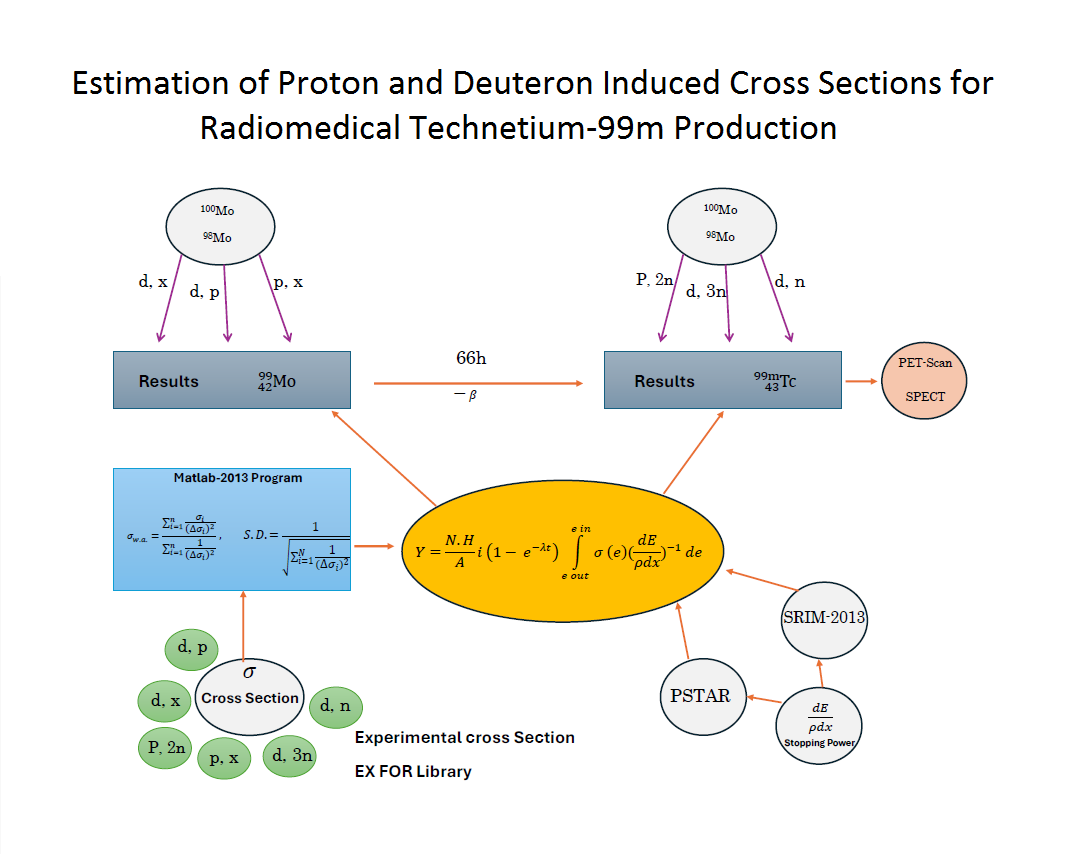
The study calculates cross-sections for charged particles on molybdenum to produce the medical isotope technetium-99m and its parent isotope, molybdenum-99, both of which are crucial in nuclear medicine. Experimental cross sections for the following reactions: (d,3n), (d,n), (p,2n), (d,p), (d,x), and (p,x) were collected from the IAEA EXFOR library. We recalculated using MATLAB 2013 with an interval of 0.01, taking into account the error ratio for each researcher. The yield was calculated based on the calculated cross sections and stopping power, which were calculated using the SRIM 2013 and PSTAR codes. 100Mo(d,3n)99mTc reaction, highest cross section 305 mb at Ed=24 MeV, yield=0.764MBq/microAh at Ed=24.3 MeV. 98Mo(d,n)99mTc reaction, highest cross section of 75 mb at Ed = 11.75 MeV, yield = 341 MBq/microAh at Ed = 12.2 MeV. 100Mo(p,2n)99mTc reaction, highest cross section of 251.14 mb at Ep = 14.54 MeV, yield = 48.3 MBq/microAh at Ep = 19 MeV. 98Mo(d,p)99Mo reaction, highest cross section of 244 mb at Ed = 8.7 MeV, yield = 108.6 MBq/microAh Ed = 12.7 MeV. 100Mo(d,x)99Mo reaction, highest cross section of 41.14 mb at Ed = 35 MeV, yield = 0.025 MBq/microAh at Ed = 46.8 MeV. 100Mo(p,x)99Mo reaction, highest cross section of 251.14 mb at Ep = 14.54 MeV, yield = 48.3 MBq/microAh at Ep = 19 MeV. Researchers should focus on deuteron-induced reactions and enriched isotopes for producing technetium-99, as these are a promising alternative to natural methods.
References
[1] Ahmed, R.S.; Mohammed, R.S.; Mahdi, K.H.; Mahdi, Q.A.; Mostafa, M.Y.; Khalaf, H.N.; "Evaluation of uranium concentration in the blood breast cancer women with CR-39 detector". Appl. Radiat. Isot.,182: 110120, 2022.
[2] Ahmed, R.S.; Mohammed, R.S.; "Assessment of uranium concentration in blood of Iraqi females diagnosed with breast cancer". Radiat. Environ. Biophys., 60(2): 193–201, 2021.
[3] Qaim, S.M.; "Use of cyclotrons in medicine". Radiat. Phys. Chem., 71(3): 917–926, 2004.
[4] Morrissey, D.J.; Seaborg, G.T.; "Modern nuclear chemistry". "Modern Nuclear Chemistry". 1st edition; Wiley-Interscience: Hoboken, NJ, USA, 2006.
[5] Targholizadeh, H.; Raisali, G.; Jalilian, A.R.; Rostampour, N.; Ensaf, M.; Dehghan, M.K.; "Cyclotron production of technetium radionuclides using a natural metallic molybdenum thick target and consequent preparation of [Tc]-BRIDA as a radio-labelled kit sample." Nukleonika, 55(1): 113–118, 2010.
[6] Tárkányi, F.; Ditroi, F.; Takacs, S.; Király, B.; Hermanne, A.; Sonck, M.; Baba, M.; Ignatyuk, A.; "Investigation of activation cross-sections of deuteron-induced nuclear reactions on natural Mo up to 50 MeV". Nucl. Instrum. Methods Phys. Res. B, 274(1): 1–25, 2012.
[7] Ahmed, A.A.; Wronska, A.; Magiera, A.; Misiak, R.; Bartyzel, M.; Mietelski, J.W.; Was, B.; "Study of Mo-99 and long-lived impurities produced through (p, x) reactions in the Mo-nat". Radiat. Phys. Chem., 190: 109774, 2022.
[8] Takacs, S.; Ditrói, F.; Aikawa, M.; Haba, H.; Otuka, N.; "Benchmark experiment for the cross section of the 100Mo (p, 2n) 99mTc and 100Mo (p, pn) 99Mo reactions". Nucl. Instrum. Methods Phys. Res. B, 375: 60–66, 2016.
[9] Lee, S.K.; Lee, S.; Kang, M.; Woo, K.; Yang, S. W.; Lee, J.; "Development of fission 99Mo production process using HANARO". Nucl. Eng. Technol., 52(7): 1517–1523, 2020.
[10] Varalakshmi, T.V.; Suseela, T.N.; Gnana Sundaram, T.G.; Ezhilarasi, T.S.; Indrani, T.B.; "Statistics, Tamilnadu Textbook Corporation: 1st edition Chennai, India, pp. 98–100, 2005.
[11] Biersack, J.P.; Haggmark, L.G.; "A Monte Carlo computer program for the transport of energetic ions in amorphous targets". Nucl. Instrum. Methods, 174(1–2): 257–269, 1980.
[12] Ziegler, J.F.; Biersack, J.P.; "The stopping and range of ions in matter". In Treatise on heavy-ion science; 1st edition, Bromley, D.A., Ed.; Springer: Boston, MA, USA, pp. 93–129, 1985.
[13] Qaim, S.M.; "Nuclear data for medical applications: an overview". Radiochim. Acta, 89(4–5): 189–196, 2001.
[14] Tárkányi, F.; Hermanne, A.; Takacs, S.; Sonck, M.; Szűcs, Z.; Király, B.; Ignatyuk, A.; "Investigation of alternative production routes of 99mTc: deuteron induced reactions on 100Mo". Appl. Radiat. Isot., 69(1): 18–25, 2011.
[15] Randa, Z.; Svoboda, K.; "Excitation functions and yields of (d, n) and (d, 2n) reactions on natural molybdenum". J. Inorg. Nucl. Chem., 38(12): 2289–2295, 1976.
[16] Zarubin, P.P.; Padalko, V.; Khrisanfov, J.; Lebedev, P.P.; Podkopaev, J.; "Excitation functions of Mo-98+d reactions". Izv. Ross. Akad. Nauk Ser. Fiz., 42: 2386, 1978. Available in English version in Bull. Acad. Sci. USSR, Phys. Ser. vol. 42, 1978. p. 145.
[17] Scholten, B.; Lambrecht, R.M.; Cogneau, M.; Ruiz, H.V.; Qaim, S.M.; "Excitation functions for the cyclotron production of 99mTc and 99Mo". Appl. Radiat. Isot., 51(1): 69–80, 1999.
[18] Lamere, E.; Couder, M.; Beard, M.; Simon, A.; Simonetti, A.; Skulski, M.; Seymour, G.; Huestis, P.; Manukyan, K.; Meisel, Z.; "Proton-induced reactions on molybdenum". Phys. Rev. C, 100: 034614, 2019.
[19] Manenti, S.; Holzwarth, U.; Loriggiola, M.; Gini, L.; Esposito, J.; Groppi, F.; Simonelli, F.; "The excitation functions of 100Mo (p, x) 99Mo and 100Mo (p, 2n) 99mTc". Appl. Radiat. Isot., 94: 344–348, 2014.
[20] Takacs, S.; Hermanne, A.; Ditroi, F.; Tárkányi, F.; Aikawa, M.; "Reexamination of cross sections of the 100Mo (p, 2n) 99mTc reaction". ". Nucl. Instrum. Methods Phys. Res. B, 347: 26–38, 2015.
[21] Gagnon, K.; Bénard, F.; Kovacs, M.; Ruth, T.J.; Schaffer, P.; Wilson, J.S.; McQuarrie, S.A.; "Cyclotron production of 99mTc: experimental measurement of the 100Mo (p, x) 99Mo, 99mTc and 99gTc excitation functions from 8 to 18 MeV". Nucl. Med. Biol., 38(6): 907–916, 2011.
[22] Lagunas-Solar, M.C.; Zeng, N.X.; Mirshad, I.; Grey-Morgan, T.; "An Update on the Direct Production of 99mTc with Proton Beams and Enriched 100Mo Targets". Trans. Am. Nucl. Soc., 74: 137, 1996.
[23] Řanda, Z.; Svoboda, K.; "Excitation functions and yields of the (d, p) reactions on natural molybdenum for deuteron energies less than 13 MeV". J. Inorg. Nucl. Chem., 39(12): 2121–2123, 1977.
[24] Sonck, M.; Takács, S.; Szelecsényi, F.; Hermanne, A.; Tárkányi, F.; "Excitation functions of deuteron induced nuclear reactions on nat Mo and 100 Mo (90%) up to 50MeV: An alternative route for the production of 99 Mo". In: Applications of Accelerators in Research and Industry, Proceedings of the 15th International Conference on the Application of Accelerators in Research and Industry, Denton, Texas, USA, 4–7 November 1998;Editors, Duggan, J. L.; Morgan I. L.; Publisher: AIP Press, Woodbury, New York, 1999.
[25] Khandaker, M.; Uddin, M.; Kim, K.; Lee, Y.; Kim, G.; "Measurement of cross-sections for the (p, xn) reactions in natural molybdenum". Nucl. Instrum. Methods Phys. Res. B, 262(2): 171–181, 2007.
[26] Tárkányi, F.; Ditroi, F.; Hermanne, A.; Takacs, S.; Ignatyuk, A.; "Investigation of activation cross-sections of proton induced nuclear reactions on natMo up to 40 MeV: new data and evaluation". Nucl. Instrum. Methods Phys. Res. B, 280: 45–73, 2012.
[27] Uddin, M.; Hagiwara, M.; Tarkanyi, F.; Ditroi, F.; Baba, M.; "Experimental studies on the proton-induced activation reactions of molybdenum in the energy range 22–67 MeV". Appl. Radiat. Isot., 60(6): 911–920, 2004.
Downloads
Published
Issue
Section
License
Copyright (c) 2026 Abdulkader Saad Abdulkader, Ronak Ikram Ali

This work is licensed under a Creative Commons Attribution 4.0 International License.

.jpg)