Deep Image Segmentation Using Explainable Attention Mechanisms: Applications in Biomedical Imaging
DOI:
https://doi.org/10.22401/ANJS.28.4.18Keywords:
Biomedical Image Segmentation XAI Transformer-CNN Hybrid, XAI, Attention Mechanisms, Transformer-CNN Hybrid, Grad-CAM++, SHAP, Skin Lesion Analysis, Brain Tumor Segmentation, Clinical Decision Support, Deep Learning InterpretabilityAbstract
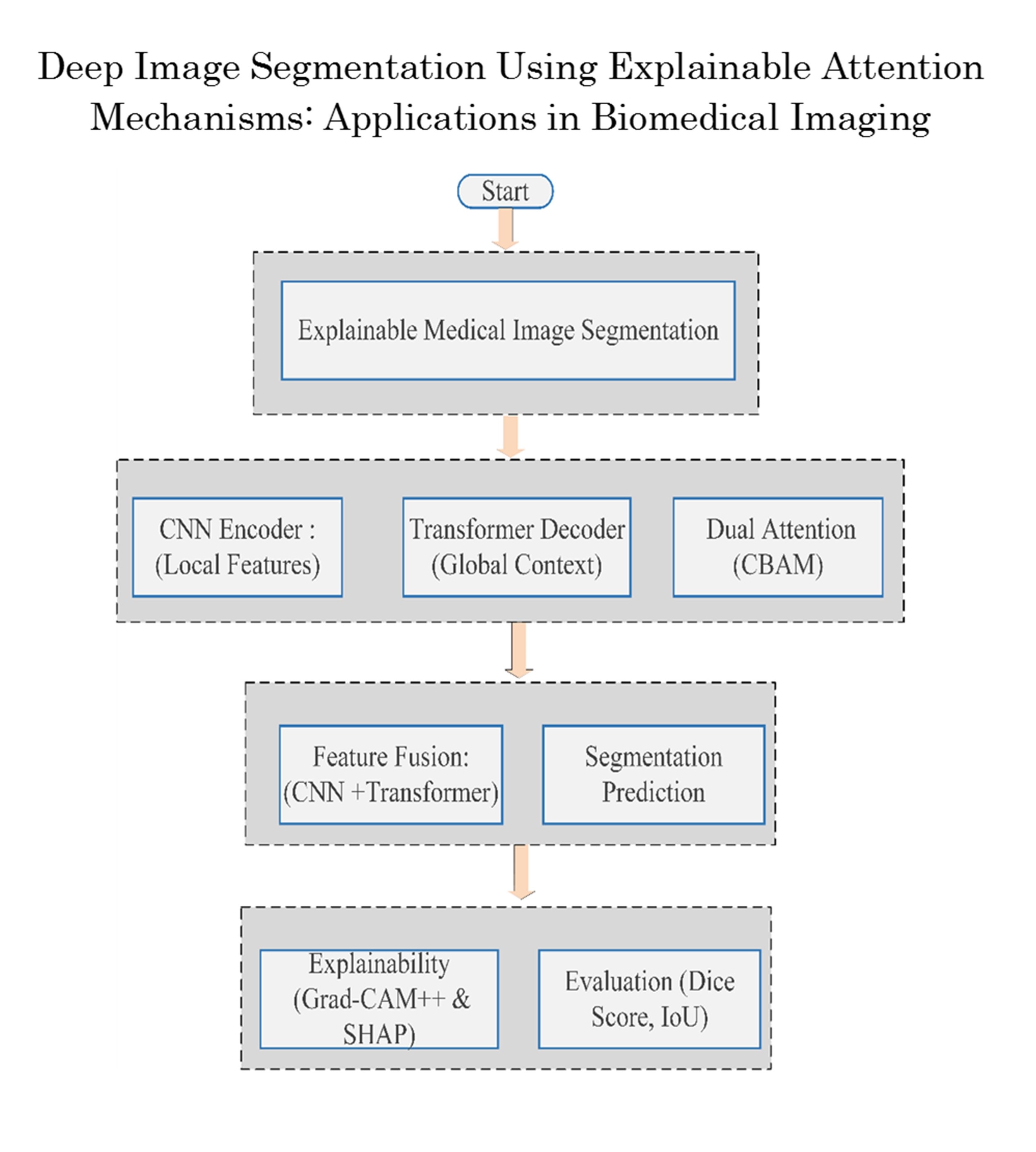
Correct and discernible segmentation of an image is an important part of biomedical imaging, especially when anatomical structures and pathological regions are identified. Although deep learning architectures, like U-Net and its variants, have performed well, their lack of interpretability, transparency and contextual reasoning has limited their clinical adoption. This research helps to overcome the most important issue of high-performance medical segmentation by introducing a new explainable framework that combines convolutional encoders with transformer-based decoders and dual attention mechanisms. There are three aspects of this work, based on the following objectives. (1) To boost the performance of segmentation by means of hybrid local-global feature modelling; (2) To bring about clarity through visual explanation tools; and (3) To conduct clinical viability checks through expert assessments. The architecture proposed includes CBAM for fine spatial and channel attention and combines Grad-CAM++ and SHAP for local and global explainability. Such modules make it possible for clinicians to view the decision paths of models and establish trust in automated outputs. Experiments in two datasets, which were publicly available, were performed: ISIC 2018 for skin lesion segmentation and BraTS 2021 for brain tumor segmentation. The quantitative results show that the suggested method is better than several strong baseline models, such as U-Net, Attention U-Net, and TransUNet, delivering Dice scores of 0.902 and 0.895 on ISIC and BraTS datasets, respectively. Visual comparisons and expert confirmation validate the clinical plausibility of the predicted masks and demonstrate the potential worth of the explainability in high-stakes healthcare conditions. On the whole, this work provides a prudent, precise and explainable deep learning approach toward medical image segmentation and offers ample room for scientific integration and trust-conscious implementation in diagnostics workflows.
References
[1] Ibrahim, A.; Al Sayed, I. A.M.; Jabbar, M. S.; Almutairi, H.; Sekhar, R.; Shah, P.; Al_Barazanchi, I.I.; “Evaluating the Impact of Emotions and Awareness on User Experience in Virtual Learning Environments for Sustainable Development Education”. Ing. Syst. Inf., 29(1): 65–73, 2024.
[2] Ali ,Z. L.; Hayale, W. S. A.; Al Barazanchi, I. I.; Sekhar, R.; Shah, P.; Parihar, S.; “Efficient Cybersecurity Assessment Using SVM and Fuzzy Evidential Reasoning for Resilient Infrastructure”. Ing. Syst. Inf., 29(2):515–521, 2024.
[3] Jasim, L. A.; Kamil, A. T.; Alsarraj, M. F. I.; Al_Barazanchi, I. I.; Sekhar, R.; Shah, P.; Malge, S.; “Network Fortification: Leveraging Support Vector Machine for Enhanced Security in Wireless Body Area Networks”. Int. J. Saf. Secur. Eng., 14(3): 923–931, 2024.
[4] Hammad, A. H.; Abdulbaqi, A. S.; “Applying modified LBP for 2D ECG images classification”. the 2nd International Conference on Emerging Technologies and Intelligent Systems, Malaysia, 3-4 Jun 2022; Al-Sharafi, A. M.; Al-Emran, M.; Al-Kabi, M. N.; Shaalan, K.; Springer, 2022.
[5] Al Barazanchi,I. I.; Hashim, W.; Thabit ,R.; Hussein, N. A.-H. K.; “Advanced Hybrid Mask Convolutional Neural Network with Backpropagation Optimization for Precise Sensor Node Classification in Wireless Body Area Networks”. Khwârizmi Int. J., (2024): 17–31, 2024.
[6] Hassan, S. M.; Mohamad, M. M. B. ; Muchtar, F. B.; “Comprehensive taxonomy of schemes for detecting and mitigating blackhole attacks in mobile ad-hoc networks: A study on tactics, classifications, and future directions”. Ing. Syst. Inf., 29(6): 2533–2548, 2024.
[7] Abdulbaqi, A. S.; Panessai, I. Y.; “Designing and implementation of a biomedical module for vital signals measurements based on embedded system”. Int. J. Adv. Sci. Technol., 29(3): 3866-3877, 2020.
[8] Hassan, S. M. ; Mohamad, M. M. ; Muchtar, F. B. ; Dawoodi, F. B. Y. P. ; “Enhancing MANET security through federated learning and multiobjective optimization: A trust-aware routing framework”. IEEE Access, 12: 181149–181178, 2024.
[9] Hassan, S. M. ; Mohamad, M. M. ; Muchtar, F. B. ; “Advanced intrusion detection in MANETs: A survey of machine learning and optimization techniques for mitigating black/gray hole attacks”. IEEE Access, 12 : 150046 - 150090, 2024,
[10] Ibraheem,I. N. ; Hassan, S. M.; Abead, S. A. ; “Comparative analysis & implementation of image encryption & decryption for mobile cloud security” . Int. J. Adv. Sci. Technol., 29(3),: 109–121, 2020.
[11] Alkhakani S. B.; Hassan, S. M.; “Suggest trust as mediation to adopt electronic voting system in Iraq”. J. Theor. Appl. Inf. Technol., 96(17): 5729–5739, 2018.
[12] Ahmed, E. Q. ; Ameen, Z. A. ; Al-Mukhtar, F. S.; Jaaz, Z. A.; “Maximizing Mobile Communication Efficiency with Smart Antenna Systems using Beam forming and DOA Algorithms”. 10th International Conference on Electrical Engineering, Computer Science and Informatics (EECSI), Palembang, Indonesia, 20-21 September 2023; IEEE Access: United States, Piscataway, New Jersey ,2023.
[13] Ameen, Z.H; Al-Mukhtar, F. S.; Ahmed, E.Q; Dhannoon, B.N; “A Review of the Past Decade's Research Outcomes on Classifying Cyberbullying”. Al-Nahrain J. Sci., 27(1): 121–135, 2024.
[14] Kaya, M.; Shahid, H.; “Cross-Border Data Flows and Digital Sovereignty: Legal Dilemmas in Transnational Governance”. Interdiscip. Stud. Soc. law polit., 4(2): 219-233, 2025.
[15] Oleiwi, S. S. ; Mohammed, G. N. ; Al-Barazanchi, I. ; “Mitigation of packet loss with end-to-end delay in wireless body area network applications” . Int. J. Electr. Comput. Eng., 12(1): 460–470, 2022.
[16] Shawkat, S. A. ; Tuama, B. A. ; Al-Barazanchi, I.; “Proposed system for data security in distributed computingin using triple data encryption standard and Rivest Shamir Adlemen”. Int. J. Electr. Comput. Eng., 12(6): 6496–6505, 2022.
[17] Abdulshaheed, H. R. ; Abbas, H. H. ; al Barazanchi, I. ; Hashim, W. ; “Control and alert mechanism of RFID door access control system using Iot”. 3C Tecnol. , 40(2): 269–285, 2022.
[18] Abdulbaqi, A. S., Obaid, A. J., Mohammed, A. H.; “ECG signals recruitment to implement a new technique for medical image encryption”. J Discrete Math Sci Crypt 24 (6): 1663–1673, 2021.
[19] Shawkat , S. A. ; Al-Barazanchi, I. ; “A proposed model for text and image encryption using different techniques”. Telecommun. Comput. Electron. Control. , 20(4): 858–866, 2022.
[20] Al-Barazanchi I. ; Niu Y.; Abdulshaheed, H. R.; Hashim, W.; Alkahtani, A. A.; Daghighi, E.; Jaaz, Z. A.; et al ; “Proposed New Framework Scheme for Path Loss in Wireless Body Area Network”. Iraqi J. Comput. Sci. Math., 3(1): 11–21, 2022.
[21] Faisal, G. M. ; Alshadoodee, H. A. A. ; Abbas, H. H. ; Gheni, H. M. ; Al-Barazanchi, I. ; “Integrating security and privacy in mmWave communications”. Bull. Electr. Eng. Info. 11(5) : 2856–2865, 2022.
[22] Sahy, S. A. ; Mahdi, S. H. ; Gheni, H. M. ; Al-Barazanchi, I. ; “Detection of the patient with COVID-19 relying on ML technology and FAST algorithms to extract the features” . Bull. Electr. Eng. Inform., 11(5): 2886–2894, 2022.
[23] Al-Mukhtar F.S.; “Automated Face Mask Detection Using Pretrained CNN”. Al Nahrain J. Sci., 26 (4): 80-87, 2023.
[24] Abdulbaqi, A. S.; Al-Attar, B.; Zaid Qudr, L. A.; Penubadi, H. R.; Sekhar, R.; Shah, P.; Tawfeq, J. F.; “Efforts of Neutrosophic Logic in Medical Image Processing and Analysis”. Int. J. Neutrosophic Sci., 24(4): 376-388, 2024.
[25] Ameen Z.H. , Al-Mukhtar F.S., Ahmed E.Q., Dhannoon B.N.; “A Review of the Past Decade's Research Outcomes on Classifying Cyberbullying”. Al Nahrain J. Sci., 27 (1): 121-135,2024.
[26] Abdulshaheed, H. R. ; Abbas, H. H. ; Ahmed, E. Q. ; Al-Barazanchi, I. ; “Big Data Analytics for Large Scale Wireless Body Area Networks;Challenges, and Applications” . Advances on Intelligent Informatics and Computing (IRICT 2021), Completely virtual (online), 30 March 2022; Saeed, F; Mohammed, M.; Ghaleb, F.; Springer, Germany, Berlin, 2022.
[27] Abdulbaqi, A. S.; Turki, N. A.; Obaid, A. J.; Dutta, S.; Panessai, I. Y.; "Spoof Attacks Detection Based on Authentication of Multimodal Biometrics Face-ECG Signals”. In Artificial Intelligence for Smart Healthcare; 10 June 2023; Agarwal , P.; Khanna, K.; Elngar, A. A.; Obaid A. J.; Polkowski, Z.; EAI/Springer Innovations in Communication and Computing : Cham, Switzerland, 507–526, 2023.
Downloads
Published
Issue
Section
License
Copyright (c) 2025 Hanaa M. Mushgil, Farah Saad Al-Mukhtar, Ehsan Qahtan Ahmed, Khairiyah Saeed Abduljabbar

This work is licensed under a Creative Commons Attribution 4.0 International License.

.jpg)