Effect of Magnetic Lens on the Efficiency of Magnetic Deflection System
DOI:
https://doi.org/10.22401/ANJS.29.2.05Keywords:
Magnetic deflection system, Magnetic lens, Initial angel of electron beam, Charge particles, SIMION 8.1Abstract
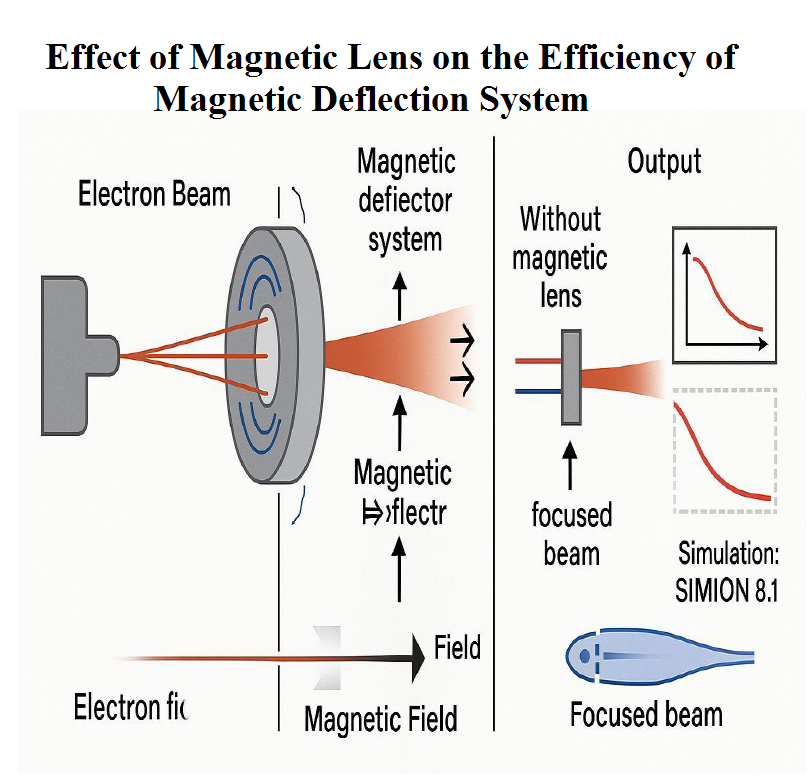
The effect of magnetic lens on the efficiency of magnetic deflector was investigated. The design appears that the magnetic lens changed the characteristic of electron beam after passing through it. The result showed that the changing in magnetic field value for the magnetic lens on the efficiency of electron beam in the magnetic deflection system. Where the effect on the diameter of beam, and K.E, the distribution of the electron beam was studied. The calculation was carried out for different value of magnetic field applied to lens, different initial angle of electron beam. And different value of kinetic energy, a comparison is made between aberration figures, and the result was carried out, to the system for point-to-point (ptp) focusing operation’ mode, in this study, the optimal operating settings for electron beam distribution and focus were identified using SIMION 8.1 software
References
[1] Schröder, A.W.; Tigner, M.; Weise, H.; Zimmermann, F.; “electromagnetic and nuclear interactions”. Handbook of accelerator physics and engineering, 3rd ed.; Alexander, W. Ch., Maury, T.; Singapore: World Scientific.; p. 460-6; 1999.
[2] Wong, L.J.; Hong, K.H.; Carbajo, S.; Fallahi, A.; Piot, P.; Soljačić, M.; et al. “Laser-induced linear-field particle acceleration in free space”. Sci Rep. 7(1):11159; 2017.
[3] Nassiri, A.; Chase, B.; Craievich, P.; Fabris, A.; Frischholz, H.; Jacob, J.; “History and technology developments of radio frequency (RF) systems for particle accelerators”. IEEE Trans Nucl Sci. 63(2):707-50; 2015.
[4] Dattoli, G.; Mezi, L.; Migliorati, M.; “Operational methods for integrodifferential equations and applications to problems in particle accelerator physics”. Taiwanese J Math. 186(1):407-13; 2007.
[5] Baumgärtel, C.; Smith, R.T.; Maher, S.; “Accurately predicting electron beam deflections in fringing fields of a solenoid”. Sci Rep. 10(1):10903; 2020.
[6] Osseyran, A.; “Computer aided design of magnetic deflection systems”. PhD Thesis. Eindhoven: Eindhoven University of Technology; 1986.
[7] Alig, R.C.; Fields, J.R.; “Computer‐aided design of electron guns and deflection yokes: A review (Part 2)”. J. Soc. Inf. Disp. 8(2):99-113; 2000.
[8] Shiltsev, V.; “Electron lenses: historical overview and outlook”. J Instrum. 16(3): P03039; 2021.
[9] Partoens, B.; Verbeeck, J.; “Exploring electron beam shaping in transmission electron microscopy”. PhD thesis. Antwerp: University of Antwerp, Faculty of Science; 2015.
[10] Mohammed, M.A.; “A study of Glaser’s ball-shaped magnetic lens under the effect of current density”. Wasit J Sci Med. 3(1):27-33; 2010.
[11] Ahmed, E.H.; Hasan, A.K.; “Performance and analysis of a designed magnetic lens for microscopic applications”. J Phys Sci. 33(2):125-38; 2022.
[12] Lidberg, G.; Pontén, K.; Millberg, J.; “Design of optical magnetic systems for terahertz lensing”. PhD thesis. Uppsala: Uppsala University; 2021.
[13] Bielajew, A.F.; “The effect of strong longitudinal magnetic fields on dose deposition from electron and photon beams”. Med Phys. 20(4):1171-9; 1994.
[14] Calvo, M.; Paola, P.; “Theory of a time dependent magnetic field lens”. Optik. 113(1):31-4; 2002.
[15] Schott, W.; Springer, K.; Daniel, H.W.; “Calculations and measurements for a magnetic quadrupole lens with a large aperture and a bell-shaped field distribution”. Nucl Instrum Methods. 111(3):541-7; 1973.
[16] Janan, M.K.A.; Salih, R.Y.J.; “Design and studying the effect of polepiece shape on the magnetic and optical properties of the unipolar lens”. Tikrit J Pure Sci. 27(6): 63-69; 2022.
Downloads
Published
Issue
Section
License
Copyright (c) 2026 Shahad A. Aziz, Oday A. Hussein

This work is licensed under a Creative Commons Attribution 4.0 International License.

.jpg)