Serum Levels of Interleukin-36α and Interleukin-1α In Iraqi Women with Polycystic Ovary Syndrome
DOI:
https://doi.org/10.22401/anjs.29.3.3061Keywords:
Polycystic ovary syndrome, Interleukin-36 alpha, Interleukin-1 alpha, Body mass index, Follicle-stimulating hormoneAbstract
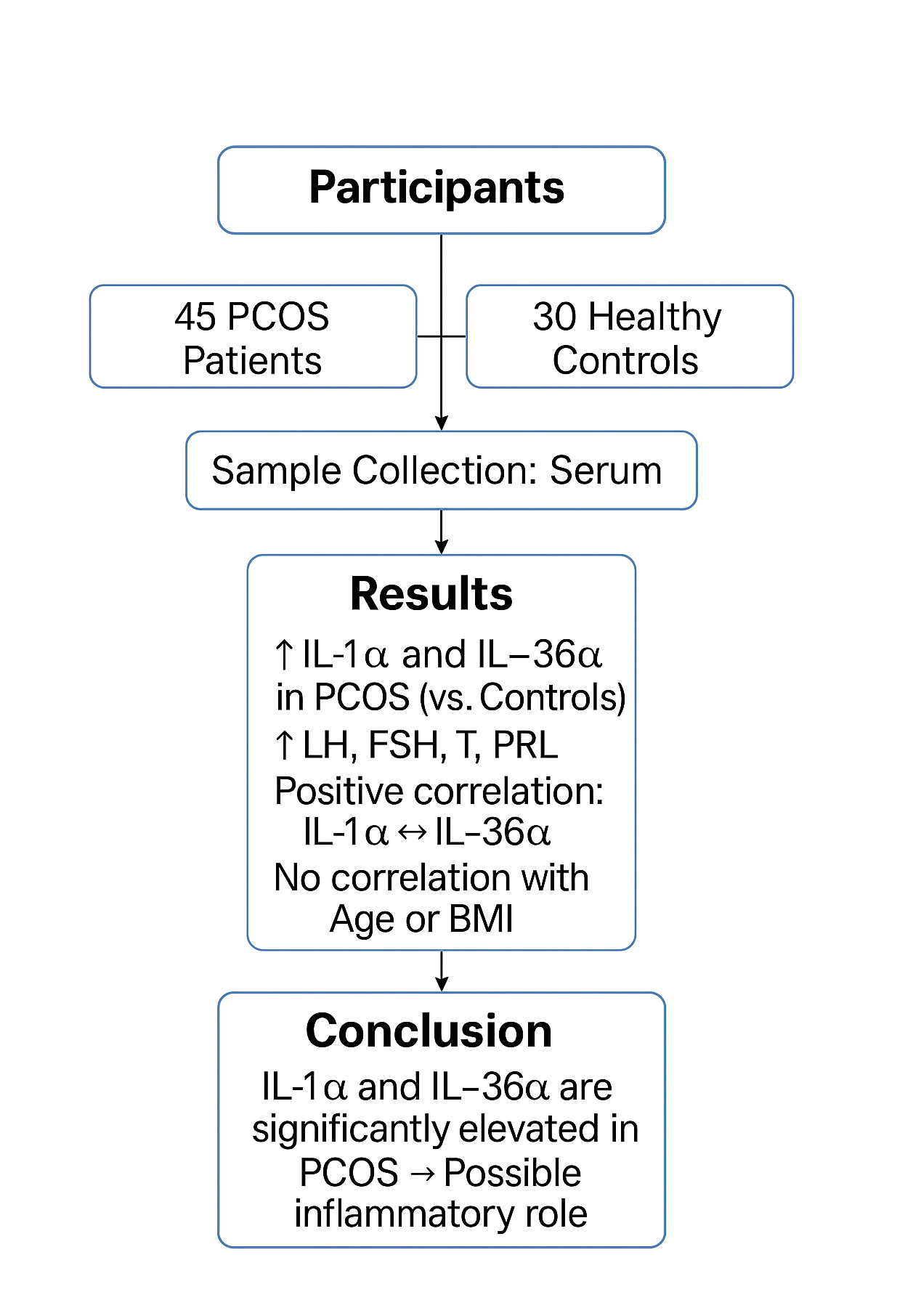
This study aimed to estimate the serum levels of interleukin-1 alpha (IL-1α) and interleukin-36 alpha (IL-36α) in women with polycystic ovary syndrome (PCOS) and to examine their relationship with age and body mass index (BMI). A total number of collected specimens are 75, which were 45 patients and 30 healthy control women participated in this study from different private clinics in Baghdad/ Iraq, for the period starting December 2023 to February 2024. The age ranges for both patients and controls was 18–40 years, with mean ages of 25.60 ± 6.38 years for patients and 29.44 ± 11.61 years for controls. BMI was determined for all participants, revealing a statistically highly significant difference between the PCOS group (27.53 ± 4.72) and the control group (24.02 ± 2.84). The results showed significantly elevated levels of IL-1α (567.0 ± 59.0 pg/ml vs. 196.56 ± 21.56 pg/ml) and IL-36α (511.0 ± 99.4 ng/L vs. 175.82 ± 41.67 ng/L) in the PCOS group compared to the control group. A positive correlation was found between IL-1α and IL-36α. IL-36α was not significantly correlated with age or BMI, while IL-1α was not significantly correlated with age but showed a significant positive correlation with BMI (r = 0.356, P = 0.013). This suggests that the higher IL-1α levels may be partly associated with the higher BMI in the PCOS group and may not be due to PCOS alone. Furthermore, levels of luteinizing hormone (LH), follicle-stimulating hormone (FSH), prolactin (PRL), and testosterone (T) were significantly elevated in women with PCOS.
References
[1] Eiras, M. C.; Pinheiro, D. P.; Romcy, K. A. M.; Ferriani, R. A.; Reis, R. M. D.; Furtado, C.L.M.; "Polycystic ovary syndrome: the epigenetics behind the disease". Reprod. Sci., 29(3): 680-94, 2022.
[2] Sirmans, S. M.; Pate, K. A.; "Epidemiology, diagnosis, and management of polycystic ovary syndrome". Clin. Epidemiol., 6: 1-13, 2013.
[3] Peña, A.S.; Witchel, S.F.; Hoeger, K.M,.; Oberfield, S.E.; Vogiatzi, M.G.; Misso, M.; Garad, R.; Dabadghao, P.; Teede, H.; "Adolescent polycystic ovary syndrome according to the international evidence-based guideline". BMC Med., 18(1): 72, 2020.
[4] Ibraheem,Q.A.; Al Obaidy, L.H.A.; Nasir,G.A.; Al-Obaidi, M.T.M.; "Fat Mass and Obesity Association gene Polymorphism in PCOS Iraqi Women". Baghdad Sci. J., 17(3): 1103-1112, 2020.
[5] Kuang, H.; Duan, Y.; Li, D.; Xu, Y.; Ai, W.; Li, W.; Wang, Y.; Liu, S.; Li, M.; Liu, X.; Shao, M.; "The role of serum inflammatory cytokines and berberine in the insulin signaling pathway among women with polycystic ovary syndrome". PLoS. ONE., 15(8): e0235404, 2020.
[6] Silva, J. R.; Lima, F. E.; Souza, A. L.; Silva, A. W.; "Interleukin-1β and TNF-α systems in ovarian follicles and their roles during follicular development, oocyte maturation and ovulation".Zygote., 28(4): 270–7, 2020.
[7] Zangeneh, F. Z.; Naghizadeh, M. M.; Masoumi, M.; "Polycystic ovary syndrome and circulating inflammatory markers". Int. J. Reprod. Biomed., 15(6): 375–82, 2017.
[8] Voronov, E.; Dotan, S.; Krelin, Y.; Song, X.,; Elkabets, M.; Carmi, Y.; Rider, P.; Idan, C.; Romzova, M.; Kaplanov, I.; Apte, R.N.; "Unique Versus Redundant Functions of IL-1alpha and IL-1beta in the Tumor Microenvironment".Front.Immunol,.4, 2013.
[9] Sachen, K. L.; Arnold, G. C. N.; Towne, J. E.; "Role of IL-36 cytokines in psoriasis and other inflammatory skin conditions". Cytokine, 156: 155897, 2022.
[10] Eroglu, S.; Cakmakliogullari, E. K.; "Decreased serum profile of the interleukin-36a in polycystic ovary syndrome". Taiwan J Obstet Gynecol., 60(6): 1018-1022, 2021.
[11] Giannoudaki, E.; Hernandez-Santana, Y.E.; Mulfaul, K.; Doyle, S.L.; Hams, E.; Fallon, P.G.; Arimin, M.; Donal, O.S.; Manfred ,K.; Andrew, E. H.; Patrick, T. W.; "Interleukin-36 cytokines alter the intestinal microbiome and can protect against obesity and metabolic dysfunction".Nat Commun., 10: 4003, 2019.
[12] Ballak, D. B.; Stienstra, R.; Tack, C. J.; Dinarello, C. A.; van Diepen, J. A.; "IL-1 family members in the pathogenesis and treatment of metabolic disease: focus on adipose tissue inflammation and insulin resistance". Cytokine, 75: 280–290, 2015.
[13] Jacob, P.C.; Marcelle, I.C.; “Current Guidelines for Diagnosing PCOS”. Diagnostics (Basel), 13(6): 1113, 2023.
[14] Flegal, K. M.; Graubard, B. I.; Williamson, D. F.; Gail, M. H.; "Excess deaths associated with underweight, overweight, and obesity". JAMA., 293(15): 1861-7, 2005.
[15] Aslam, M.; Batool, M.; Tahir, M.; Asmat, A.; Naeem, S.; Tul, W. U.; Haneef, Y.; Sabir, U.; "An Explanatory Research to Undermine the Knowledge Related Attributes of Polycystic Ovary Syndrome Among Adult Females: Polycystic Ovary Syndrome Among Adult Females". Pakistan Biomed.J., 5(3): 73-77, 2022.
[16] Agarwal, M.; Sinha, S.; Lohani, P.; Singh, R.; Dureja, S.; "Polycystic Ovarian Syndrome in Aging Women: An Observational Study". Cureus., 14(9): e29776, 2022.
[17] Kasim, S. F.; Saadoon, S. J.; "The Correlation of BMI and Age to Some Hormonal Indices in Iraqi Women with the Polycystic Ovarian Syndrome". Int. J. Drug Deliverv. Technol., 12(2): 829-833, 2022.
[18] Ibrahim, M. I.; Al-saffar, J. M.; "Serum level evaluation of interleukin-18 in obese women with polycystic ovary syndrome". Iraqi J. Sci., 59(4B): 1989-1994, 2018.
[19] Al-Shattawi, S. S. M.; Al-Jumili, E. F.; Al-Azzam, M.A.; "The relationship between obesity and polycystic ovary syndrome in a sample of Iraqi infertile women". Iraqi J. Biotechnol., 7(3): 40-46, 2018.
[20] Alfatlawi, W. R.; "Study the Effect of Interleukin36 Gamma and AMH in Iraqi Women with PCOS". Al-Mustansiriyah J. Sci., 28(3): 151–156, 2017.
[21] Al-Taie, F. K. H.; Al-Jawadi, Z. A.; "The Impact of Obesity on Infertile Women with Polycystic Ovaries in Iraq". Al-Rafidain J. Med. Sci., 28(2): 1-9, 2019.
[22] Alsaadi, Y.L.; Mohamad, B.J.; "Prevalence of hyperandrogenism in Iraqi women with polycystic ovary syndrome". Iraqi J. Sci., 60(12): 2600-2608, 2019.
[23] Al-Musawy, S. H. H.; Al-Saimary, I. E.; Flaifil, M. S.; "Levels of cytokines profile in polycystic ovary syndrome". Med. J. Babylon, 15(2): 124-128, 2018.
[24] Solomon, C.G.; "The epidemiology of polycystic ovary syndrome prevalence and associated disease risks, endocrinology and metabolism clinics of cohort study". J. Women Health , 28(2): 247–263, 1999.
[25] AL kafhage, F. A.; Abbas,A. N.; Al-Masaoodi, R. A.; Hassan, S.; Al-Shemery, M. K.; "The relationship between hormonal levels and hematological parameters in cystic ovarian syndrome". J. Med. Life, 16(6), 2023.
[26] Wang, K.; Li, Y.; Chen, Y.; "Androgen excess: a hallmark of polycystic ovary syndrome". Front. Endocrinol, 14: 1273542, 2023.
[27] Neurath, M.F.; "IL-36 in chronic inflammation and cancer". Cytokine Growth Factor Rev., 55 : 70–79, 2020.
[28] Abraham Gnanadass, S., Divakar Prabhu, Y. & Valsala Gopalakrishnan, A.; "Association of metabolic and inflammatory markers with polycystic ovarian syndrome (PCOS): an update". Arch Gynecol Obstet, 303, 631–643, 2021.
[29] Halah A. A., Methaq J. A., Manal, T. A.; Majid, M. M.; "Functional impact of IL-36γ rs28947206/rs28947207 and IL-17 a rs2275913 polymorphisms in polycystic ovary syndrome: Novel insights from the Iraqi population". Science Direct, 198, 157106, 2026.
[30] Hlail, Z. A.; Mohammed, K. I. A.; "Immunological Detection of Interleukin-1alpha (IL-1α) In Iraqi Women with Polycystic Ovarian Syndrome". SAR J. Med. Biochem., 3(3): 39-42, 2022.
[31] Moin, A.S.; Sathyapalan, T.; Atkin,S.; Butler,A.; "Inflammatory markers in non-obese women with polycystic ovary syndrome are not elevated and show no correlation with vitamin D metabolites". Nutrients, 14(17): 3540, 2022.
[32] Aboeldalyl, S.; James, C.; Seyam, E.; Ibrahim, E.M.; Shawki, H.E.; Amer, S.; "The Role of Chronic Inflammation in Polycystic Ovarian Syndrome-A Systematic Review and Meta-Analysis". Int. J. Mol. Sci.., 22(5): 2734, 2021.
[33] Rostamtabar, M.; Esmaeilzadeh, S.; Tourani, M.; Rahmani, A.; Baee, M.; Shirafkan, F.; Kiarash, S.; Sajedeh, S. M.; Soheil, E.; Hamid, R. N.; "Pathophysiological roles of chronic low-grade inflammation mediators in polycystic ovary syndrome". J Cell Physiol., 236(2): 824–38, 2021.
[34] Yuan, Z.C.; Xu, W.D.; Liu, X.Y.; Liu, X.Y.; Huang, A.F.; Su, L.C.; "Biology of IL-36 Signaling and Its Role in Systemic Inflammatory Diseases". Front. Immunol.,10: 2532, 2019.
[35] Saleh, H.S.; AlRufaei, I.A.; Jawad, E.S.; "Physiological Change of Interleukin-1 Alpha (IL1α) in Iraqi, Thi-Qar Women with Polycystic Ovarian Syndrome".Univ. Thi-Qar J. Sci., 10(1), 171-174, 2023.
[36] Mazloomi, S.; Barartabar, Z.;Pilehvari ,S.; "The Association Between Increment of Interleukin-1 and Interleukin-6 in Women with Polycystic Ovary Syndrome and Body Mass Index". J Reprod Infertil., 24(1): 26-34, 2023.
[37] Fain, J. N.; "Release of inflammatory mediators by human adipose tissue is enhanced in obesity and primarily by the nonfat cells: A review". Mediators Inflamm., 2010: 1–20, 2010.
Downloads
Published
Issue
Section
License
Copyright (c) 2026 Fatima Hussein, Esraa Ahmed Abdul Qader, Riyam Ahmed Saber

This work is licensed under a Creative Commons Attribution 4.0 International License.

.jpg)