Immunogenetic Association of TNFAIP3 rs10499194 Polymorphism with Susceptibility to Immune Thrombocytopenia in Iraqi Patients
DOI:
https://doi.org/10.22401/anjs.29.3.3016Keywords:
rs10499194, TNFAIP3, Immunogenetic association, ThrombocytopeniaAbstract
Immune thrombocytopenia (ITP) is an autoimmune disorder characterized by increased platelet destruction and impaired production. This study evaluated the association of the TNFAIP3 rs10499194 polymorphism and serum TNFAIP3 levels with ITP susceptibility. This case–control study
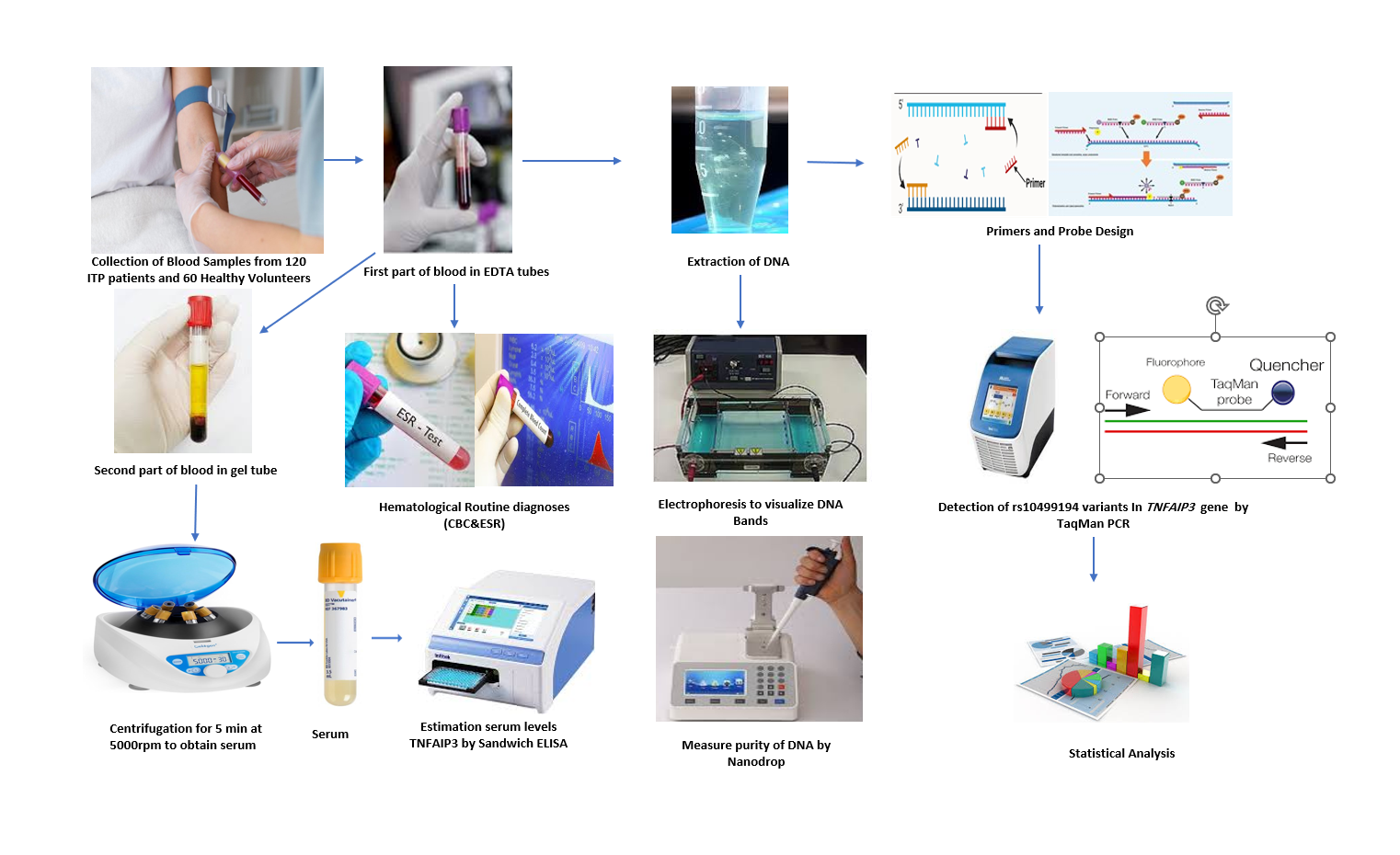
included 120 Iraqi patients with ITP and 60 healthy controls. TNFAIP3 rs10499194 (C>T) was genotyped using TaqMan real-time PCR, and serum TNFAIP3 levels were measured by ELISA. Genotype and allele distributions and Hardy–Weinberg equilibrium was assessed. The distribution of TNFAIP3 rs10499194 genotypes differed significantly between ITP patients with healthy controls (p < 0.001). The CT genotype was more frequently observed among patients, whereas the CC genotype predominated in the control group. Allelic analysis demonstrated a significantly higher frequency of the T allele in patients compared with controls, indicating an association between rs10499194 and susceptibility to ITP. Serum TNFAIP3 concentrations were significantly elevated in ITP patients compared with healthy controls (638.63 ± 62.11 pg/mL vs. 401.94 ± 45.32 pg/mL, p < 0.001). Moreover, serum TNFAIP3 levels differed significantly according to rs10499194 genotype, with higher concentrations observed among carriers of the T allele. TNFAIP3 rs10499194 was
significantly associated with ITP susceptibility and elevated serum TNFAIP3 levels, suggesting a potential role in ITP pathogenesis.
References
[1] Khan, A.M., Mydra, H., and Nevarez, A. “Clinical practice updates in the management of immune thrombocytopenia”. PT, 42(12): 756–763, 2017.
[2] Arnall, J.R., DiSogra, K.Y., Downing, L., Elmes, J.B., Tran, T., and Moore, D.C. “Comparative utilization and efficacy of thrombopoietin receptor agonists in relapsed/refractory immune thrombocytopenia”. Am. J. Ther., 28(5): e525–e530, 2021.
[3] Bu, S., Liu, M., Yang, L., Lee, P., Miller, H., Park, C., and Liu, C. “The function of T cells in immune thrombocytopenia”. Front. Immunol., 16: 1499014, 2025.
[4] Kim, S. “Recent advances in treatments of adult immune thrombocytopenia”. Blood Res., 57(Suppl. 1): 112–119, 2022.
[5] Moulis, G., Comont, T., and Adoue, D. “New insights into the epidemiology of immune thrombocytopenia in adult patients: Impact for clinical practice”. Rev. Med. Interne, 42(1): 11–15, 2021.
[6] El-Hady, M., Mosallam, D., Anis, S., Mansour, B., and Yassa, M. “Tumor necrosis factor induced protein 3 gene polymorphism and the susceptibility to chronic primary immune thrombocytopenia in Egyptian children: A case-control study”. Egypt. J. Med. Hum. Genet., 22(1): 1–9, 2021.
[7] Georgi, J.A., Middeke, J.M., Bornhäuser, M., Matzdorff, A., and Trautmann-Grill, K. “Deciphering the genetic basis of immune thrombocytopenia: Current evidence for genetic predisposition in adult ITP”. Blood Adv., 7(14): 3710–3724, 2023.
[8] Kargar, M., Torabizadeh, M., Purrahman, D., Zayeri, Z.D., and Saki, N. “Regulatory factors involved in Th17/Treg cell balance of immune thrombocytopenia”. Curr. Res. Transl. Med., 71(2): 103389, 2023.
[9] Li, J., Sai, M., Linlin, S., Chunhong, M., Chengjiang, G., Xiao-hui, Z., Ming, H., and Jun, P. “Inflammation-related gene polymorphisms associated with primary immune thrombocytopenia”. Front. Immunol., 8: 744, 2017.
[10] Al-Samkari, H., and Nagalla, S. “Efficacy and safety evaluation of avatrombopag in immune thrombocytopenia: Analyses of a phase III study and long-term extension”. Platelets, 33(2): 257–264, 2022.
[11] Mititelu, A., Onisâi, M.C., Roșca, A., and Vlădăreanu, A.M. “Current understanding of immune thrombocytopenia: A review of pathogenesis and treatment options”. Int. J. Mol. Sci., 25(4): 2163, 2024.
[12] Audia, S., Mahevas, M., and Bonnotte, B. “Immune thrombocytopenia: From pathogenesis to treatment”. Rev. Med. Interne, 42(1): 16–24, 2020.
[13] Onisâi, M., Vlădăreanu, A.M., Spînu, A., Găman, M., and Bumbea, H. “Idiopathic thrombocytopenic purpura (ITP): New era for an old disease”. Rom. J. Intern. Med., 57(4): 273–283, 2019.
[14] Lv, Y., Shi, H., Liu, H., and Zhou, L. “Current therapeutic strategies and perspectives in refractory ITP: What have we learned recently?”. Front. Immunol., 13: 953716, 2022.
[15] Andreescu, M. “The link between immune thrombocytopenia and the cytokine profile—a bridge to new therapeutical targets”. Front. Hematol., 2: 1191178, 2023.
[16] Terrell, D.R., Beebe, L.A., Neas, B.R., Vesely, S.K., Segal, J.B., and George, J.N. “Prevalence of primary immune thrombocytopenia in Oklahoma”. Am. J. Hematol., 87(9): 848–852, 2012.
[17] He, Y., Xu, L., Feng, F., Wang, Q., Zhu, X., Wang, C., and Zhang, X. “Mesenchymal stem cell deficiency influences megakaryocytopoiesis through the TNFAIP3/NF-κB/SMAD pathway in patients with immune thrombocytopenia”. Br. J. Haematol., 180: 395–411, 2018.
[18] Das, T., Chen, Z., Hendriks, R., and Kool, M. “Tumor necrosis factor α-induced protein 3 in immune cells controls development of auto-inflammation and autoimmunity: Lessons from mouse models”. Front. Immunol., 9: 104, 2018.
[19] Provan, D., Stasi, R., Newland, A., Blanchette, V., Bolton-Maggs, P., Bussel, J., and Kuter, D. “Updated international consensus report on the investigation and management of primary immune thrombocytopenia”. Blood Adv., 3(22): 3780–3817, 2019.
[20] Li, J., Ma, S., Shao, L., Ma, C., Gao, C., Zhang, H., Hou, M., and Peng, J. “Inflammation-Related Gene Polymorphisms Associated With Primary Immune Thrombocytopenia”. Front Immunol.28(8):744,2017
[21] Tariq, Z., Qadeer, M., Zahid, K., Cherepkova, E., and Olzhayev, S. “Immune thrombocytopenia: Immune dysregulation and genetic perturbations deciphering the fate of platelets”. Front. Biosci. Landmark, 29(10): 342, 2024.
[22] Wang, J.G., Dou, H.H., and Liang, Q.Y. “Impact of gut microbiota and inflammatory cytokines on immune thrombocytopenia”. Eur. J. Haematol., 114(1): 120–128, 2025.
[23] Green, M.R., and Sambrook, J. “Preparation and analysis of DNA”. In: Molecular Cloning: A Laboratory Manual, 4th ed., Cold Spring Harbor Laboratory Press, New York, USA, pp. 11–150, 2012.
[24] Neunert, C., Terrell, D.R., Arnold, D.M., Buchanan, G., Cines, D.B., Cooper, N., and Vesely, S.K. “The American Society of Hematology 2019 guidelines for immune thrombocytopenia”. Blood Adv., 3(23): 3829–3866, 2019.
[25] Madkhali, M.A. “Recent advances in the management of immune thrombocytopenic purpura (ITP): A comprehensive review”. Medicine, 103(3): e36936, 2024.
[26] Moulis, G., Palmaro, A., Montastruc, J.L., Godeau, B., Lapeyre-Mestre, M., and Sailler, L. “Epidemiology of incident immune thrombocytopenia: A nationwide population-based study in France”. Blood, 124(22): 3308–3315, 2014.
[27] Rodeghiero, F., Stasi, R., Gernsheimer, T., Michel, M., Provan, D., Arnold, D.M., and George, J.N. “Standardization of terminology, definitions and outcome criteria in immune thrombocytopenic purpura”. Blood, 113(11): 2386–2393, 2009.
[28] Audia, S., Mahévas, M., Nivet, M., Ouandji, S., Ciudad, M., and Bonnotte, B. “Immune thrombocytopenia: Recent advances in pathogenesis and treatments”. HemaSphere, 5(6): e574, 2021.
[29] Mageau, A., Terriou, L., Ebbo, M., Souchaud-Debouverie, O., Orvain, C., Graveleau, J., and Comont, T. “Splenectomy for primary immune thrombocytopenia revisited in the era of thrombopoietin receptor agonists: New insights for an old treatment”. Am. J. Hematol., 97(1): 10–17, 2021.
[30] Cunin, P., and Nigrovic, P.A. “Megakaryocytes as immune cells”. J. Leukoc. Biol., 105(6): 1111–1121, 2019.
[31] Zitek, T., Weber, L., Pinzon, D., and Warren, N. “Assessment and management of immune thrombocytopenia (ITP) in the emergency department: Current perspectives”. Emerg. Med., 14: 25–34, 2022.
[32] Zufferey, A., Kapur, R., and Semple, J.W. “Pathogenesis and therapeutic mechanisms in immune thrombocytopenia (ITP)”. J. Clin. Med., 8(9): 1496, 2019.
[33] Matzdorff, A., and Arnold, D.M. “Immune thrombocytopenia: Current knowledge and future directions”. HemaSphere, 5(4): e547, 2021.
[34] Xingxing, H., Meng, W., Yubo, M., and Jiajia, Y. “TNFAIP3 genetic polymorphisms reduce ankylosing spondylitis risk in Eastern Chinese Han population”. Sci. Rep., 9: 10209, 2019.
[35] Daghestani, M., Nashwa, O., Mohammed, A., Omair, K., Alenzi, F., Maha, A., Omair, E., Alqurtas, S., and Arjumand, W. “Single nucleotide polymorphisms associated with rheumatoid arthritis in Saudi patients”. J. Clin. Med., 12(15): 4944, 2023.
[36] Zhou Q., Wang H., Schwartz D.M. “Loss-of-function mutations in TNFAIP3 leading to A20 haploinsufficiency cause autoinflammatory disease”. Nat. Genet., 48: 67–73, 2016.
[37] Elsaadany, Z.A., and An, S.A. “Studying the role of IL-1B genetic polymorphisms in the development of primary immune thrombocytopenia among Egyptian children”. Gene Rep., 30: 101736, 2023.
[38] Ellithy, H.N., Yousry, S.M., Abdel-Aal, A., Tawadros, L., and Momen, N. “Association of CD40 gene polymorphisms and immune thrombocytopenic purpura in the adult Egyptian population”. Blood Res., 57(3): 229–234, 2022.
[39] Bagyinszky, E., and An, S.A. “Genetic mutations associated with TNFAIP3 (A20) haploinsufficiency and their impact on inflammatory diseases”. Int. J. Mol. Sci., 25(15): 8275, 2024.
[40] Rajamäki, K., Keskitalo, S., Seppänen, M., Kuismin, O., Vähäsalo, P., Trotta, L., and Varjosalo, M. “Haploinsufficiency of A20 impairs protein-protein interactome and leads into caspase-8-dependent enhancement of NLRP3 inflammasome activation”. Rheum. Dis., 4(2): e000740, 2018.
[41] Pasula, S., Yao, F., Kandice, L., Tessneer, Y., Mandi, M., Wiley, R., Pelikan, J., Kelly, A., Patrick, M., and Gaffney, N. “Systemic lupus erythematosus variants modulate the function of an enhancer upstream of TNFAIP3”. Front. Genet., 13: 1011965, 2022.
Downloads
Published
Issue
Section
License
Copyright (c) 2026 Ola Adnan Hashim, Rawaa AlChalabi, Bassam Francis Matti, Yaseen Ismael Mamoori

This work is licensed under a Creative Commons Attribution 4.0 International License.

.jpg)