Investigation of the Interaction between Indium Oxide Cluster and a Water Molecule via Density Functional Theory
DOI:
https://doi.org/10.22401/ANJS.28.3.13Keywords:
Indium oxide nanocluster, Water molecule, Density functional theory, Density of state (DOS)Abstract
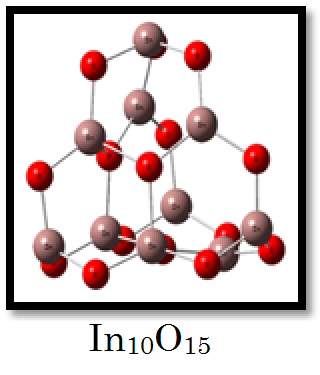
Density Functional Theory (DFT), with a hybrid function B3LYP, has continued to be considered an adequate computational methodology for evaluating the interaction between indium oxide (In10O15) pyramid nanoclusters and water. This computation evaluated the light atoms (O and H) with the 6-311G ** basis set, while the heavier indium atoms were treated with the Stuttgart/Dresden (SDD) basis set. HOMO, LUMO molecular orbital electronic structure, and energy gap, as well as geometrical structure, were computed in Gaussian 09W and GaussView 05, respectively. It was found that the energy gap of In10O15 increases in the presence of water, which means water uptake would reduce the electrical conductivity of the indium oxide nanocluster. While the Gibbs free energy was found to be a positive value, ∆G ≈ 2.9 eV, which means the reaction is endergonic. This transformation is associated with an energetically favorable electron transition, which may involve photocatalytic activity.
References
[1] Jia, T. Q.; Sun, H. Y.; Li, X. X.; Feng, D. H.; Li, C. B.; Xu, S. Z.; and Sun, Z. R.; et. al.; “The Ultrafast Excitation Processes in Femtosecond Laser-Induced Damage in Dielectric Omnidirectional Reflectors”. J. Appl. Phys. 100(2): 023103, 2006.
[2] Si, M.; Lin, Z.; Charnas, A.; and Ye, P.D.; "Scaled Atomic-Layer-Deposited Indium Oxide Nanometer Transistors With Maximum Drain Current Exceeding 2 A/mm at Drain Voltage of 0.7 V". IEEE Electron Device Lett., 42(2): 184-187, 2021.
[3] Sharma, N.; Sharma, B.; Das, S. K.; Chettri, P.; Karki, P.; Pradhan, R.; and Pradhan, A.; et. al.; “A First-Principle Study to Investigate Electrical and Optical Properties of Tin Oxide”. Proc. 2024 IEEE Int. Conf. Electron Devices Society Kolkata Chapter (EDKCON), Kolkata, India, 30 November; IEEE Conf. Series: New Jersey, United States, 2024.
[4] Swallow, J.E.N.; Palgrave, R.G.; Murgatroyd, P.A.E.; Regoutz, A.; Lorenz, M.; Hassa, A.; and Grundmann, M.; et al.; "Indium Gallium Oxide Alloys: Electronic Structure, Optical Gap, Surface Space Charge, and Chemical Trends within Common-Cation Semiconductors". ACS Appl. Mater. Interfaces, 13(2): 2807-2819, 2021.
[5] Kumar, V.; Chauhan, V.; Ram, J.; Gupta, R.; Kumar, S.; Chaudhary, P.; and Yadav, B. C.; et al.; "Study of humidity sensing properties and ion beam induced modifications in SnO2-TiO2 nanocomposite thin films". Surf. Coat. Technol., 392(6): 125768, 2020.
[6] Li, C.; Choi, P.G.; and Masuda, Y.; "Large-lateral-area SnO2 nanosheets with a loose structure for high-performance acetone sensor at the ppt level". J. Hazard. Mater., 455(8): 131592, 2023.
[7] Xu, C.; Tamaki, J.; Miura, N.; Yamazoe, N.; "Grain size effects on gas sensitivity of porous SnO2-based elements". Sens. Actuators B Chem., 3(2): 147-155, 1991.
[8] Liang, Y.X.; Chen, Y.J.; Wang, T.H.; "Low-resistance gas sensors fabricated from multiwalled carbon nanotubes coated with a thin tin oxide layer". Appl. Phys. Lett., 85(4): 666-668, 2004.
[9] Chiorino, A.; Ghiotti, G.; Prinetto, F.; Carotta, M.C.; Malagù, C.; Martinelli, G.; "Preparation and characterization of SnO2 and WOx–SnO2 nanosized powders and thick films for gas sensing". Sens. Actuators B Chem., 78(1): 89-97, 2001.
[10] Li, P.; Fan, H.; Cai, Y.; "In2O3/SnO2 heterojunction microstructures: Facile room temperature solid-state synthesis and enhanced Cl2 sensing performance". Sens. Actuators B Chem., 185(8): 110-116, 2013.
[11] Lu, G.; Ocola, L.E.; Chen, J.; "Room-Temperature Gas Sensing Based on Electron Transfer between Discrete Tin Oxide Nanocrystals and Multiwalled Carbon Nanotubes". Adv. Mater., 21(24): 2487-2491, 2009.
[12] Sharma, A.; Tomar, M.; Gupta, V.; "Room temperature trace level detection of NO2 gas using SnO2 modified carbon nanotubes based sensor". J. Mater. Chem., 22(44): 23608-23616, 2012.
[13] Bahuguna, G.; Mondal, I.; Verma, M.; Kumar, M.; Bhattacharya, S.; Gupta, R.; and Rathi, A.; et. al.; “Innovative Approach to Photo-Chemiresistive Sensing Technology: Surface-Fluorinated SnO₂ for VOC Detection”. ACS Appl. Mater. Interfaces 12(33): 37320–37329, 2020.
[14] Jafer, N. F.; and Hussein, M.; “Study of the Transition State of SnO₂ Cluster with NO₂ Gas Molecule via Density Functional Theory”. Int. J. Nanosci. 21(01): 2250006, 2022.
[15] Abdulradha, S. K.; Hussein, M.; and Abdulsattar, M. A.; “Study of the Interaction Between Reduced Graphene Oxide and NO₂ Gas Molecules via Density Functional Theory (DFT)”. Int. J. Nanosci. 21(02): 2250009, 2022.
[16] Abdulridha, S.K.; Abdulsattar, M.A.; Hussein, M.T.; "Sensitivity of SnO2 nanoparticles/reduced graphene oxide hybrid to NO2 gas: a DFT study". Struct. Chem., 33(6): 2033-2041, 2022.
[17] Hussein, M.; Fayad, T.; Abdulsattar, M.; "Concentration effects on electronic and spectroscopic properties of ZnCdS wurtzoids: a density functional theory study". Chalcogenide Lett., 16(11): 557-563, 2019.
[18] Hussein, M.T.; Thjeel, H.A.; "Vibration Properties of ZnS nanostructure Wurtzoids: ADFT Study". In: Proceedings of the International Workshop in Physics Applications, Fallujah, Anbar, Iraq, 20–21 November; IOP Publishing: England, United Kingdom, 2019.
[19] Abdulsattar, M.A.; "Transition state theory application to H2 gas sensitivity of pristine and Pd doped SnO2 clusters". Karbala Int. J. Mod. Sci., 6(2): 13-20, 2020.
[20] Abdulsattar, M.; Hussein, M.; Kahaly, M.; "Effect of reduced graphene oxide hybridization on ZnO nanoparticles sensitivity to NO2 gas: A DFT study". J. Ovonic Res., 19(2): 153-163, 2023.
[21] Louie, S.G. "Chapter 2: Predicting Materials and Properties: Theory of the Ground and Excited State." In Contemporary Concepts of Condensed Matter Science, Vol. 2; Louie, S.G., and Cohen, M.L., Eds.; Elsevier: Amsterdam, Netherlands, pp. 9–53, 2006.
[22] Zhang, H.; Yang, J.; "First-principles study on the structural and electronic properties of In₂O₃ nanoclusters". J. Phys. Chem. C, 115(16): 7721–7726, 2011.
[23 ] Li, C.; Zhang, D.; Liu, X.; Han, S.; Tang, T.; Han, J.; and Zhou, C.; “In₂O₃ Nanowires as Chemical Sensors.” Appl. Phys. Lett., 82(10): 1613–1615, 2003.
[24] Kuang, P.; Park, J.-M.; Leung, W.; Mahadevapuram, R.C.; Nalwa, K.S.; Kim, T.-G.; and Chaudhary, S.; et al.; “A New Architecture for Transparent Electrodes: Relieving the Trade-Off Between Electrical Conductivity and Optical Transmittance.” Adv. Mater., 23(21): 2469–2473, 2011.
[25] Xiao, F.; He, Z.; Zheng, Y.; Xiong, S.; and Cheng, Q.; “A DFT Study on Mechanisms of Indium Adsorption on Sphalerite (100), (110), and (111) Surfaces: Implications for Critical Metal Mineralization.” Ore Geol. Rev., 181(6): 106572, 2025.
[26] Azeez, Y.H., Kareem, R.O., Qader, A.F., Omer, R.A., and Ahmed, L.O. "Spectroscopic characteristics, stability, reactivity, and corrosion inhibition of AHPE-dop compounds incorporating (B, Fe, Ga, Ti): A DFT investigation", Next. Mater., 3(4): 100184, 2024.
[27] Inerbaev, T.; Sahara, R.; Mizuseki, H.; Kawazoe, Y.; and Nakamura, T. "Theoretical Modeling of Oxygen and Water Adsorption on Indium Oxide (111) Surface." In Photoinduced Processes at Surfaces and in Nanomaterials, Vol. 1196; American Chemical Society: Washington, D.C., United States, pp. 137–149, 2015.
[28] Temkin, O.N.; “'Golden Age' of Homogeneous Catalytic Chemistry of Alkynes: Some Oxidative Transformations of Alkynes (A Review).” Kinet. Catal., 64(5): 521–577, 2023.
[30] Zhang, B.; Zhang, N.N.; Chen, J.F.; Hou, Y.; Yang, S.; Guo, J.W.; et al.; “Turning Indium Oxide into a Superior Electrocatalyst: Deterministic Heteroatoms.” Sci. Rep., 3(1): 3109, 2013.
[31] Zhanpeisov, N.U.; Nakatani, H.; Fukumura, H.; "Theoretical DFT study of the structure and chemical activity of small indium(III) oxide clusters". Res. Chem. Intermed., 37(6): 647-658, 2011.
[32] Chen, H.; Blatnik, M.A.; Ritterhoff, C.L.; Sokolović, I.; Mirabella, F.; Franceschi, G.; et al.; “Water Structures Reveal Local Hydrophobicity on the In₂O₃(111) Surface.” ACS Nano, 16(12): 21163–21173, 2022.
[33] Hassan, S.F. and El-Shahawy, A.S.; “Preparation and study of indium oxide nanoparticles using DFT method.” Int. J. Nanosci. Nanotechnol., 11(3): 203–210, 2022.
[34] Jiang, X.; Nie, X.; Gong, Y.; Moran, C.M.; Wang, J.; Zhu, J.; and Zhang, H. et al.; “A combined experimental and DFT study of H₂O effect on In₂O₃/ZrO₂ catalyst for CO₂ hydrogenation to methanol.” J. Catal., 383: 283–296, 2020.
[35] Chen, H.; Blatnik, M.A.; Ritterhoff, C.L.; Sokolović, I.; Mirabella, F.; Franceschi, G.; and Müller, T. et al.; “Water Structures Reveal Local Hydrophobicity on the In₂O₃(111) Surface.” ACS Nano, 16(12): 21163–21173, 2022.
[36] Perera, D.C. and Rasaiah, J.C.; “Exchange Functionals and Basis Sets for Density Functional Theory Studies of Water Splitting on Selected ZnO Nanocluster Catalysts.” ACS Omega, 7(15): 12556–12569, 2022.
[37] Perera, D.C. and Rasaiah, J.C.; “Computational Study of H₂O Adsorption, Hydrolysis, and Water Splitting on (ZnO)₃ Nanoclusters Deposited on Graphene and Graphene Oxides.” ACS Omega, 8(35): 32185–32203, 2023.
Downloads
Published
Issue
Section
License
Copyright (c) 2025 Nisreen A. Fejer, Mohammed T. Hussein, Asmaa H. Mohammed

This work is licensed under a Creative Commons Attribution 4.0 International License.

.jpg)