Antibacterial and Cytotoxicity Effects of Aloe Vera Leaves Extract Gel and Zinc Oxide Nanoparticles (ZnO NPs) on Bacterial Skin Infections
DOI:
https://doi.org/10.22401/ANJS.28.3.09Keywords:
Aloe vera, Alopecia, ZnO NPs, Staphylococcus sppAbstract
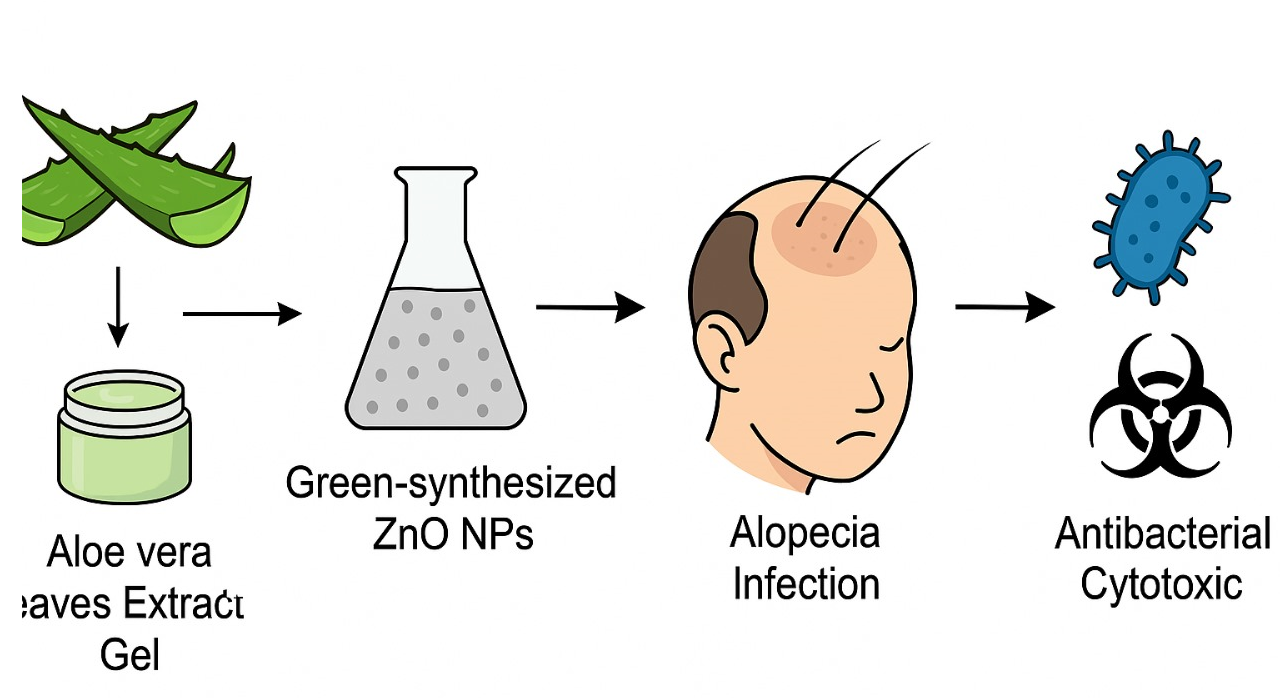
The skin establishes an immunological barrier against bacterial infections. Despite the presence of several bacterial species on the skin, they typically lack the capacity to infect people. A bacterial skin infection can vary in size from a little area to extensive coverage and in severity from benign to life-threatening. Four identified isolates by VITEK-2 for Staphylococcus spp; S1, S1 Control, S2 and S2 Control were used in this study. S1, S1C, S2 and S2C were collected from alopecia disease assigned by S1, S2 and the healthy hair skin from the same patients (S1C and S2C). The ZnO NPs was green synthesized (GS- ZnO NPs) by aqueous extraction of Aloe vera leaves gel (AG) and characterized by UV-V is spectrometry, Atomic force microscope (AFM), Fourier transform infrared spectroscopy (FTIR), Scanning electron microscope (SEM) and XRD spectroscopy. Minimum inhibitory concentration (MIC) was determined for AG and GS-ZnO NPs, mixture of standard ZnO NPs and AG leaves extract in addition to standard ZnO NPs against Staphylococcus spp. (S1,S1C,S2 and S2C). Cytotoxicity was assessed by MTT assay against normal skin cell, Human dermal fibroblast (HdFn). Compared to the control group, the viability rate was drastically reduced at a dosage of 400 mg/mL. Results showed that the GS-ZnO NPs have the better MIC result (0.400 ±0.03, 0.650 ±0.07, 0.478 ±0.08 b, 0.632 ±0.08) on S1, S1C, S2 and S2C, respectively. The HdFn were slightly more affected by the cytotoxic effects of GS-ZnO NPs, at concentration of 400 mg/mL compared to the control group (100%) (p < .05). In conclusion, based on the outcomes of the microdilution experiment and the cytotoxicity impact of HdFn, GS-ZnO NPs displayed antibacterial activities against Staphylococcus spp., while also displaying cytotoxic effects on HdFn cells at 400 mg/ml.
References
[1] Aljamali, N.M.; Al-Zubaidy, Z.H.; Enad, A.H.; “Bacterial infection and common bacterial diseases: A Review”. Pharm. Nanotechnol. 3: 13–23, 2021.
[2] Qiu, L.; Wang, C.; Lan, M.; Guo, Q.; Du, X.; Zhou, S.; Cui, P.; Hong, T.; Jiang, P.; Wang, J.; Xia, J.; “Antibacterial photodynamic gold nanoparticles for skin infection”. ACS Applied Bio Materials. 4(4): 3124–3132, 2021.
[3] Ruggiero, M. A.; Gordon, D. P.; Orrell, T. M.; Bailly, N.; Bourgoin, T.; Brusca, R. C.; Kirk, P. M.; “A higher level classification of all living organisms”. PloS One. 10(4): e0119248. DOI: https://doi.org/10.1371/journal.pone.0119248, 2014.
[4] Serra, R.; Grande, R.; Butrico, L.; Rossi, A.; Settimio, U.F.; Caroleo, B.; Amato, B.; Gallelli, L.; De Franciscis, S.; “Chronic wound infections: the role of Pseudomonas aeruginosa and Staphylococcus aureus”. Expert review of anti-infective therapy. 13(5): 605–613, 2015.
[5] Sánchez-Pellicer, P.; Navarro-Moratalla, L.; Núñez-Delegido, E.; Agüera-Santos, J.; Navarro-López, V.; “How Our Microbiome Influences the Pathogenesis of Alopecia Areata”. Genes 13(10): 1860, 2022. DOI: https://doi.org/10.3390/genes13101860.
[6] Arbab, S.; Ullah, H.; Weiwei, W.; Wei, X.; Ahmad, S.U.; Wu, L.; Zhang, J.; “Comparative study of antimicrobial action of aloe vera and antibiotics against different bacterial isolates from skin infection”. Veterinary Medicine and Science 7(5): 2061–2067, 2021.
[7] Chacón, O.; Forno, N.; Lapierre, L.; Muñoz, R.; Fresno, M.; San Martín, B.; “Effect of Aloe barbadensis Miller (Aloe vera) associated with beta-lactam antibiotics on the occurrence of resistance in strains of Staphylococcus aureus and Streptococcus uberis”. European Journal of Integrative Medicine, 32: 100996, 2019.
[8] Iosageanu, A.; Mihai, E.; Seciu-Grama, A.M.; Utoiu, E.; Gaspar-Pintiliescu, A.; Gatea, F.; Cimpean, A.; Craciunescu, O.; “In Vitro Wound-Healing Potential of Phenolic and Polysaccharide Extracts of Aloe vera Gel”. Journal of Functional Biomaterials, 15(9): 266, 2024.
[9] TAŞTAN, Z.; Gulcin, A.L.P.; KILIC, T.U.; AVCI, E.; “In vitro evaluation of the biological activity potential of Aloe vera gel: Antioxidant activity and cytotoxic effects in Hepg2 and L929”. Journal of Microbiology, Biotechnology and Food Sciences, 13(5): e10668, 2024.
[10] Youssef, A.M.; el-Sayed, S.M.; el-Sayed, H.S.; Salama, H.H.; Dufresne, A.; “Enhancement of Egyptian soft white cheese shelf life using a novel chitosan/carboxymethyl cellulose/zinc oxide bionanocomposite film”. Carbohydrate Polymers 151: 9–19, 2016.
[11] Babapour, H.; Jalali, H.; MohammadiNafchi, A.; “The synergistic effects of zinc oxide nanoparticles and fennel essential oil on physicochemical, mechanical, and antibacterial properties of potato starch films”. Food Science & Nutrition 9(7): 3893–3905, 2021.
[12] Tamimi, N.; MohammadiNafchi, A.; Hashemi-Moghaddam, H.; Baghaie, H.; “The effects of nano-zinc oxide morphology on functional and antibacterial properties of tapioca starch bionanocomposite”. Food Science & Nutrition 9(8): 4497–4508, 2021.
[13] Verma, S. K.; Jha, E.; Panda, P. K.; Das, J. K.; Thirumurugan, A.; Suar, M.; Parashar, S. K. S.; “Molecular aspects of core-shell intrinsic defect induced enhanced antibacterial activity of ZnO nanocrystals”. Nanomedicine (London, England) 13(1): 43–68, 2018.
[14] Razavi, S.; Partoazar, A.; Takzaree, N.; Fasihi-Ramandi, M.; Bahador, A.; Darvishi, M. H.; “Silver sulfadiazine nanoethogel for burn healing: Characterization and investigation of its in vivo effects”. Nanomedicine (London, England) 13(11): 1319–1331, 2018.
[15] Ahmed, N.; Ahmed, A.S.; “Identification and MIC determination of bacterial isolates isolated from alopecia areata and skin injuries”. Iraqi Journal of Bioscience and Biomedical 1(2): 73–80, 2024.
[16] Ecer, Ü.; Şahan, T.; Zengin, A.; Gubbuk, İ.H.; “Decolorization of Rhodamine B by silver nanoparticle-loaded magnetic sporopollenin: characterization and process optimization”. Environmental Science and Pollution Research 29(52): 79375–79387, 2022.
[17] Nawar, M.H.; Yaaqoob, L.A.; Hatem, M.W.; Mohammed, A.K.; “The effect of nanoparticles preparation from extract of Dodonaea Viscosa L. leaves on the biological performance of the Great Waxworm”. In AIP Conference Proceedings 2922(1): 2024.
[18] Wayne, P.; “Clinical and Laboratory Standards Institute (CLSI), approved standard M07-A9, methods for dilution antimicrobial susceptibility tests for bacteria that grow aerobically”. CLSI, 2012.
[19] Wu, C.; Zhang, T.; Ji, B.; Chou, Y.; Du, X.; “Green synthesis of zinc oxide nanoparticles using Aloe vera leaves extract and evaluation of ALE-ZnO/Regenerated Cellulose Films antibacterial, antioxidant properties”. 2023.
[20] Zhang, X.-F.; Wang, H.-M.; Song, Y.-L.; Nie, L.-H.; Wang, L.-F.; Liu, B.; Shen, P.-P.; Liu, Y.; “Isolation, structure elucidation, antioxidative and immunomodulatory properties of two novel dihydrocoumarins from Aloe vera”. Bioorganic & Medicinal Chemistry Letters 16: 949–953, 2006.
[21] Lawrence, R.; Tripathi, P.; Jeyakumar, E.; “Isolation, purification and evaluation of antibacterial agents from Aloe vera”. Brazilian Journal of Microbiology 40: 906–915, 2009.
[22] Naik, V.V.; Rao, P.; Suman, E.; Jeppu, U.; “Antibacterial effect of Aloe Vera on bacteria isolated from cases of wound infection”. Infectious Disorders Drug Targets 25(1): e280624231439, 2025. DOI: https://doi.org/10.2174/0118715265301138240605071106.
[23] Rudrangshu, C.; Dushyant, S.; Dimri, A.G.; Ankita, P.; Shiwani, C.; Aggarwal, M.; “Comparative study of antimicrobial activity of Aloe vera gel and antibiotics against isolates from fast food”. World Journal of Pharmacy and Pharmaceutical Sciences 4: 1058–1073, 2015.
[24] Partoazar, A.; Bideskan, F.R.; Takzaree, N.; Dallal, M.M.S.; “Antibiofilm activity of ZnO/zeolite nanocomposite (ZnO/zeonc) against Klebsiella pneumoniae and its biocompatibility in an animal model”. Anti-Infective Agents 19(2): 174–181, 2021.
[25] Alswat, A.A.; Ahmad, M.B.; Saleh, T.A.; Hussein, M.Z.B.; Ibrahim, N.A.; “Effect of zinc oxide amounts on the properties and antibacterial activities of zeolite/zinc oxide nanocomposite”. Materials Science & Engineering: C 68: 505–511, 2026.
[26] Arsene, M.M.; Viktorovna, P.I.; Sergei, G.V.; Hajjar, F.; Vyacheslavovna, Y.N.; Vladimirovna, Z.A.; Aleksandrovna, V.E.; Nikolayevich, S.A.; Sachivkina, N.; “Phytochemical analysis, antibacterial and antibiofilm activities of Aloe vera aqueous extract against selected resistant Gram-negative bacteria involved in urinary tract infections”. Fermentation 8(11): 626, 2022.
[27] Ali, K.; Dwivedi, S.; Azam, A.; Saquib, Q.; Al-Said, M. S.; Alkhedhairy, A. A.; Musarrat, J.; “Aloe vera extract functionalized zinc oxide nanoparticles as nanoantibiotics against multi-drug resistant clinical bacterial isolates”. Journal of Colloid and Interface Science 472: 145–156, 2016.
[28] Huang, Y.; Mei, L.; Chen, X.; Wang, Q.; “Recent developments in food packaging based on nanomaterials”. Nanomaterials 8(10): 830, 2018.
[29] Kumar, R.; Umar, A.; Kumar, G.; Nalwa, H. S.; “Antimicrobial properties of ZnO nanomaterials: A review”. Ceramics International 43(5): 3940–3961, 2017.
[30] Esmaeili, Y.; Zamindar, N.; Paidari, S.; Ibrahim, S. A.; MohammadiNafchi, A.; “The synergistic effects of Aloe vera gel and modified atmosphere packaging on the quality of strawberry fruit”. Journal of Food Processing and Preservation 45(12): e16003, 2021.
[31] Abd EL-Tawab, A.; Abo El-Roos, N.; El-Gendy, A.A.M.E.; “Effect of Zinc Oxide Nanoparticles on Staphylococcus aureus isolated from cows’ mastitic milk”. Benha Veterinary Medical Journal 35(1): 30–41, 2018.
Downloads
Published
Issue
Section
License
Copyright (c) 2025 Noor Ahmed Kshash, Ali S. Ahmed

This work is licensed under a Creative Commons Attribution 4.0 International License.

.jpg)