Evaluation of Generating DNA Profile from Keratinous Tissues
DOI:
https://doi.org/10.22401/ANJS.29.1.06Keywords:
keratinous tissues, crime scene, DNA profile, Mini-Filer kitAbstract
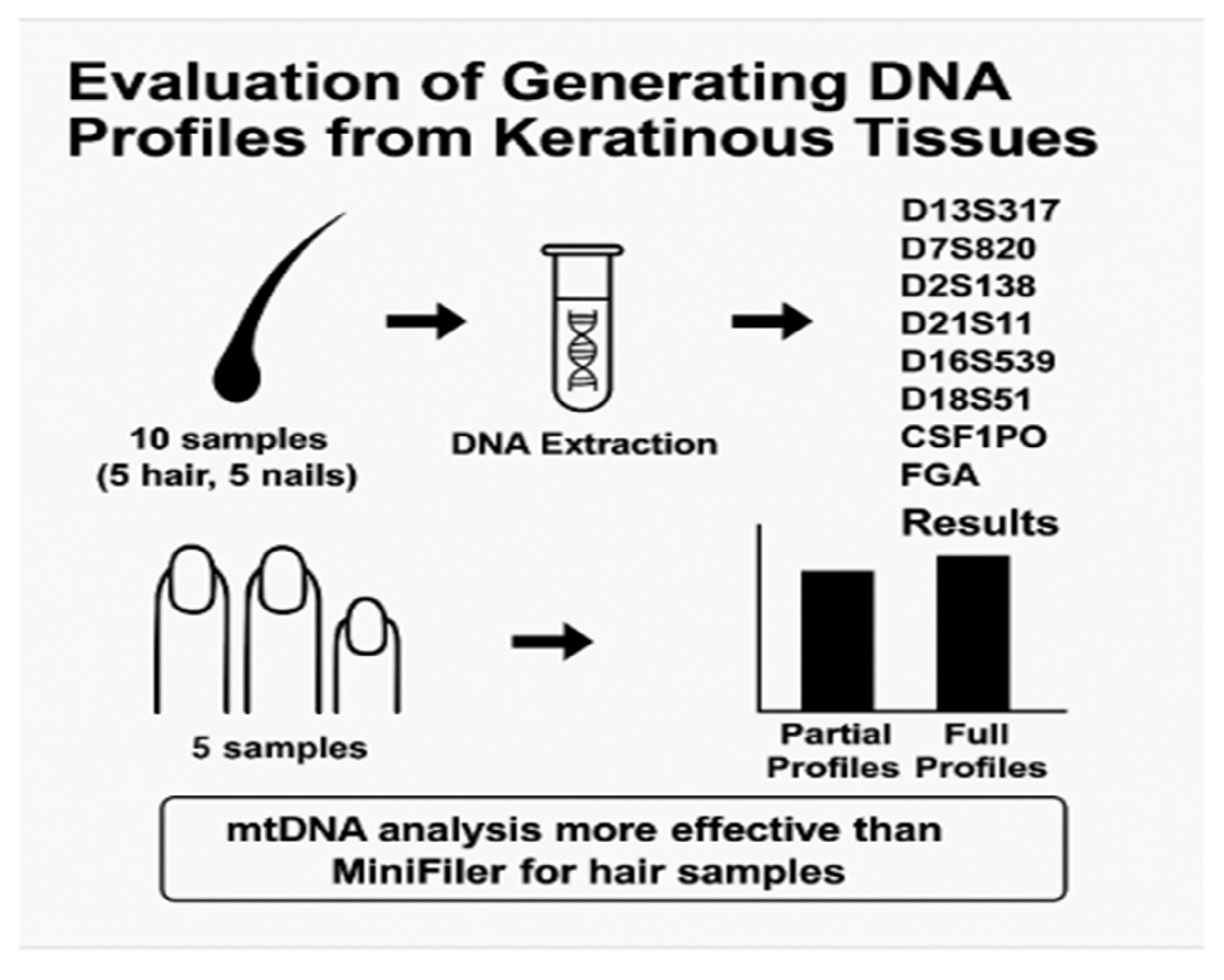
Fragmented DNA samples became serious issue in crime scene and all most result in incomplete DNA profile. Keratinous tissues such as hair and nails contain highly fragmented DNA and could be seen as biological evidence at crime scene. This study aimed to evaluation of generating DNA profile from keratinous tissues. Ten samples (five from hair and five from nails) collected from volunteers. Extraction of DNA was carried out by using PrepFilerTM forensic DNA extraction kit. The quantities of DNA were measured using real-time PCR, while the amplification of eight loci (D13S31, D7S820, D2S1338, D21S11, D16S539, D18S51, CSF1PO, FGA) and amelogenin was performed using the AmpFLSTR™ MiniFiler™ PCR Amplification Kit. The genetic Analyzer 3130 XL system and GeneMapper ID software v.3.2 were used to perform capillary electrophoresis and data analysis. The results indicated that the mean quantities of DNA isolated from hair (3.34 ± 1.7) and the DNA isolated from nails (4.36 ± 3.02). Analysis of MiniFiler results revealed that most of hair samples generated partial DNA profile while all samples of nail produced full profile and the percentage of allele’s appearance for hair samples range between (30%-90%). Whereas, nail samples alleles appearance was 100%. Conclusion, although both nail and hair tissues are subject to DNA fragmentation due to their keratinized structure and cellular composition, nail samples produces more consistent and complete DNA profiles compared to hair samples when analyzed using MiniFiler kit. This is likely attributed to the relatively lower degradation and greater stability of DNA in nails. In contrast, hair samples especially those lacking follicles exhibited a high degree of allele drop-out, particularly in loci with large amplicon sizes.
References
[1] Nwawuba, S. U.; Mohammed, Khadija, A.; Adams, Tajudeen, B.; Omusi, Precious. I.; Ayevbuomwan, Davidson. E.; “forensic DNA profiling: autosomal short tandem repeat as a prominent marker in crime investigation”. Malays J. Med. Sci. 27(4): 22–35, 2020. https://doi.org/10.21315/mjms2020.27.4.3
[2] Ambers, A.; Turnbough, M.; Benjamin,R.; King, J.; Budowle,B.; “ Assessment of the role of DNA repair in damaged forensic samples”. Int. J. Legal Med. 128: 913–921, 2014.
[3] Kantidze, O. I.; Velichko, A. K.; Luzhin, A. V.; Razin, S. V.; “Heat stress-induced DNA damage”. Acta Natural 8(2): 75–78, 2016.
[4] Bendall, K. E.; Sykes, B. C.; “Length heteroplasmy in the first hypervariable segment of the human mtDNA control region”. J. Hum. Genet, 57, 248–256, 1995.
[5] Alaeddini, R.; Walsh, S.J.; Abbas, A.; “Forensic implications of genetic analyses from degraded DNA—A review”. Forensic Sci. Int.: Genet. 4(3): 148-157. 2010. https://doi.org/10.1016/j.fsigen.2009.09.007 .
[6] Shehab, M. J. “Short Tandem Repeat Typing Using Endogenous DNA Isolated from Human Fingernail”. Al-Nahrain J. Sci. 21 (1): 104-110, 2018. https://doi.org/10.22401/JUNS.21.1.16
[7] Linch, C.A.; et al” Evaluation of the human hair root for DNA typing subsequent to microscopic comparison”. J. Forensic Sci, 43: 305–14, 1998.
[8] Tanigawara, Y.; Kita, T.; Hirono, M.; Sakaeda, T.; Komada, F.; Okumura, K.; "Identification of N-acetyltransferase 2 and CYP2C19 genotypes for hair, buccal cell swabs, or fingernails compared with blood". Ther Drug Monit, 23(4): 341-346, 2001.
[9] Bengtsson, C.F.; Olsen, M.E.; Brandt, L.O.; Bertelsen, M.F.; Willerslev, E.; Tobin, D.J.; “DNA from keratinous tissue. Part I: hair and nail”. Ann. Anat. 194(1): 17–25, 2012.
[10] Hogervorst, J.G.; Godschalk, R.W.; Van Den-Brandt. P. A.; Weijenberg, M. P.; Verhage, B. A.; Jonkers, L.; Goessens J.; Simons, C.C.; Vermeesch, J. R.; Schooten, F. J.; Schouten, L. J. ;" DNA from Nails for Genetic Analyses in Large-Scale Epidemiologic Studies” AACR, 23(12): 2703–12, 2014.
[11] Wickham, C. L.; Boyce,M.; Joyner M. V.; “Amplification of PCR products in excess of 600 base pairs using DNA extracted from decalcified, paraffin wax embedded bone marrow trephine biopsies”. J. Mol. Pathol. 53(1): 19 –23, 2000.
[12] Hadi, S., Mohammad Al-Enizi; Jianye, Ge.; Samer, Ismael; “Genetic diversity and forensic parameters of 15 STR loci in the Kuwaiti population”. J. Forensic Legal Med. 47: 41-45, 2017.
[13] Jeffreys, A. J.; Wilson, V.; Thein, S. L.; "Hypervariable ‘minisatellite’regions in human DNA". Nature, 314(6006): 67-73, 1985.
[14] Bengtsson, C.F.; Olsen, M. E.; Brandt, L. Ø.; Bertelsen, M. F.; Willerslev, E.; Tobin, D. J.; Wilson, A. S.; Gilbert, M. T.; “DNA from keratinous tissue. Part I: hair and nail. Annals of Anatomy”. 194(1): 17-25, 2011. https://doi.org/10.1016/j.aanat.2011.03.013.
[15] Kloosterman, A.D.; Kersbergen, P. A.; “Summary of the parameters affecting the variation in DNA extracted from human hair”. Forensic Sci. Int. 31(78): 9-17, 1996. https://doi.org/10.1016/0379-0738(95)01804-4.
[16] Grootveld, M.; Atherton, M. D.; Sheerin, A.N.; Hawkes, J.; Blake, D. R.; Riches, P.G.; “The characterization of DNA extracted from human nail”. Int. J. Legal Med. 107(5): 239-44, 1995. https://doi.org/10.1007/BF01225338.PMID:7585315.
[17] Wiegand, P.; Kleiber, M.; “DNA extraction from keratin: comparison of manual and automated methods”. Int. J. Legal Med., 115(4): 235-8, 2001. https://doi.org/10.1007/s004140100238.PMID:11508794.
[18] Coble, M.D.; Butler, J. M.; “Characterization of new miniSTR loci to aid analysis of degraded DNA”. J. Forensic Sci. 50(1): 43–53, 2005.
[19] Foran, D. R.; Graffy, E. A.; “A Simplified Method for Mitochondrial DNA Extraction from Head Hair Shafts”. J. Forensic Sci. 5(50): 1119-1122, 2005.
[20] Takayanagi, K.; Asamura, H.; Tsukada, K.; Ota, M.; Saito, S.; Fukushima, H.; “Investigation of DNA Extraction from Hair Shafts. International Congress Series”. 1239: 759-764, 2003
[21] Andrade, L. C.; Bento, A. M.; Serra, Antonio.; Carvalho, M.; “AmpFlSTR® MiniFiler™ PCR amplification kit: The new miniSTR multiplex kit”. Forensic Sci. Int.: Genet. Suppl. Ser. (1):89-91, 2008.
[22] Bengtsson, C. F.; Olsen, M. E.; Brandt, L. O.; Bertelsen, M. F.; Willerslev, E.; Tobin, D. J.; “DNA from keratinous tissue. Part I: hair and nail”. Ann. Anat. 19(4): 17–25, 2012.
[23] Khandagale, P.; Shinde, R.; “Use of Nails as a Source of DNA for Forensic Investigations”. J. Forensic Dent. Sci., 6(1): 58-70, 2014.
[24] Hanson, E. K.; Ballantyne, J.; “Whole nail DNA typing: a forensic investigation”. Forensic Sci. Int. Genet. 11: 1-6, 2014.
[25] Shehab, M. J.; Namaa, D.H.; Al-Zubaidi, M. M.; “Assessment of Short tandem Repeat profiling that obtained from Some Biological Sources as Forensic Tool”. Int. J. Med. Toxicol. Forensic Med,. 25(3 and4): 90-96, 2022. https://doi.org/10.5958/0974-4614.2022.00057.2 .
Downloads
Published
Issue
Section
License
Copyright (c) 2026 Mohammed M Al-Zubaidi, Miriam Jasim Shehab, Thoalnoon Younis Salih, Rasha Sadeq Ameen

This work is licensed under a Creative Commons Attribution 4.0 International License.

.jpg)